Thursday, April 20, 2023

Railstream Webcam Highlights, Part 4


My highlight-reel images from late-February to mid-March, 2023 showing Railstream webcam images from Geddes Street level crossing over CN's Kingston Subdivision in Belleville, ON. (All images courtesy Railstream, LLC). It's not as if I observed every train, maybe only 2% of each day's trains. More oddities plus exceptional locomotives and cars that led me to saving and sharing them in this post. Previous months' highlights can be enjoyed in these previous posts:
  • Part 1 - end of October to November 2022
  • Part 2 - December 2022
  • Part 3 - January to early-February 2023
Blue BCOL 4645 DPU on CN No 372 - Feb. 19

CNA 404835 skolrwai graffiti on CN No 368 - Feb. 20

SOXX 526658 526657 fifteen new gondolas on CN No 368 - Feb. 20

GTW 384662 westbound - Feb. 22

CN air cars 0065 and 0093 on wesbound intermodal - Feb. 25

ONT 6000 6001 6003: 3 of 4 new grain covered hoppers on CN No 372 - Feb. 25

'Breeding pair' of ex-Citirail 2772-2793 on CN No 149 - Feb. 26

Cat excavator on HTTX flat car on CN No 372 - Feb. 27

Grove crane on HTTX 93300 also on CN No 372 - Feb. 27

LB45 on HTTX flatcar on CN No 305 - Mar. 2

Rare National Steel Car logo NSCX 54158 on westbound - Mar. 2

VIA 8509 trailing VIA No 42 - Mar. 2

Heritage-not-Heritage IPO25 CN 8898 westbound - Mar. 6

New car from Kingston Invista TILX 526030 westbound - Mar. 8

Westbound VIA Siemens test run No 627 - Mar. 9

Looks like a buffer loco! VIA 910  trailing No 42 - Mar. 9

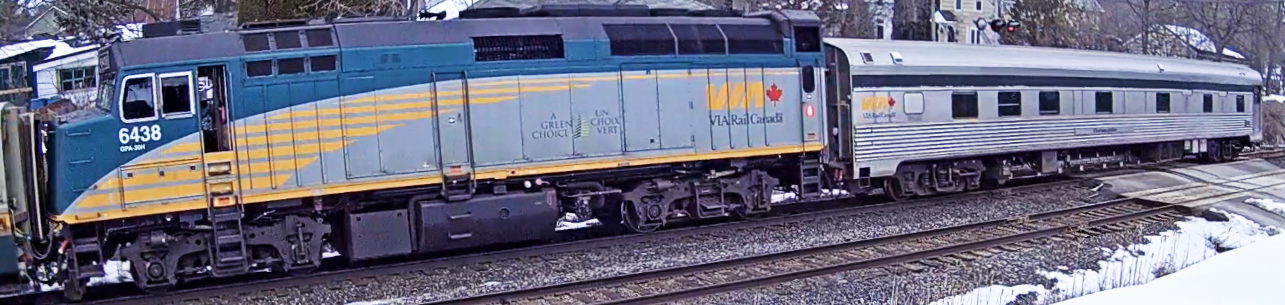
'Open-door' VIA 6438 and Chateau Jolliet to go on No 1,  trailing VIA No 67 - Mar. 12

Rarely-seen baggage car. VIA 8621 trailing No 42 - Mar. 16

Running extra...

And the latest event to crash the internet is the CP-KCS merger. One day in and over-reacting rail enthusiasts are bemoaning the loss of everything CP, already calling it a fallen flag. It was impressive that CPKC (as it is now called in a 1970's recall reference to the inimitable disco group KC and the Sunshine Band) contracted with sign contractors to change CP yard signs all over the network to CPKC on the same day. So many sign photos! Get [That Old Sign] Down Tonight! Please Don't Go [CP Sign]! Or perhaps a Wild Cherry reference: Change That Funky Sign Right Now, Boy! Or Quebec disco chanteuse Patsy Gallant: [No Longer Just] Mon Pays or perhaps Back Back to the [Kansas] City!

An interesting data sheet on Trailer-Train TTUX Uni-Level Railcars. To show operator egress after loading a vehicle, a burly trucker is thoughtfully included in the photo!

97 Hours on the Canadian for $11,257. Wot, no spa on the Canadian? No, not in the "state of On - tarr -io", chum. This couple looks pretentious even just looking out the window, never mind the spa product ad snuck in to the video. Every move they make is cinematically filmed in slow motion, even imbibing a Diet Coke! Dude, you're in Prestige. Time to drink booze from breakfast to bedtime! At least this video shows the 'extra course' served to Prestige Class passengers which until now has remained top secret! Sure, the two front seats in the Park car dome are reserved for the only two (!) bougies on the train, but the window is snow-encrusted. West of Jasper, the Park car lounge is much more crowded, and some Prestige Class passengers adopt a rather strange Economy-class of sitting (below) I think they call that social justice. Egads - reference made to power on the Canadian as two P42DC's. How have I missed this also-secret motive power? Oh wait...

Thursday, April 13, 2023

Testing VIA's HEP Fleet - The Results Are In!

VIA Rail Canada (VIA) added buffer cars to both ends of Head-End Power (HEP) consists back in mid-October, 2022. Little if any information was provided by VIA at the time on the implementation of the unoccupied buffer cars, but rail enthusiasts immediately noted their presence. This led to speculation in the rail enthusiast community and even the national media. Fare-paying VIA passengers were instantly affected as baggage car access was denied and the bullet lounge view from Park cars was obscured by a trailing sleeper, leading some passengers to jokingly rename them 'bummer cars'. Many other passengers were oblivious to this implementation, ostensibly made to enhance their safety while riding the decades-old stainless-steel equipment. VIA operates 203 cars in its HEP fleet, built by the Budd Company between 1947 and 1955, so the implementation affected multiple routes and raised concerns about the fleet's future and eventual replacement.

TRACKSIDE TREASURE TRACKS BUFFER CARS

Trackside Treasure has tracked (pun intended) the buffer car implementation since the additional cars were first observed. You'll find posts tracking the buffer cars over the past six months, the secretive testing performed for VIA, the initial HATCH engineering report, national media and trade press articles trying to get to the bottom of what was occurring, and my retrospective post showing daily changes to the  Corridor HEP consists. From what I've seen, Trackside Treasure has hosted the most comprehensive coverage of buffer cars.

Why? I have to ask myself why this has become such a pursuit for me, besides my obvious interest in daily VIA operations as a VIAphile. The answer is - secrecy. It's been frustrating to see interested parties try to divine 'the answers' while others fan the flames with speculation. In the course of this implementation, several 'sources familiar' and silent partners, some from within VIA itself, have shared information. Rail enthusiasts, consist-takers and videographers have posted consists, photos and observations. All the while, VIA has remained silent for all intents and purposes, or so it seems. For example, the cars for compression testing were sent to Ottawa at night, stripped and wrapped, apparently to make visual identification impossible.

After the issuance of the Transport Canada ministerial order, and the passage of the reporting dates set out by the order, it has only been through Access to Information (ATI) requests that I have been able to personally obtain definitive data from VIA. 

This is disappointing to me. I'm a taxpayer, and you are likely one, too. We're all potential VIA passengers. Many of us have VIA trains passing through our communities, sharing tracks with freight and other trains. We are owed some sort of accountability, if not transparency. Imagine the outcry if similar deficiencies were found in the national airline fleet and kept quiet by the air carriers, or detected by auto manufacturers without recall notices being issued! Fortunately, there is recourse for individuals in the face of this silence, and it's thanks to existing access-to-information legislation.

FINALLY - VIA PROVIDES INFORMATION!

In response to the aforementioned ATI requests, VIA fulfilled its responsibilities under its own Governance & Ethics policies. I have found their responses professional and responsive. No restrictions were placed on sharing this information by VIA.

I'm a railfan, not a professional engineer, or even a locomotive engineer! I'm interested in car names and numbers, the future of VIA's fleet that I can observe and photograph, and more generally, safe and reliable rail transportation within Canada. The reports provided to me are engineering reports, and more complex than I'm used to dealing with. So I'm not able to divine details from graphs nor parrot a lot of engineering terminology that I'll either have to define, or that you need to Google! Elements from the reports are contained in the following sections. Let's get to the results!

REQUIREMENTS UNDER THE MINISTERIAL ORDER

Based on the six paragraphs of the order, these were the requirements for mitigation, testing and reports submitted to the Senior Manager of Engineering at VIA, and the effective dates of each:
  • 1 - Implement buffer cars (October 19, 2022)
  • 2 - Engineering simulation of predicted HEP car collision performance (October 31, 2022)
  • 3 - Tear-down inspection of four HEP cars with structural defects (January 31, 2023)
  • 4 - Static structural test of two unrepaired HEP cars (January 31, 2023)
  • 5 - Final report incorporating 2, 3, 4 (March 31, 2023)
  • 6 - Static structural test of one repaired HEP car (December 31, 2023)

MITIGATION PLAN BUFFER CAR ONE-DIMENSIONAL CRASH ANALYSIS (PARA 2)
To assess the effectiveness of buffer cars, an engineering analysis was conducted to simulate various train-to-train collision scenarios. The purpose of the analysis is to confirm that the unoccupied buffer cars reduce the consequences of a collision event in the adjacent occupied cars. The engineering analysis includes one-dimensional train-to-train crash scenarios with a standard FRA reference train of one locomotive and five coaches. The subject train of the analysis was VIA’s revenue-service HEP fleet trainset with different consist sizes to simulate different services, such as the Corridor (one 900-series locomotive and five coaches), Skeena (one 6400-series locomotive and three coaches), and Canadian (two 6400-series locomotives and 21 coaches).

The analysis was intended to demonstrate how collision energy was dissipated along various train configurations with buffer cars. The analysis would not predict the actual outcome or all possible behaviours of the train in a collision event. The simulation was consistent with industry practice for demonstrating low and medium speed collisions with limited crush. 

VIA's HEP fleet of Budd-built cars are constructed of a stainless-steel body, frame, center sill, side sills and cross bearer beam, in combination with carbon steel draft sills and body bolsters using rivets or plug welding to connect the sections of dissimilar materials.

Engineering analysis found that a Lead Coach Vehicle Body Front End Crush impact (the crush zone of the first coach behind a locomotive) could extend up to 100 inches, the limit for the fidelity of a coach's end crush zone. This was of course estimated, prior to the actual compression testing of an unrepaired HEP car, completed soon after by the National Research Council in Ottawa.

Based on the Transportation Safety Board Rail Occurrence Database System (RODS) information on a sample of Head-on/Rear-end collisions, 50 out of 68 collisions with speed more than 15 mph resulted in derailment (74%) and 15 of the 18 non-derailed trains had fewer than 20 cars. In collisions with speed more than 20 mph, 29 out of 36 collisions  resulted in derailment (81%) with 6 out of the 7 non-derailed trains having fewer than 3 cars.

Most rail enthusiasts decried buffer cars as not effective in stopping a 15,000-ton potash train going 50 miles per hour, or some other fairly wild estimate of the David-and-Goliath crash scenario of a CN versus VIA train. The above criteria detail makes it clear that such an extreme collision was never the scenario envisioned prior to the analysis, and was also not envisioned for the protective value of buffer car implementation. VIA informed Hatch verbally that in the last 30+ years there had been no accidents that resulted in actual carbody longitudinal deformation. Many buffer-car doubters pointed to the August 17, 1959 Gull Lake, SK collision between a CP train Nos 8 and 6, and the 69 resulting injuries as the most recent such scenario example of a serious train collision. However, the 30+ year timeline just misses the February 3, 1986 date of the catastrophic Hinton, AB collision and derailment involving CN No 413 and VIA No 4/6! Ideally, lessons learned combined with improved technology will, and have, lead to further reductions in the possibility of such collisions occurring.

As a result of the analysis, the temporary mitigation plan to use an unoccupied buffer car behind the leading locomotive and as the end coach of the consist, was supported by one-dimensional analysis results, and would reduce the consequences of a collision event.

HEP FLEET CARBODY STRUCTURAL ASSESSMENT (PARA 3&4)

TEAR-DOWN INSPECTION (PARA 3)

The required teardown inspections on four HEP cars, VIA 4006 (HEP2 Business), 8225 (HEP1 Chateau Rouville), 6208 (RDC-2), and 8402/Alexandra (Diner) were completed on January 20, 2023.  Gerry Burridge kindly shared a photo (top) of the latter two cars taken outside CAD on February 12, 2023 looking torn-down! These cars were selected as representatives of the age, the various structural configurations, and general condition of the entire HEP fleet. The tear-down inspections were planned in detail and completed in three primary phases: 
  • i) a complete strip-down of each car,
  • ii) accessing by cutting and cleaning inspection visually inaccessible areas, and
  • iii) detailed inspections.
The goal of inspection was to assess the presence of already known structural conditions using NDT (Non-Destructive Testing such as dye penetrant) or other means, and to identify additional structural conditions visible only by invasive type inspection. VIA hired Hatch to prepare the strip-down and tear-down procedures, perform the inspections including data collection, provide recommendations and prepare the reports. The inspections were conducted at the CAD Railway Industries shops in Lachine, QC, a qualified industry contractor, as supervised by VIA and Hatch staff.

The inspected cars required full interior and underframe strip-down to access structural elements and their connections. Once strip-down was completed, the cars were cleaned to remove materials obstructing inspection of the car shell such as insulation, paint, primer, shimming, adhesive residue, corrosion product, and dirt. The tear-down phase involved the cutting of certain structures.

All four cars were inspected visually (VT), as well as with a liquid penetrant crack indicator (PT) and using ultrasonic measurement (UT) to assess the thickness of parts. These methods were applied to primary structural elements and their connections, as appropriate, following the inspection procedure.

Data from the inspections was compared to the VIA’s previous STR Inspection condition data collected from other vehicles in the HEP fleet. Five of the eight known conditions were found among the inspected cars. Condition 5 and 6 (visible crack on the transition zone) was not found and Condition 7 (Dome Car cross bearer damages) is not applicable to the 4 cars inspected. 

The tear-down revealed five conditions not seen during VIA's normal visual inspections:

1. Bolster to Side Sill Connection: Plates associated with the bolster connection at the side sill exhibit substantial corrosion deterioration that can only be quantified with the removal of other structural elements. This was found on all four cars. In some cases, holes due to corrosion were found in the structure adjacent to the connection. VIA applies repairs at such locations based on presence of cracked connection plug welds. 

2. Bolster to Side Sill Top Plate Interior Connection: Partially cracked welds were identified on one car only, car RDC-2 6208, in a gusset connecting the top plate of the bolster to a post; separation or detachment were not observed. Partly corroded welds were also found on 8225, 4006 and 8402, where plate thickness loss was also observed. These defects are not visible without the removal of significant interior components. The RDC car has a different design than the other HEP cars and may need to be assessed differently.

3. Significant thickness loss was noted on tops and sides of body bolsters of car diner 8402, under the kitchen area, and 6208 and 4006 at dissimilar metal interfaces. This observation was made by the removal of floor structure and using a pattern of UT measurements. Some UT measurements are currently made during VIA’s routine inspections from the underside on exposed areas, but not to the same extent performed during the tear-down inspections, due to access constraints. 

4. Center Sill Transition Zone Plug Welds (where present): On two cars out of the four inspected (8205 [sic] and 8402 - the two other cars have different connections), partial cracking around the circumference of the plug welds was observed on the inside surfaces, seen when floor pans are removed, but same was not visible on exterior side. Complete separation of the connections was not observed. VIA’s standard repairs would address this condition.

5. Areas of the carbon steel structure fully exposed to the environment exhibited very low corrosion loss. Stainless steel members did not show signs of thickness loss or degradation. This suggests that inspection efforts can be focused on crevices, overlapping parts and dissimilar metal areas.

6. Collision posts: The carbon steel internal members of the collision posts were accessed for inspection as part of the tear-down procedures. Non-significant deterioration was observed on any [sic] of the posts. Stainless steel portions of the post did not show any deterioration. 

The tear-down inspections conducted on the four cars suggest that VIA’s inspections can capture all the visual defects conditions. However, such inspections are not providing the data needed to evaluate the non-visible conditions of the cars, notably at dissimilar metal interfaces that trap corrosion accelerators. Therefore, the tear-down inspection of additional cars, to be completed by March, may help to extrapolate these conditions on all cars. 

In addition, the tear-down inspections may demonstrate the need for different inspection procedures and any repairs required at the bolster and its connections, if this is deemed a critical structural integrity concern. VIA’s HEP fleet is comprised of multiple car configurations, and different design vintages within a given car type, hence the approach must consider these variants. The implications of this finding on VIA's HEP fleet are manifold, and not all configuration variations have been examined yet. Therefore, it is prudent to continue with the planned tear-down inspections.

Notably, although four torn-down cars were photographed outside CAD on February 12 (RDC, diner, Chateau, Business Class), three more cars (Manor, Skyline, baggage) representing additional car types were photographed on March 25. These likely represent the continuation of the wider VIA fleet tear-down inspections as referred to above.

COMPRESSION TESTS (PARA 4)

A static structural test on certain unrepaired HEP cars to validate the structural capacity of the cars to the requirements of the Association of American Railroads Standard S034. The compression test load to 800 kips on the line-of-draft in accordance with OEM (Original Equipment Manufacturer) Standard AAR (Association of American Railroads) S-034:1945, was performed on two HEP cars: 8222 (Chateau Richelieu) and 8138 (Coach 'SEPTA') on December 15, 2022, and January 19, 2023 respectively. 

Pre-test inspections were carried out on both cars showing that they are representative of general degradation in the fleet. Chateau Richelieu/8222  had general corrosion and material loss mainly on carbon steel surfaces at Draft-Sill top surface and cracks and defects on Side-Sills. Coach 8138 had general degradation and corrosion at Draft-Sill and Center-Sill/Draft-Sill A-End Transition Zone, as well an unrepaired Condition #5 defect on A-End LHS.

The test cars were fitted with strain gauges in five cross-sections: three mid-sections at the stainless-steel portion and two end-sections at the end-underframe assemblies with carbon steel construction. The strain gauges were attached to the structural members on the longitudinal load path to evaluate the criteria of the AAR standard of 800 kips - kips are customary US measuring units of force where one kip equals 1000 pounds-force - compression on the line-of-draft load case for (a) maximum allowable strain at maximum load application, and (b) residual strain and permanent deformation after load removal. 

Both cars successfully passed the structural criteria of the tests, based on three pass/fail criteria:
  • There were no visible cracks, fractures, separations or permanent deformation within the vehicle structure.
  • Strain gauge readings showed no stress values exceeding allowable yield strength of structural members.
  • Residual strain readings are below defined criteria after removal of maximum load, confirming no permanent deformation.
The compression test was continued to the ultimate load capacity of Chateau Richelieu above the required 800 kips load. Coach 8138 was tested to 800 kips to this date, as it was decided to postpone the ultimate test for other interim testing. After performing the envisioned internal tests, 8138 will be tested to ultimate sometime in February 2023.

The testing on Chateau Richelieu carbody showed fully elastic behaviour to ~885 kips of applied load, which gives approximately 10% safety margin against the required 800 kips compression on the line-of-draft load case. The global buckling of the carbody shell occurred at 1,045 kips of applied load. This load is identified as the ultimate load capacity of the car.

Further details of the analysis of test outcomes, including further testing of 8138 and compression testing of a Park car, will be reported at a later stage on or about March 31, 2023.

PENDING RESULTS

Conclusions released increase the extent and locations checked by UT measurements on focus areas such as crevices, overlapping parts and dissimilar metal areas when performing a repair and on scheduled car inspections. The car preparation process should be modified to include abrasive cleaning of areas that facilitates UT measurements. The impact of degraded Bolster to Side Sill Connections on the integrity of the car should be investigated and the current repair should be revisited, as necessary.

Assumptions used in the Crash Analysis (Simulation) of the Buffer Car Operation were valid and conservative. The investigation and analysis to evaluate the necessity of operational mitigation with buffer cars is in progress using the current test results. The temporary mitigation plan using buffer car continues and will be re-evaluated once the testing program is completed.

EPILOGUE

The cost, not just the financial cost, of this testing was the reduction of VIA's HEP fleet by at least 11 cars: one-sixth of its remaining RDC fleet, one-twelfth of its diners, one-ninth of its Business Class cars, an overall five per cent of the total HEP fleet. No fewer than three of the cars sacrificed were unlikely to see service again, however, so perhaps their loss is not as dramatic as it might at first seem.

VIA, in its 2023 First Quarter Report risk analysis released in May, said, "The ... HEP rolling stock equipment has essentially reached the end of its operating life. Its reliability has deteriorated in the past few years, resulting in delays and additional operating costs to maintain a state of good repair."  Then, giving as much information on the testing as it ever has publicly, continued, "...an aging fleet requiring more inspections and repairs, as a result of which service revenues and costs as well as equipment availability will benegatively impacted in the future.

Following the discovery of new structural conditions with the HEP equipment, and the filing of a thorough engineering assessment by a competent third-party, the Corporation had to put in place additional safety measures to mitigate the safety concern until a structural reinforcement and repair program of the entire HEP fleet has been undertaken. These measures included the use of buffer cars, tear-downs of cars with structural defects to identify potential additional structural conditions as well as structural compression tests to validate the structural capacity of the HEP cars.

The results of these measures showed that the structure of the equipment is adequate and the structural
reinforcement and repair program will not be as substantive as initially projected. In addition, the ministerial order issued by Transport Canada in October 2022 requesting that the Corporation add buffer cars in its trains was lifted on May 18, 2023."

Once the final March 31, 2023 report provided to Transport Canada is released, I'll be publishing additional information, more testing results, conclusions and recommendations. After six months, it is good to have solid data that can be made available, albeit through an ATI request to VIA. 

Never in Trackside Treasure's nearly 15-year history has a series of posts been constantly updated over such a period of several months.

Published June, 2023 this post profiles the final report provided by Hatch Engineering to VIA thence Transport Canada.

Running extra...

Spring has sprung, the grass has riz. I wonder where the flowers iz? 
(Only in Kingston can we grow limestone-coloured grey tulips!)
It's been a long winter of wondering. Wondering when this particular VIA mystery would ever clearly revealed by our national rail passenger carrier. Wondering if Access to Information requests were ever going to be responded to. Wondering, along with many others, if the former CPR Canadian fleet's time had finally run out. 

But, patience! Like a garden bed full of tiny bulbs' breakout with fresh green shoots through the autumn's leaves, maybe if we wait just a little longer, if we let the glaring light of day bring forth the story, that it will blossom into a fulsome, truthful account of the events that began last October. Actually, much longer ago than that, because who knows when the various structural elements of these cars started showing their age!

Friday, April 7, 2023

VIA's Diners - Refurbished!

As part of VIA's ongoing refurbishing of its ex-CP HEP1 equipment, a $16.4 million contract for work on its remaining diners was let to Rail GD of New Richmond, QC in October, 2018. The work was to be completed in the second quarter of 2020 and was to include installing a new kitchen and devices to make the cars Wi-Fi ready for future deployment, carrying out a mechanical upgrading and replacing various electronic and electrical components. Rail GD features the diner project on their website. As with most contracts these days, there were delays and cost over-runs, though ideally adding 25 years of useful life to the diners. 

Rail GD boasts a modern shop with an area of ​​2,230 square metres and three tracks each 65 metres long that can accomodate six cars. The company had also performed repairs to Manors and other VIA equipment, as well as Rocky Mountaineer. This uncredited photo posted to social media shows the Rail GD shop interior, with three diners undergoing refurbishing.
The first of the refurbished diners, Annapolis, received the teal-and-yellow window-band "D&H" scheme. The succeeding cars did not receive this scheme, and most of the refurbishing can only be seen on their interiors.  It was during the refurbishing of Annapolis in 2018 that structural integrity issues were first detected that would result in emergency inspection, some structural repair, and eventually imposition of a ministerial order and implementation of buffer cars on HEP consists in October, 2022. The repair costs due to corrosion exceeded the budgeted costs, so the contract requirements likely had to be revised for the remaining cars.

As of April, 2023 seven of the remaining 13 of CP's 18 diners have been refurbished. This post lists VIA's in-service diners as of April, 2023. I've listed them as "number/name" because although many VIAphiles refer to these cars by number, I always find referring to the Canadian equipment by name to be so much more classy! I will update this post in real-time as more cars are refurbished.

In February, 2024 during a media tour of the MMC, reporters saw a diner's kitchen and dining area that had been completely stripped on the interior (Acadian), and then the new version of the same car with a working kitchen, grey tables and chairs with a grey carpet and grey pull-down blinds (Imperial).  VIA's VP of Mechanical Services Bouchard noted, “We’ve replaced the electric and air-conditioning systems. We've also revamped the whole kitchen to make it more ergonomic for the health and safety of the chefs on board. It’s been updated to all the standards as well, but the goal is to ensure the safety of all passengers.” This gives an idea of the scope of work VIA was doing in-house 
* * *
8401/Acadian
In service. At Winnipeg for on-board staff training, will return to service for summer. Deadheaded east in April, 2023. Being refurbished as of October, 2023. This video by Rail Fans Canada shows 8401/Acadian and 8411/Imperial (below) being refurbished at the MMC during the media opportunity publicizing VIA's RFP for a new long-distance fleet in February, 2024. Acadian and Imperial:
Acadian is completely stripped in the dining area. The media tour did not go as far as the kitchen.
Acadian was still in the MMC in July, 2024. It headed west on VIA No 61 on September 6, 2024 with coach 8146, both likely on break-in runs, returning the same day eastward on VIA No 68. Acadian went west on VIA No 63 on October 9, and was on VIA No 1 deadheading from Toronto to Vancouver behind the power on October13.
* * * 
8402/Alexandra
Stripped and torn-down at CAD in Lachine, QC. Photo (above) kindly shared by Gerry Burridge, taken  February 12, 2023. Scrapped onsite.
* * *
8404/Annapolis
The first diner refurbished at Rail GD, with a new kitchen and pantry. Released April, 2021 wearing the "D&H" scheme [the only diner that has received this scheme] added to the westbound Ocean at Matapedia. CFMG403 posted this video showing the one-car movement at the 1:00 mark. I photographed it trailing VIA No 67 on July 15, 2021 (above) just west of Kingston.
In service, then returned to Rail GD and re-released in December, 2021. 
In service since. Apparently stored at Vancouver station since February, 2024 not in active service since.

According to this VIA chef, here's why: "The car is disliked by onboard staff because it has a completely different workflow than all the other Diners (imagine being a chef on the Canadian for 20 years and suddenly there’s randomly one car with an entirely different kitchen layout and different appliances) and less storage space for their various sundries. The higher-tech kitchen features are mechanically unreliable and poorly designed. Spare parts support is limited because all the other diners underwent a less extensive overhaul, making the 8404 a “unicorn” with lots of unique parts that aren’t on the other ones."

August 26, 2025 - Annapolis operated on VIA No 693 to/from Churchill as there were no operable Skylines in Winnipeg. A rare use of a diner on the Churchill train.
* * *
8407/Emerald
The only diner given a Churchill wrap. We had the pleasure of dining in Emerald out and back on our trip aboard the Canadian in June, 2019 (above, westbound at Sioux Lookout, ON).

Emerald, Empress and Frontenac headed east as VIA No 614 on May 29, 2021 and were at Rail GD in June. Two units and three diners at the 1:11 mark in this video by CFMG403 showing the movement. Refurbished and released in March, 2023 Emerald made a 'test run' on the Ocean Mar 15-18. Now wrapless, Emerald went west to Toronto on April 2's No 67, before deadheading west on No 1 departing Toronto on April 5.
In service.

Tim Hayman kindly shared this photo of the refurbished Emerald in Halifax duting its test run:

* * *
8408/Empress
Refurbished, Empress deadheaded west to Toronto on VIA No 51 on February 15, 2023. 
In service, though not in active service October, 2023-July, 2024.
Empress control panel (above), VIA nameplate and Rail GD refurbishment (below):
Empress interior (below and top photo)
Member of Parliament Diane Lebouthillier posted this photo of truckless Empress to social media during a visit by Prime Minister Justin Trudeau to Rail GD on August 18, 2022:

* * *
8409/Fairholme
In service. Deadheaded east to Toronto on VIA No 2 February 9, 2024. In Montreal March, 2024 awaiting refurbishment. Being refurbished in the MMC in July, 2024, released September, 2024. Not seen in service until May 2, 2025 on No 2.
* * *
8410/Frontenac
Refurbished (interior), released by Rail GD July, 2022. Some of the refurbishing work is also now being done in-house by VIA.  Frontenac deadheaded west with 8101 on VIA No 63 on November 17, 2022 (below - image courtesy Railstream, LLC), before trailing the tail-end buffer car on VIA No 1 on November 20. Interestingly, Frontenac rested in the West, at Vancouver from February until August, 2023 and again from October, 2023 to March, 2024!
In service.
* * *
8411/Imperial
Sent east, I photographed it looking rather empty while trailing VIA No 64 at Collins Bay, ON on March 19, 2023 (below) with a tiny accent aigu over the 'e' in Imperial!
Being refurbished as of February, 2024. Imperial will emerge with an unitalicized font nameplate.
During the VIA media opportunity in February, 2024 linked above under Acadian, these screenshots from the Rail Fans Canada Youtube video show Imperial looking complete:
Imperial has been in service since April, 2024.

* * *
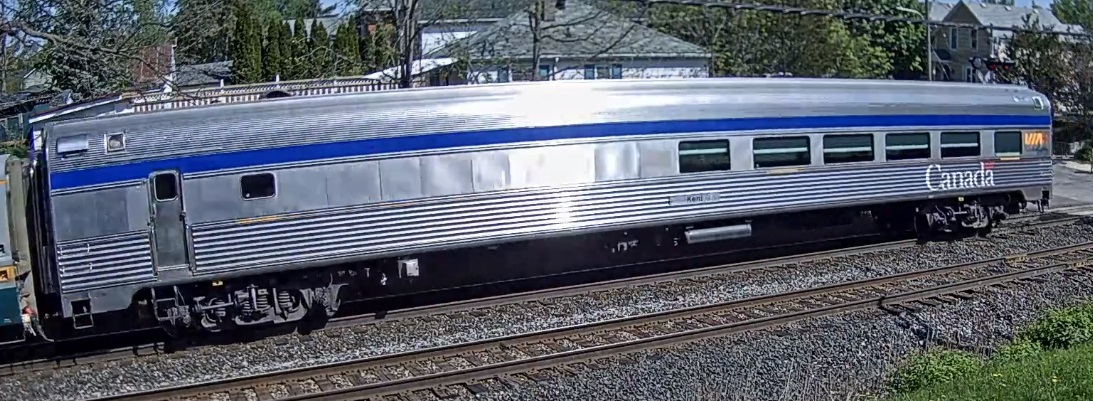
8412/Kent 
Last in service March, 2020; deadheaded to Montreal in May, 2020. Being refurbished. Refurbished and released in April, 2023 Kent made a 'test run' on the Ocean April 5-8. Kent headed west for service on the Canadian, trailing VIA No 61 on May 13.
Lesley Bernard kindly shared interior photos of Kent during its test run. Protective coverings still adorn the tables:

An end-door view, with a cropped close-up (above) shows table coverings and temporary carpet runner to keep everything nice and clean. A crew member mentioned that 'measuring equipment' was in the car therefore there could be no passenger access! Lesley notes that the steward's station is still in place, though photos on the Rail GD website (likely of Annapolis) show it has been removed.
The refurbished Kent heads west here on May 13 on the tail-end of VIA No 61 (image courtesy of Railstream, LLC). Kent departed Toronto on VIA No 1 Sun., May 21.
In service May-November, 2023, though not from December, 2023 to June, 2024. In service June, 2024 to March, 2025. Deadheaded east on No 2 May 16 to MMC, deadheaded west to Toronto on No 47 on July 6, 2025 thence deadheading No 1 on July 13.
* * *
8413/Louise
Was at CAD for work in March, 2020.
The last diner to be refurbished, in service as of October, 2024.
Deadheading east from Vancouver on VIA No 2 on December 6, 2024.
Still being worked on as of August 2, 2025 with no ETA for completion.
Deadheading west on the tail end of VIA No 61 at Belleville, February 19, 2026 (image courtesy Railstream, LLC):

* * *
8414/Palliser
In service as of late-July, 2024. Deadheaded east on No 2 September 24, 2024 (on the same train as Louise, still in service). Deadheaded east on No 68 from Toronto on September 28, at MMC being refurbished as of October 1, 2024. Palliser was planned west on No 43 on Friday, August 1, 2025 returning east with coach 8110 as break-in runs. Deadheaded west on No 1 on Sunday, December 7, 2025.
* * *
8415/Princess
In service until October, 2019. Princess deadheaded east on VIA No 66 at Collins Bay on May 25, 2020 (below) while the Canadian was not running. Many cars came east in May for shop work including diners Acadian, Empress, Emerald, Fairholme, Frontenac and Kent came east. Acadian, Alexandra and Fairholme went west in June. Emerald headed west in March, 2021. 
Princess was photographed trailing an LRC consist on December 12, 2021, likely following refurbishing.
Refurbished, in service as of December, 2021. Deadheaded east on No 2 August 16, 2024 and not in service as of late-September, 2024.
* * *
8418/York
Out of service since 2019.
Being refurbished.
Making test runs on VIA Nos 68/61 in the last week of July. Unlike Emerald and Kent that made test runs on the Ocean, the Ocean was being short-turned at that time due to washouts in Nova Scotia.
Final release was in late October, 2023 and York deadheaded west on VIA No 1 on October 29. Its name is in dark-blue, non-italic lettering. York still has not made a revenue run as of at least January 9, 2024! On the Moonlighters' Special in late-February, York went bad-order with electrical issues after a kitchen finer at Capreol, with Empress (and Brock Manor that 'wouldn't uncouple') added to No 1 at Winnipeg. Back in [somewhat] regular service as of May, 2024.
* * *

Here's an up-to-date summary of VIA's 12 extant refurbished diners listed by number/name then dates in (may be approximate) and out of refurbishment:
  • 8401/Acadian 6/23-9/24
  • 8404/Annapolis 3/20-5/21
  • 8407/Emerald 5/21-3/23
  • 8408/Empress 5/21-2/23
  • 8409/Fairholme 3/24-9/24
  • 8410/Frontenac 5/21-7/22
  • 8411/Imperial 3/23-4/24
  • 8412/Kent x/21?-4/23
  • 8413/Louise 10/24?-2/26
  • 8414/Palliser 9/24-7/25
  • 8415/Princess x/20?-12/21
  • 8418/York x/23?-7/23
Cars that were received unserviceable from CP and did not see VIA service, or were removed from the roster while in VIA service:
  • 8402/Alexandra - torn-down during HEP fleet structural integrity testing, 2023.
  • 8403/Alhambra - Received unserviceable from CP, sold for scrap 1985.
  • 8405/Cartier - Received unserviceable from CP, sold for scrap 1985.
  • 8406/Champlain - Scrapped after September 3, 1997 derailment at Biggar, SK.
  • 8416/Selkirk - Received unserviceable from CP, sold for scrap 1985.
  • 8417/Wascana Scrapped on site after April 12, 2001 derailment at Stewiacke, NS.
And since we're talking CP Budd diners, here's a list of their name origins, from a 1953 CPR memorandum: 
  • Acadian - main dining room in the Cornwallis Inn, Kentville.
  • Alexandra -  main dining room in the Royal Alexandra, Winnipeg.
  • Alhambra - main dining room at the Banff Springs Hotel, Banff.
  • Annapolis - public room in the Digby Pines, Digby.
  • Cartier -dining Room in the Chateau Frontenac, Quebec City.
  • Champlain - tea lounge in the Chateau Frontenac, Quebec City.
  • Emerald - dining room in Emerald Lake Chalet.
  • Empress - main dining room in the Empress Hotel, Victoria.
  • Fairholme - main dining room in the Banff Springs Hotel, Banff.
  • Frontenac - cocktail Lounge in the Chateau Frontenac, Quebec City.
  • Imperial - main dining room in the Royal York Hotel, Toronto.
  • Kent - private dining room in the Empress Hotel, Victoria.
  • Louise - private dining room in the Chateau Lake Louise.
  • Palliser - main dining room in the Hotel Palliser, Calgary.
  • Princess - cocktail lounge in the Royal York Hotel, Toronto.
  • Selkirk - private dining room in the Royal Alexandra, Winnipeg.
  • Wascana - main dining room of the Hotel Saskatchewan, Regina.
  • York - private dining room in the Royal York Hotel, Toronto.
This post lists all the ex-CP cars no longer in VIA service. I dined in Champlain and Frontenac on my trips West in the 1980's, as well as ex-CN diners like 1363.

(Photos in this post of the refurbished Emerald on VIA No 1 kindly shared by Andrew Stott.)

Running extra...

Fun non-fact from VIA's webpage on dining carsVIA's dining cars are named for famous luxury hotels across Canada. Like Sheraton and Hyatt? Acually, dining rooms in former CPR hotels.

I was able to watch most of the debut of TRIPPING Train 185 tonight, and will watch the rest on the ol' PV-R. Film quality and sharpness are excellent. Down-the-track, drone and historical recreation footage alternate, and there is even winter footage. On-screen captioning has some curious captions, at one point referring to inspection of train 'under casings' for undercarriage, and noting that a 4 km-long CP freight train can take 30 minutes to pass. I would not want to be sitting at that crossing! Local residents and fishermen are showing using the train, and there is in-cab and radio communication to eavesdrop on. Notably, the drone footage shows only a two-car train, but the long, along-river drone scenes show off the area's natural beauty very well. A very enjoyable ride!

Saturday, April 1, 2023

Sudbury-White River Dayliner Documentary

Last year, a strange object appeared on a VIA RDC at Sudbury. Someone was taking pictures of something, and people were TRIPPING about what it could be. Now we know it was TRIPPING Train 185, an original TVO documentary profiling the geography, history and rails between Sudbury and White River. Produced by goodearth productions, the documentary has an excellent website that I highly recommend previewing. There's lots of material there, including videos, that will get you all ready for the premiere. Friday, April 7 at 7 PM ET, pop some popcorn and pour a potent potable for the three-hour run. Now posted to Youtube!
Brian Martyniuk of Thunder Bay recently emailed me with his account and photos of a chance encounter with the film train VIA 6217-6219-6250 in July, 2022. His account and photos will definitely get you ready for the TRIPPING.  Brian takes over...

"Here's my chance encounter with the filming crew and train:

Some background: During the summer months I travel from Thunder Bay to Wawa [and return] along the Hwy 17 corridor. I always plan my trip[s] so that I can be at White River prior the arrival of VIA No 185, before continuing  on to Wawa. On that particular afternoon I arrived at White River about 1630 and hung around the CP tracks waiting for the arrival of the Budd cars. 

One hour went by, and then two, and after three hours and no trains, I packed up and continued east to my overnight accommodation in Wawa.  It is an hour's drive from White River to Wawa. So that meant getting up at 0500 the next morning if I wanted to be back at White River for the entraining of any passengers and the on-time departure of the Budd cars.
Arriving trackside at White River the next morning about 0630, the three-car VIA train No 186 was already idling away at the former CP station (above and top photo). I parked my vehicle at the west end of the station to the rear of the Budd cars. 
The first thing I noticed was this huge, black object fastened to the door of the car. Some individuals were walking about beside the train and one man in a pink shirt had a joystick in hand and was watching the screen on his handheld. 
In conversation he told me that he was operating a drone and taking footage of the train yard and the town of White River for an up-and-coming documentary. He explained that the black object was a forward-facing camera that the crew had used yesterday to record the rail trip from Sudbury to White River. And it was now in the 'down position' for the return trip. When I remarked that I had waited several hours for the train yesterday, he apologized and explained that, because of all the numerous stops along the way, they were probably about four to five hours late arriving. 
Before I could ask him any more questions he excused himself as the time for departure was getting near and he had to retrieve the drone. We parted ways and I hung around to get more pictures. 
VIA No 186 departed on time at 0700. 
The one and only location for a picture east of White River is the Highway 17 overpass about 12 miles east of the town. There is a bush road just a little further into the CP siding called O'Brien but the best vantage point is from the highway bridge.
I took a picture from the highway structure of the RDC's approaching (above), receding (below) and then they were gone."

Many thanks to Brian for getting in touch, and for kindly sharing his story and his photos! Bryan is a long-time Lakehead resident, railfan and photographer  Bryan previously shared his early-era VIA in Thunder Bay photos and contributed to posts on the Diefenbaker funeral train and CPR 5468's journey west.

Ex-CN RDC's were just so mundane in my early railfanning years that I rarely photographed them. I did, however, note lots of consists. And if I photographed them, they're most likely here in this post.

APRIL 7 UPDATE: I was able to watch most of the debut of TRIPPING Train 185 tonight, and will watch the rest on the ol' PV-R. Film quality and sharpness are excellent. Down-the-track, drone and historical recreation footage alternate, and there is even winter footage. On-screen captioning has some curious captions, at one point referring to inspection of train 'under casings' for undercarriage, and noting that a 4 km-long CP freight train can take 30 minutes to pass. I would not want to be sitting at that crossing! Local residents and fishermen are showing using the train, and there is in-cab and radio communication to eavesdrop on. Notably, the drone footage shows only a two-car train, but the long, along-river drone scenes show off the area's natural beauty very well. A very enjoyable ride!

Running extra...

I like to promote the preservation-by-photography of the mundane. Bernd and Hilla Becher have taken it to new heights.Watertowers, mills and even grain elevators have been preserved in a photographic exhibit of the German couple's work at the San Francisco Museum of Modern Art. The images are stunning in their simplicity:


A University of Waterloo professor has gamed out the Tim Hortons Roll up the Rim contest and is now winning 80% of the time. The abstract? Go to Tims at 3:16 and you'll win - it's the most optimal time, according to the professor. Forget going to Tims, that's probably the time of night most folks wake up to go to the john: 3:16.