Showing posts with label Ontario. Show all posts

Thursday, September 28, 2023

Cataraqui Spur Update

Living a mile away from CN's Cataraqui Spur, with its dubious record of recent derailments, it was not a surprise when CBC's Dan Taekama recently contacted me about his report (below). Dan's report was published on September 14, in the wake of an access-to-information request by CBC that garnered 22 pages of Transport Canada inspection reports of the Cataraqui Spur. At the time of the most recent Cataraqui Spur derailment, the third in as many years, Dan had interviewed me for background information on the condition of the track. Knowing how long it takes government agencies to provide information, I'm not surprised that it's already four months later!

Back in May, I expected CN to initiate a maintenance blitz with new ballast, a major tie program and surfacing, maybe heavier rail installation, and a new trestle north of Bath Road. Only by pouring money into the infrastructure on the spur would CN stop pouring chemicals and cars heading to Invista into sensitive wetlands, and perhaps onto bystanders and vehicles waiting at level crossings.
The spur runs between the CN Kingston Subdivision mainline and the Invista nylon plant on Lake Ontario, crossing the Little Cataraqui Creek and wetlands by at least four trestle bridges. Dan's reporting shows that CN knowingly ignored deteriorating conditions in the structure and condition of the trestle over the Cataraqui Creek. No plan, monitoring or ongoing evaluation of its capacity and condition was in place. Transport Canada safety inspectors raised 40 points, 32 of which dealt with signals and level crossings, four with track, and four with the bridge.

And who knew the trestle involved in the most recent derailment is scheduled for repair this November...

A 2020 underwater report did not meet the standard of CN's own Bridge Safety Management Plan (BSMP), but remained without follow-up by CN. Following the derailment, another underwater inspection this year did not deal with the condition of the riverbed, nor the lack of sampling of the wooden bridge supports. However, a 2022 inspection by CN noted some bridge bents were in poor condition at that time.

A 2022 CN inspection rated some bents — the piles and base that support a bridge over water — near Bath Road as being in poor condition, according to Transport Canada. CN performed subsequent inspections in November, 2022 and March, 2023. Indeed, Transport Canada noted that CN was not following its own BSMP reporting or recordkeeping standards.

Not surprisingly, CN provided little information for media requestors, giving a boiler-plate answer about regular inspections and prompt action when issues are identified on its network. Following the derailment, CN said (and it's OK to cover both ears, and repeatedly say "la-la-la-la-la" as you read the following because that's the response that this carefully-crafted corporate clap-trap deserves) that the railway has  completed a "thorough exploration" of the track structure using its automated technology, replaced railway ties, added crushed rock to the rail bed and made other repairs.

Really? I routinely drive over the level crossings on the Cataraqui Spur and all I've seen is a single pass by a brush-cutter on both sides of the spur. Perhaps this was to satisfy Transport Canada requirements for visibility at crossings (also making it easier for the clean-up crews to reach derailment sites!)

Dan reports that four months after the derailment, "..it's still not clear whether the bridge collapse caused the cars to crash, or if it was the derailment that caused the bridge to break. Transport Canada said it has received CN's response to its inspection, including corrective actions, but those changes are considered businesses decisions, so it cannot share further information."

Business decisions? I greet that with derision. I'll be listening for the rumble of heavy equipment and the buzz of track gangs as further evidence of CN's maintenance blitz on the spur, and its bridge repairs supposedly scheduled for this fall. In the meantime, I decided to do my own, citizen's track inspection of the upper part of the Cataraqui Spur. Not wanting to have a blog post about my interaction with a CN Police constable, I limited my photographic vantage points to the four public access points/level crossings: Centennial Drive, Armstrong Road, Tanner Drive and Gardiners/Golden Mile Road.
Centennial Drive looking east toward Armstrong Road behind Frontenac Mall (above) with evidence of a rail changeout. Looking west there is evidence of tie replacement at some point....in the past. The 'new' ties only look 'new' because the old ties are so bleached, like the bones of a whale skeleton on some long-forgotten seashore.The small-size ballast looks too undistrubed for it to be recent tie replacement.
A camera zoom view looking up the grade to the mainline. There is a trestle mid-way. Look at those joints!

Armstrong Road looking west toward Centennial Drive behind the Riverstone Apartments. Miscellaneous track materials and a low joint (blue arrow - above). Looking east toward the long trestle, aka the derailment site, this Armstrong Road-Bath Road stretch has had special attention. The ballast has been groomed, but the grooming ends just before the crossing.
A camera zoom view shows a rise up to the west end of the trestle (blue arrows). 
Tanner Drive camera zoom view looking east to Centennial Drive behind Arbour Heights Long Term Care Home. A rise up to the trestle, stretch of new ties mid-way but again...those joints!

Looking just east of the Tanner Drive crossing (above) it appears the weeds are overtaking the ballast. Looking west toward Gardiners Road (below) there's that small, granular ballast again! The switch takes the spur to the right, up to the mainline connection at Mi 178.0 Kingston Sub, with the team track, runaround and CN compound to the left of the cellphone antenna tower, which is on the flight path for Kingston airport runway Two-Five.
Notice the run-off allowance and culvert at left in the camera zoom view (below) with a substantial tie pile (double-ended blue arrow at right) perhaps from the derailment clean-up in May.
The scene at the CN compound (fibre-optic installation, team tracks and runaround track) at the top of the Cataraqui Spur. This is located at the end of Golden Mile Road off Gardiners Road. Three track machines, a CN equipment mechanic and an excavator right were here for some reason. I'm guessing for the Cataraqui Spur maintenance blitz, but maybe more likely mainline maintenance!

Knox Kershaw KSF 940 ballast regulator (above) and Harsco Mark IV HD production/switch tamper (below).
CN mechanic working on what looks like a Railavator:
My citizen's track inspection report reveals little evidence of what CN claims it has done, except perhaps at the derailment site at the long trestle north of Bath Road! Although professional railroaders will say the branchline trackage is safe for the expected train speed of 5-10 mph, I would suggest that for thrice-weekly CN service to a regular shipper of chemicals, through a protected wetland, with a regrettable record of disastrous derailments, this is NOT the best CN can do and definitely does not bear out its claims of adequate, recent maintenance.

Thanks to Dan Taekama not only for the link he sent, the tenacity of his reporting, and for keeping this important story in the local news headlines!

AUGUST 2025 UPDATE: The Bath Road crossing was out of service for four days for renewal, causing massive traffic chaos on all other major arteries. The result, as posted to social media the day after:

Running extra...

While this post includes my modest efforts at documenting railway infrastrucutre, here's a nice page of vintage Portage la Prairie, MB post cards here. It's always been an important railway and grain-handling point! Closer to home, Kingston photographer Paul Wash has been very busy prolifically preserving for posterity a plethora of Kingston construction projects, including the John Counter Boulevard overpass

Paul kindly 'gifted' me with his Dad's copy of Ralph Beaumont's excellent book on the heretofore-unknown photography of Grant Heckman. I already spent one afternoon immersed in Heckman's documenting of CPR infrastructure, and I'm looking forward to many more. Thanks, Paul! (As the author recounts, the prolific photographer of long ago did NOT photograph the CPR's Kingston & Pembroke Railway!) 
The Weather Network pointed out that Toronto had received only 9 mm of the normal average 70 mm of September showers. It's so dry that cows are giving evaporated milk. It's so dry that trout have ticks. It's so dry that dogs are marking their territory with chalk lines.

Thursday, May 11, 2023

Industry Profile: Biscotasing Store

Admittedly, this is not really an on-line, railway-served industry - the usual criteria for an 'industry profile' Trackside Treasure post. But two factors have led me to research and publish this post on the long-standing store in Biscotasing, ON, located hard by the now-demolished CPR station at Mile 54.4 of the Nemegos Subdivision. 

The first factor was discussion of this photo (below) that I took of the classic scene at 'Bisco' from the front, right dome seat of Prince Albert Park on Sunday May 27, 1984. The VIA (ex-CP) station and parking lot for the station and store are visible at centre. Scheduled to arrive at 1035, our actual stop here was at 1105. (Eastbound we were scheduled in at 1950, arriving at 2057. And two years earlier, a late-running VIA No 1 got us there at 1115.) We made up time, running at 50-55 mph, arriving 11 minutes early into Chapleau. I was travelling west from Kingston to Winnipeg aboard VIA No 1, in roomette 2 of Thompson Manor, which I'd occupied since Kingston. Only two Montreal sleepers, Thompson Manor and Chateau Vercheres were on the train when I boarded, with Prince Albert Park (but no Skyline) added in Toronto. In fact, only five of the twelve cars at Kingston continued west beyond Toronto, with seven new cars added while stopped in Toronto Union! But I digress!
The second factor was interest in the Sudbury-White River route, sparked by my previous post on modelling Northern Ontario, as well as the recent TRIPPING Train 185 TVO documentary. I wanted to learn more about Biscotasing, its history and that store and station. I was fortunate to find an excellent selection of photos in the "Biscotasing, Ontario" Facebook group, albeit mostly undated and uncaptioned. All photos in this post are from this group unless otherwise noted. Individual photographers are not acknowledged because many of the photos are historic in nature, and others do not list the photographer, only the poster. (If you are the photographer of one or more of these photos, I will gladly credit you personally!) This post follows one on modelling CP in Northern Ontario.

Biscotasing is an indigenous word meaning 'a body of water with long arms'. Biscotasi Lake leads to the Spanish River, which flows all the way to Lake Huron near Webbwood, ON. Although a comprehensive history of Biscotasing is beyond the scope of this post, the settlement was established on the shores of Lake Biscotasi by the CPR as early as 1882. While 470 acres were set aside for the CPR, only 30 were cleared. Described alternatively as a construction town or a divisional point, Biscotasing was clearly a major point with a large station and freight shed, though its importance plummeted upon the establishment of Chapleau to the west as a CP yard and shops.
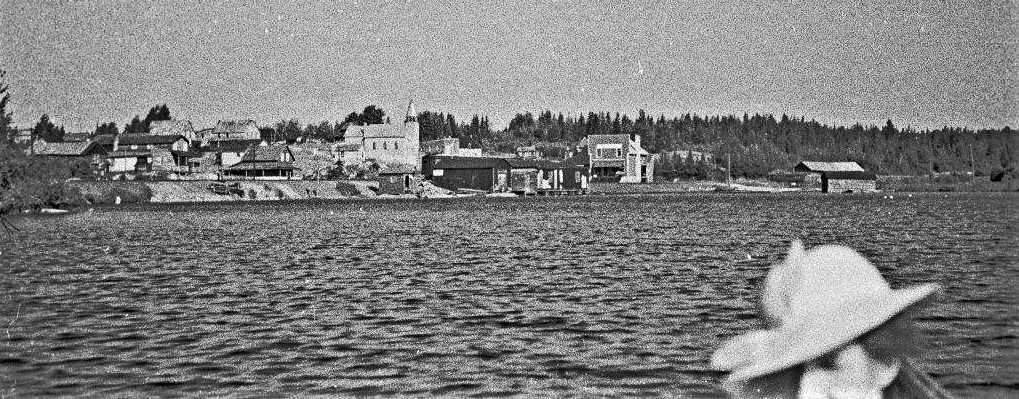
The Hudson's Bay Co. established a trading post in 1887. Sudlen & O'Neil's lumber mill operated from 1894-1898, before being purchased by Booth & Shannon. The post was destroyed by fire, as was the lumber mill in 1913. Both operations were closed down in 1927, the former experiencing another fire, the latter having been sold to lumbermen Pratt and Shanacy. Most of the area's valuable lumber had already been harvested by 1920. A between-the-wars view of the townsite from across the lake:
A store was first established here by J.A. Wright in 1885. I believe this is the current false-front store under construction:


The steps up to the front door had a retractable awning over them. Two different-sized display windows flanked the front door:
A CPR crane lifts the small logging locomotive that was used between the CPR and the mill. Taken to Algonquin Park, it still forms part of the exhibit on logging there. It was donated by David Pratt, son of the original lumberman, in 1958.
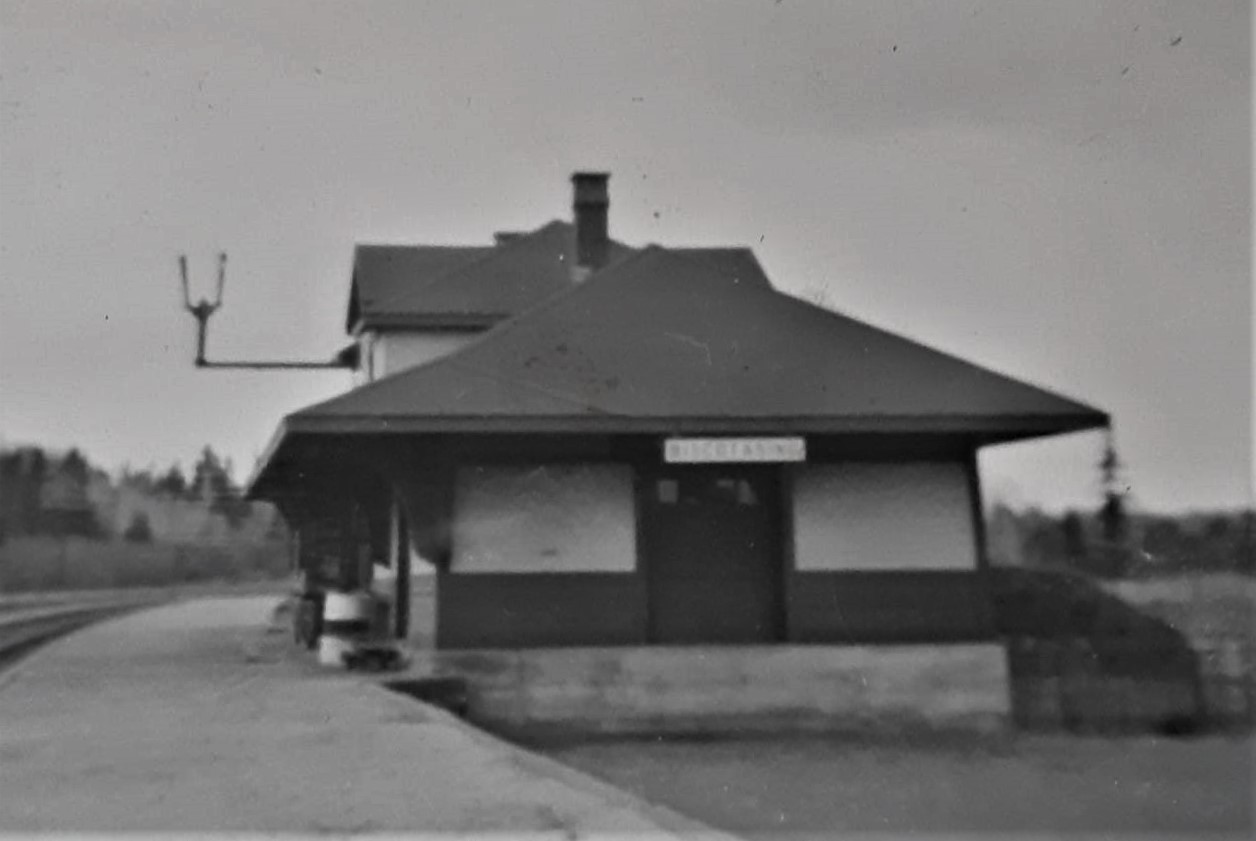
Of course, there was more to Biscotasing than the store. A small community that varied in population from hundreds in summertime to as few as 20 in the long winter months, it also featured the large CPR station, two churches and many houses. A school was opened in 1906 and an Ontario Forestry office in 1907. Old-timey photos show simply 'BISCO' painted on the first station, with passengers and bundles of trapped furs piled high on the platform. Here's the station in my 1984 photo, at this point in a two-tone paint scheme, probably grey- or tan-and boxcar red:
The arrival of the diesel era, with CP 4051 and a road repair car or idler car drawing the attention of townspeople in this undated photo:
Now we enter the colour era! The store was clad in wood siding, but later received the ubiquitous Insulbrick covering (below). Note the church at left:
More modern signage and once again, wood siding:
The store functioned as a grocery, hardware, liquor outlet and post office. 

The agent's door to the platform, with local residents of the two-legged and four-legged variety:
Dated 1969, with the station and store still Insulbricked:


A busy time in the parking lot (above). This aerial view shows the relative locations of store, CP station footprint and the R[oman] C[atholic] church:
St. Paul's Roman Catholic Church is visible in this screenshot of the TRIPPING documentary, its silver steeple poking through the trees. VIA No 185 is arriving, and this view clearly shows the juxtaposition of the CP mainline with the townsite to the south, the store to the north and beyond it, the former site of the station (below) in what has to be a unique nexus of lake, station and town anywhere in Canada. This would look great on a model railway!

Both churches in Biscotasing are located on hilly land south of the tracks. St. Paul's is now abandoned, though St John the Evangelist [Anglican] Church is still holding services. Over the years, the front stairs were removed, with access through both sides of the rear of the church.
A cold winter's day (above) and St. Paul's as it currently stands, privately-owned and decaying:
That nexus: station, store, rails and lake shown from the south side of the mainline:
The station looking worse for wear, on the day before its demolition...
...and day of...
Check out my brother's blog Rolly Martin Country for a compendium of schedules and a ton of other information on the Sudbury-White River CPR passenger services. The station closed in 1966 and town's school was closed in 1972. Some websites insist on calling it a ghost town. As to our 1984 station stop - it's hard to tell if we're actually stopped in my photo, but we were. Up until 1981, VIA system timetables show Biscotasing denoted by Reference Mark 62: "Stops to detrain revenue passengers and on advance notice stops to entrain revenue passengers.", one of ten such stops between Sudbury and Winnipeg. Most other stops were denoted by Reference Mark 9: "Stops on signal.", in other words a flag stop.

After 1981, Biscotasing became a Reference Mark 9 but was a scheduled stop for the June to September RDC runs i.e. VIA Nos 185/186. In the summer schedule, most of No 1/2's stops were transferred to 185/186, then reverting to Nos 1/2 for the fall, winter and spring. The nearest scheduled stops were Cartier and Chapleau.
Today, the store is called the Trading Post and the site gives water access to Biscotasi Lake Park, a provincial backcountry park for canoeists and campers. A popular canoe route follows part of the 338 km Spanish River from here to Agnew Lake near Espanola - 164 kilometres of paddling over six or seven days'.
A modern-day aerial view:
The false front of the store has been obscured by an architecturally glommy patio addition with awning. The transport trailer parked next door, likely for storage, does nothing to redeem its architectural value. The tiny VIA stop (white box beside tracks between store and tracks) nor the current store will warrant further photographical depiction in this post. We will instead wallow in the nostalgia of Biscotasing in its earlier glory days!

Running extra...

An 11-car VIA No 40 headed east from Toronto on May 2. Five deadhead cars trailed the usual six-car buffer car-equipped consist. Now, if only the once-a-week HEP No 45 had been two minutes later, it would have been a stainless-steel symphony or silvery sandwich! Here's the link where you can VIAcariously enjoy the video shot from the Bayridge Drive overpass. It was a no frills shoot!
I'm fortunate to be able to participate in the Railway Modellers Meet of British Columbia Virtual Prologue by ZOOM tonight, along with more than 80 other modellers. Two weeks rom now, I'll be presenting at the second session, "Blog, Paper, Scribblers!'" describing my modelling journey on the learning curve of Kingston's Hanley Spur.

Rehearsals have been going on all week in London and a former airfield. All in preparation for King Charles III's coronation procession. CBC and CNN coverage begin as early as 0400 ET Saturday morning. It should be an occasion fit fo a king! This photo at the airfield reminds me of the Waterloo movie for some reason:
Long Live the King!