Showing posts with label derailments. Show all posts

Friday, November 17, 2023

Postscript: CN Nos 318 and 45 Collide at Ernestown - December 20, 1974

In this postscript to my initial post, I'll be profiling the derailment clean-up, the state of the wrecked equipment and a brief epilogue. Having profiled the December 20, 1974 Ernestown collision between eastbound CN freight train 318 and westbound CN passenger train No 45, I received photos taken at the scene from two fellow rail enthusiasts to include in this postscript. From the investigation report I read, I have included a timeline of the clean-up plus photos taken by CN as part of documenting the railway's investigative process. I've also included contemporaneous press accounts from our local newspaper. Some details and facts have been excluded from the initial post, and they will not be included in this post either, for reasons I summarize at the end of this post.

THE DERAILMENT CLEAN-UP

Thirty-five cars of No 318's train were removed from the tail-end at 0150 December 21 westward to Belleville. The two box cars near the head-end were moved clear of the tracks by the Toronto auxiliary in the darkness. The second gondola was rerailed at 0830 and removed also by the Auxiliary. Then, econd engine 9466 was started and used to push the two gondolas west at walking speed to the business track on the south side, opposite Ernestown station. The intense search for 318's engineer continued with the mobile crane coming forward at 0945 but unable to move 9487. The Toronto auxiliary returned at 1045 on the north track. The Montreal auxiliary in the service track, and the mobile crane on the south track were able to reposition 9487, and the body was finally found at 1100, still at the controls, though the head-end trainman had jumped clear. Then, 9487 was positioned south of the south track at 1200.

The south main track was clear by 1730 on December 21 and had a slow order of 15 mph applied. The north track was clear by 1750 though non-existent for about 90 feet east of the estimated point of impact, rebuilt and returned to service by 0115 December 22. CN 6860 had been moved clear of the north track by both auxiliaries at 1710 and 6792 at 1740. Both auxiliaries cleared for the night in the service track by 2100. 

On Sunday, December 22 a work extra called at Belleville brought gondolas and flat cars east, and at 0700 on Sunday the 22nd and both auxiliaries were in service at first light to place the cleared wreckage onto these cars in the service track for removal from the site. At 1045 CN 291140 was retrucked on the north track and moved to the service track. CN 6792 was rolled onto the north track at 1700 and lifted onto flat car CN 665410 at 1810. When trains were passing, much time was spent cleaning up scrap along the right-of-way and 'trimming' (torching off debris from) the wrecked equipment enabling safe movement.

On Monday, December 23 both auxiliaries returned to the south track to lift equipment onto the service track. At 0815, 6860 was lifted from north of the north track, its 'B' end onto a temporary truck and moved to the service track at 1005. At 1150, lead unit 9487 was lifted from south of the south track and placed on flat car CN 665370.  Boxcar CN 432000 was left north of the north track, for subsequent removal. The work extra returned to Belleville at 1630. The Montreal auxiliary departed east to Montreal taking with it 6792 and 9487 on their flatcars, 9466, CN gondolas 143439 and 143194 (both with engine trucks), 143168 with scrap, CN 291140 and both CBQ gondolas from 318. The Toronto auxiliary departed westward at 1920 on the 23rd.

Both units underwent extensive further mechanical inspection at CN's Pointe St Charles shops in Montreal. This inspection would reveal evidence of heavy braking on the passenger units, though none on the freight units. Extensive investigation of the controls: throttle, braking, deadman's pedal and overspeed controls as well as miscellaneous cab contents were catalogued. Leading units of 318 and 45  had damage loss estimated at $350,000 and 250,000 respectively. Their respective trailing units were able to be towed, with damage estimated at $1,000 and 40,000. 

PHOTOS OF THE DERAILMENT CLEAN-UP

The first five following photos have been kindly shared by John Mayell. They show Montreal Auxiliary crane 50028, Toronto hi-rail mobile crane RC60471 and section crews moving both trains' locomotives on December 21, in order to quickly clear the double-track mainline for train movements. Perhaps cutting the steel of 9487's cab-side:
Notice the south-to-north signal wires down over the site, likely pulled down by 9487 rearing up at the point of collision.
No 45's baggage car is visible at right, with part of 9487's engineer's side cab being lifted clear, perhaps having been torched off to find the engineer's body:
Neither auxiliary had a CN wet-noodle logo on its flanks as applied in later years.
The next five photos, taken by the late Bob Hunter, were kindly shared by his son Paul Hunter. Paul remembers being at the site. These photos also show the line-clearing operations, and I believe are all taken from south of the mainline, from the same side and around the same time as John's. This would have been during daylight hours on December 21, marking the transition between RC60471 and the Toronto Auxiliary working the west end of the wreck. The line was clear of both trains' equipment by suppertime.
Note the three month-old unit's numberboard propped up in the snow (above)  at the fenceline, centre.  Wood blocking for cranes' outriggers is stacked ready for use.
Toronto road-rail crane RC60471 on the south track, and Montreal Auxiliary crane in the service track reposition 9487 in the search for the engineman's body.  Linemen work on restoring the signal wires that coincidentally crossed from south to north directly above the wreck. No 45's cars are visible on the north track behind it:

The Toronto auxiliary on the north track, replacing Toronto hi-rail mobile crane RC60471 for the lifting of the locomotives:
Two photos by Robbin Rekiel published in the January-February 1975 issue of the Upper Canada Railway Society Newsletter. Both photos were likely taken on December 23. With traffic cleared for the lift, Toronto auxiliary at left and Montreal Auxiliary CN 50028 at right both work to lift CN 9487 onto its flat car positioned on the service track at 1150 on Monday, December 23:
CN  6792 already on flat car CN 665410 on an unknown spur, likely the service track. This lift had been made at 1810 on December 22:
CN PHOTOS

Photos taken at CN's Pointe St Charles shops in Montreal show the extent of the damage caused by tremendous forces of physics exerted at Ernestown that night. CN 6792 and 9487 sit side-by-side on flat cars:
Side views showing the bending of the frame behind the cab of CN 9487. I've seen no photos of 9487's long hood, presuming it was removed separately in a gondola car or flat car.
 Untarped black & white views:

The relatively light damage to 318's trailing unit:
CN 6860 from both ends, its 'B' end resting on temporary auxiliary truck.  Some reports say 6860 was scrapped, but it most definitely returned to service and received VIA paint on July 8, 1980.

CN 6792, various views from both sides:


NEWSPAPER REPORTS

As a matter of public record of that time, a selection of Kingston Whig-Standard newspaper clippings are included below. These clippings cover contemporaneous reporting on the December derailment's immediate aftermath, the March 1975 inquest and subsequent crew reinstatements (as always, click the image to enlarge for reading). You'll find several factual errors in the Whig's reporting of the events surrounding the collision, and in its coverage of the four-day inquest. For some of these printed inaccuracies, the Whig-Standard subsequently published corrections. The inquest's jury's returned with 12 recommendations, some of which took years to become industry practice, while others never have. 
The inquest held in Napanee - March 11-15, 1975
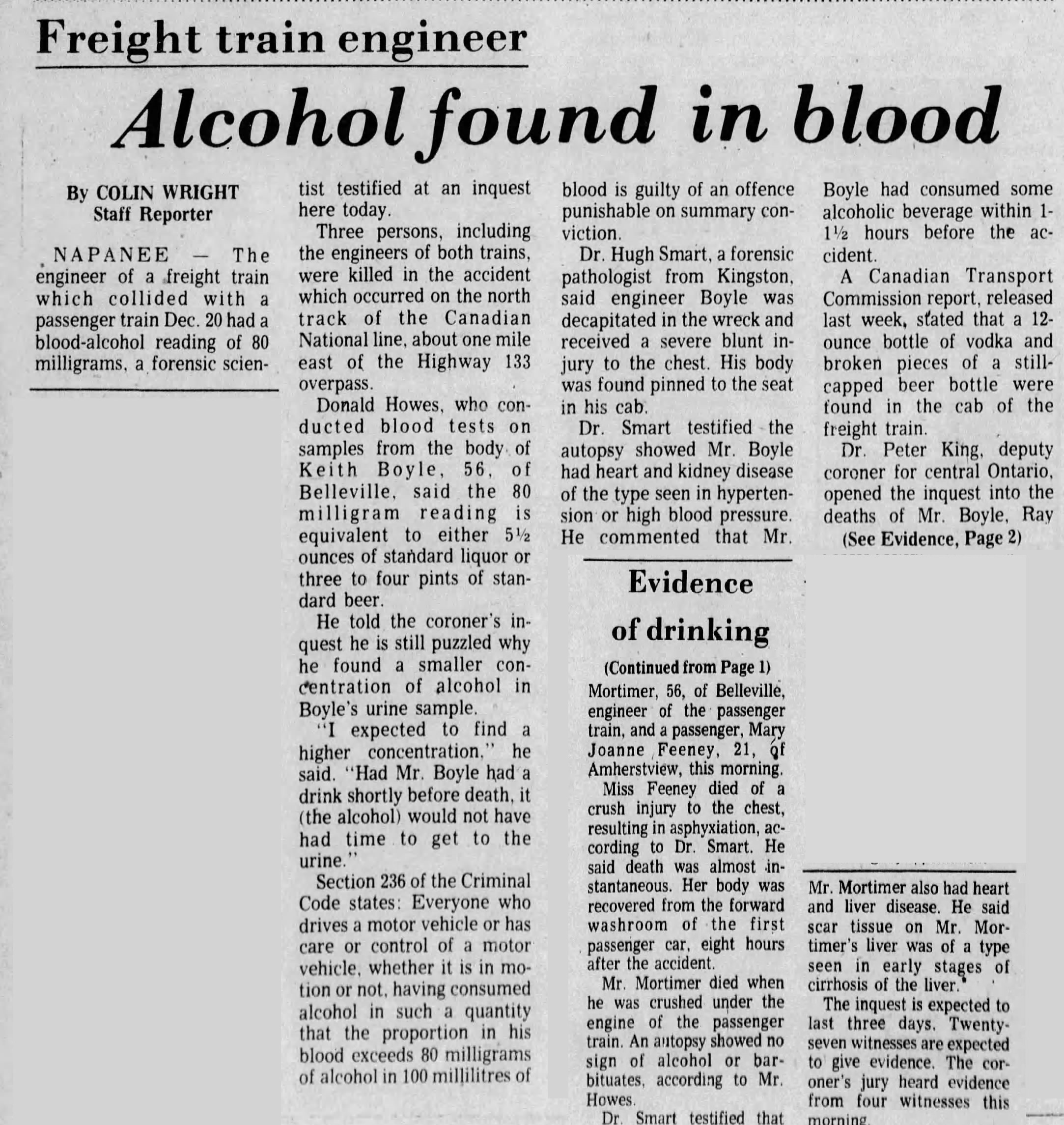
Reinstatements, March 25, 1975
EPILOGUE

With mechanical and signal causes ruled out, the tragic and controversial nature of the human-based causes of this derailment has revealed a lot of latent memories and potent feelings from former railroaders. Not only was there an in-depth CN investigation that I was privileged to have read, but also a coroner's inquest held in March, 1975. 

Cultural and workplace issues of 1970's railroading are clearly much different than today. Some current workplace measures were not in place then: in-cab cameras, voice recordings, site surveillance cameras, advanced train monitoring technology and signal and communication technology, employee assistance programs, access to medical leaves, and concern for work/life balance for crews. Cultural factors from the seventies have disappeared: generational differences, length of careers, pre-railway experiences, substance use and labour-management relations, In fact, many of the positive changes were made at the behest of railway unions. Conversely, negative changes were brought about by railway management to monitor employees and their railway operations for safety and other reasons.

As a well-known local incident, I did not have to share very much in advance of publishing my initial post before a spectrum of reaction quickly came my way. This includes coworkers and relatives of the train crews. As a rail enthusiast and not a current or former railway employee, I can appreciate but not fully identify with the railway work culture. Regardless, I respect railroading and those who devote their lives to it on either side of the labour/management divide. It provides them with a living and it has provided me with a lifetime full of trackside treasure as a railfan, photographer, passenger and blogger. That's why I have and will continue to steer clear of any editorializing, fault-finding, innuendo or salacious details that have been associated with this incident.

What 21st century workplace is recognizable compared to its 1974 iteration?  I have been fortunate to have several former Belleville railroaders reach out and add their experiences. Some of the crewmen involved were war veterans, railroaders whose careers began in the days of steam, and whose decades of experience were never questioned by younger, newer employees. Some of the railroaders that I was in touch with knew all the employees involved personally, to the extent that they were not only workmates and mentors, but also family friends. That's the reason I'm not publishing all - out of respect for those men and those who knew them. As one succintly put it, after the collision, "The Belleville terminal changed that day."

In the investigation, each side had their points to prove and agenda to advance. The crewmen were represented by the United Transportation Union, and the railway had testimony from its local officials and legal counsel. While the union did its best to stand up for its members, the railway had an obligation to investigate, find fault, and remedy or discipline anyone involved in a rule violation or other conduct while on duty. 

All I can really say in summary is that this incident shows that railroading is a job, a career, a workplace and a culture unlike any other.

First-person accounts can be found in this post.

My thanks to Paul Hunter and John Mayell for their assistance with this post.
A streaking CN passenger train near Ernestown in autumn, 1973 (above - L.C. Gagnon photo). This one with two similar MLW's plus a roadswitcher in the locomotive consist:

Friday, November 10, 2023

CN Nos 318 and 45 Collide at Ernestown - December 20, 1974

On a clear and cold winter's night just before Christmas in December, 1974 an eastbound CN freight collided with a westbound CN passenger train east of Mile 188 CN Kingston Subdivision, near  Ernestown, Ontario. As a result, tragically, an engineer on CN No 45 was killed as was the engineer on CN No 318, also known as CN Extra 9487 East. The latter, a 'maid-of-all-work' lifting and setting out cars and often handling dimensional loads, left Toronto for Montreal with 9487-9466. Departing Belleville, it had 28 loads, 12 empties, 2,962 tons and 2250 feet in length, travelling only on the north track from Belleville until the point of collision. (Above - Whig-Standard clipping published December 23, 1974 taken from the west end of the derailment with south track in foreground.) In this postscript, you'll find additional photos of the aftermath of this incident.

THE TRAINS

CN Passenger train No 45 left Ottawa for Toronto with 6792-6860 and eight cars, with a ninth coach (CN 5560) not required and removed before departing Ottawa station. The crews for both trains comprised an engineman, front and rear trainmen and conductor, though No 45 had a second engineman with duties exchanged at Brockville.

This image is my best attempt at showing the area of the collision east of Ernestown with eastbound approach signals at Mi 190.0 out of the picture to the west, and westbound approach signals at Mi. 185.5 also out of the picture to the east. The crossovers and related block signals just east of the station and highway overpass, as well as my best estimate at the point of impact, approximately Mi 187.2 and relative length of the two opposing trains on the north track, have been added to the satellite image:
Photos taken from the Highway 133 (now County Road 4) overpass in 2014. Looking west (above) coming out of a left-hand curve into tangent track in front of the unoccupied CN Ernestown station. A back track once ran west to where the equipment sits. Looking east (below) tangent track showing the crossovers. CN No 45 was lined from north (left) to south (right) track with the point of impact site in the distance under the tall poles:
The collision occurred at 2025 on December 20, 1974. What follows is an account of the incident from documents of the time. No confidential testimonial details are divulged. No speculation as to events behind the cause, nor discussion, insinuation or innuendo will be introduced.

THE COLLISION

The cause of the collision and derailment was found to be a violation of UCOR Rule 292 (stop signal) by No 318 at signal 1876N. First notice of the derailment from afar was by the CN Belleville Desk 'A' Train Dispatcher, controlling Mi 174.9 at Queens to Mi 287.0 at Clarke, noting the two trains converge and a dropped circuit on the north track. No 45 had been lined through the crossovers from north to south track. There was track occupancy showing on north track east of the eastward control signal at Ernestown, then seconds later another occupancy on the south track east of the Ernestown crossover. The dispatcher communication system crackled as a CTC failure was evident and broken communication wires were grounded in the snow.

A Canadian Transport Commission report diagram of the collision:

THE IMMEDIATE AFTERMATH

All train crew on both trains, as well as 169 passengers of approximately 239 on board CN No 45, reported injuries of various severity. No radio communications were received from the site. Toronto auxiliary Extra 5539 East was ordered at 2035, departed Toronto at 2150, arriving Ernestown 0300 on December 21. Toronto hi-rail mobile crane RC60471 was ordered at 2130, arriving Ernestown at 0250 December 21. Montreal auxiliary Extra 5550 West was ordered at 2040, departed Montreal at 2230, arriving Ernestown 0640 December 21. Both auxiliaries had switched their trains, just before approaching the site, to have crane at head-end approaching the wreck. The Montreal auxiliary switched its train at the east end of the service track at Ernestown.

Heading east toward the site, likely the Toronto auxiliary, crane-first (photo taken by the late Reg Aitken). This photo has been in my collection for years and I just now connected it with events of that December, 1974. The car at left is likely IC 971527, a load of ties shifted by the impact that the extra train, called out of Belleville to remove the tail-end cars of 318, left at the site. This is a north business track no longer in place. Note the snowmobiler at right:
A relief train of RDC's from No 648's train operated from Belleville to scene thence Toronto evacuating passengers.
Passengers were taken by snowmobile relay parallel to the tracks, 2,900 feet west to the Highway 133 overpass vicinity. I've heard from at least two snowmobilers who simply responded on their own, having heard of the collision! I've also heard from one passenger who had his cross-country skis on board and skied his way to 133. Four injured were taken to hospital in Napanee, 21 to Kingston HDH, 16 to Kingston KGH, and two to Belleville. After rescue operations were complete by 2245, trains were sent from Belleville and Kingston to remove uninvolved rear portions of both trains.

Both units on No 45 (6792 and 6860) derailed, with 6792 completely derailed, badly damaged, partially reversed and leaning at 40 degrees on the north track. CN 6860 was upright, 45 degrees to the track and leaning at 20 degrees on the north track. It was still coupled to derailed baggage car 9635 derailed at its west end and fouling the south track. Derailed at its east end, Club Laurier was forced upright and had telescoped five feet into the first coach, underailed 5589 in which the train's conductor and front trainman had been seated at a table. 
CN 6860 head-end and 9635 (above) and looking east (below) 9635 and Club Laurier (CN photos, likely taken December 21, 1974).
The tail-end of No 45 was 745 feet east of the estimated collision point. Coaches 5442, 5621, 2502, 5449 and 5447 were removed to Kingston by 0210 December 21, arriving Montreal on a freight train on December 22. 

An engineman's body, though not the engineman operating the train, was not recovered until 1300 the next day. An unfortunate female passenger, who other passengers remember leaving her seat but not returning, was found dead in the washroom of coach 5589. One of approximately 75 passengers boarding at Kingston, she was travelling with her husband and infant as far as Belleville. The first three cars were rerailed: 5589 at 1200, Club Laurier at 1300, and 9635 at 1545. All three were taken to Kingston by 1825 on December 21, arriving in Montreal on a freight train January 4.

No 318's lead unit 9487 derailed onto its side across the south track and service track at 45 degrees to the north track. The top of its engine housing was separated. The second unit 9466 and following gondola car CBQ 197702 were damaged but not derailed, the latter with one truck up off the rails. The next three cars derailed to north at an angle: another gondola CBQ 197532, boxcar CN 432000 its strewn cans and drums of motor oil from Sarnia billed to Kingston, and empty insulated car CN 291140 for Brockville. The CBQ gondolas were empty and billed to Kingston. 
Montreal auxiliary crane working from the east (above - with linemen beginning to rebuild poles and wires above the derailment - photo kindly shared by John Mayell). 

The traffic pattern at the time of the derailment, before and after (below). Especially interesting are trains diverted from Montreal to Belleville via Ottawa-Smiths Falls-Napanee: 

THE EVENTS

Interestingly, of the five train orders given to No 45 at Brockville, two appeared to pertain to the construction of the curve reduction between Division and Montreal Streets in Kingston. One mentioned a speed restriction of 20 mph on eastward track between 173.9 and 172.8, another a speed restriction of 30 mph on westward track between 173.2 and 174.0, and a third advising of  a newly-installed switch at Mi 173.4.

Phil Jago kindly shared this photo (below) of CN No 45 Eng 6792 at Ottawa station on what was likely its penultimate trip. Phil was returning to St Catharines from Ottawa via Toronto before Christmas. Upon his return, he recalls his eastbound train gingerly passing through the derailment site in darkness.
CN No 45 was operating at 80 mph past the intermediate signal 1855N (displaying yellow over green = Approach Limited) with an expected crossover to the south track at Ernestown. CN No 44 had passed on the south track, and 318 was eastbound to Ernestown on the north track. No 45 made a reduction in speed to 65 mph prior to the crossover where it would be normally slowing to 45 mph for the interlocking signal 1875N (displaying red over green over red = Limited Clear) putting it on the south track for its upcoming station stop at Belleville. This was a usual procedure due to evening passenger train conflictions at Kingston, and allowed freight trains to depart Belleville and run as far east as Ernestown on the north track even if working Kingston on the south service track.  

A scanner transmission heard just seconds before impact warned, "55 you had better soak 'er!" Actually CN No 55 was operating miles behind 45, back around Brockville. The headlight of an eastbound train (318) was visible on the north track ahead as the speeding passenger train rounded a 0-degree 38-minute curve to the left. One engineer had left the cab already, and the second left the cab seconds later, having heard the warning to 55 spoken close-by and clearly, quickly making his decision to exit the cab and jump from the side ladder, seconds after making an emergency brake application and shutting off the throttle. The estimated train speed at time of impact was down to 30 mph.

After the impact, no cab radios were operable, communication wires (10 open signal wires) on two now-broken poles crossed sides south-to-north, ironically directly over the collision site were enmeshed in the equipment below. (The locomotives collided head-on and the passenger units rode up and over contacting the overhead lines.)

CN No 318 departed Toronto MacMillan Yard at 0510 with 38 loads, 35 empties, and a tonnage of 4,604. Set-outs en route included 18-7 at Oshawa, 2-1 at Cobourg prior to arrival in Belleville at 1040. Departing Belleville at 2000 after being switched and the two units brought to the head-end from the Belleville shop tracks where fuelling had taken place, the train included nine dimensional loads. 

After an uneventful trip east from Belleville, 318 passed intermediate signal 1900N (displaying yellow over red = Approach) without any notable speed reduction. Interlocking signal 1876N was reported as a red Stop signal. Fearing an impending collision, the head-end trainman went through the nose door to the steps and jumped at an unknown speed into deep snow to the north. With no noted slowdown and aware of their location, both caboose crew decided to "Soak it!", knowing from the train's location that it could not stop in time for the home signal. Not only was there no speedometer anywhere in the caboose, the air pressure gauge was not lit and could only be seen by turning on interior lights. The only way the crew could see approaching signals was due to a low-profile car being marshalled directly ahead. Reaching to pull the rope-type emergency cord after ascertaining their location between the approach and control signal to the east, the train came to a gradual stop and neither reported roughness in the train doing so.

Unaware of a collision, walking forward from caboose 79503 which had stopped 40 feet west of signal 1876N, debris was noticed and a private residence telephone in Ernestown hamlet had to be used to contact the dispatcher to initiate emergency response. The conductor also made this request to an Ontario Provincial Police constable whose car was stopped near the overpass.

Power crossover switch 5B from the north track to the south track, lined for No 318, had clearly been run through, with damage to switch points and rods (throw, rod and point detector rods). The signal system was found to have been operating normally at time of collision, inspected and returned to service by 2300 hours on December 22.

CN No 318 had been operating between 62 and 69 mph (averaged) east of Belleville and 60 mph at the point of collision, found to be 2,245 feet east of the interlocking signal 1876N. Sight lines for the four signals prominent in the collision:
  • Intermediate signal 1900N (eastward north track) = 4,070 feet
  • Interlocking signal 1876N (eastward north track) = 2,990 feet
  • Intermediate signal 1855N (westward north track) = 4,650 feet
  • Interlocking signal 1875N (westward north track) = 5,490 feet

Two other derailments have since occurred at this location:
  • April 5, 1999 - CN No 318 derailed cars onto the mainline, colliding with CN No 321.
  • September 5, 2019 - CN No 519 pushed tank cars foul of the south track, subsequently struck by VIA No 48, damaging VIA 906 and Business Class car 3453
THE AFTERMATH

One blessing in all this: that the collision did not happen while No 45 was in the crossovers. I can only imagine the injuries and loss of life if No 318 had plowed into the side of 45's passenger cars. The head-on collision east of the crossovers still resulted in a plethora of injuries and the loss of three lives.

In happier times: CN 6792 leads a westbound CN passenger train past the closed station at Collins Bay about eight miles to the east (John Wallington photo, autumn 1973.
An after-church photo at Collins Bay station (L.C. Gagnon photo) earlier that autumn. The station's oil tank is still in place and windows not yet boarded-up:
My thanks to Phil Jago, John Mayell and John Wallington for their assistance with this post, which has been reviewed in draft form by two former CN engineers familiar with the area and the incident. In an upcoming postscript, I'll be including photos and a timeline of the cleanup and aftermath of the derailment, the state of the wrecked equipment and a brief epilogue. First-person accounts can be found in this post.

Running extra...

If you can, attend a Remembrance Day service tomorrow. If you can't, here's an interesting read prepared and just published by my brother Dave on his Rolly Martin Country blog detailing our maternal grandfather's experiences over 100 years ago including some arresting archival artifacts!

Business Train Lite. CN 3309, wearing the nine-degree tilted-wafer logo...

***May 2025 UPDATE - the tilted wafer logo is gone, replaced by a CN logo, no website address, aboriginal logo intact, white frame stripe***

...sped three cars of CN's executive train fleet  - Fraser Spirit, American Spirit and ex-IC theatre car Sandford Fleming - east at Collins Bay thence Montreal Taschereau Yard doing 60 mph on the 138th anniversary of the driving of the CPR's Last Spike, November 7. Randy Zarowny notes, "..Fraser Spirit was rebuilt as a power car with two Cummins gensets, the engines basically the same as in the Budd cars. BC Rail mechanical staff in North Vancouver did the work. The car was used to power BC Rail's Northwind tour train that ran successfully before all of the BCR passenger service was cancelled. The two Cummins gensets came out of a trailer that was used in the construction of the Tumbler Ridge rail line." Thanks, Randy!