Showing posts with label caboose. Show all posts

Friday, November 3, 2017

The Love/Hate Relationship of Caboose Life

Riding in the caboose seemed to me to be the ideal workplace. Travelling in a self-contained comfortable world all your own. As fate would have it, my career was not to be spent working on the railway. Less than a decade after I would have hired out, cabooses would have been removed and my comfortable world would have disappeared. Who knows - maybe my first training trip would have shattered my idyll. Were cabooses really all that great? Near White River in 1984 (top photo).

I recently posed the following question on the 'If Your Work[ed] On The Railroad - Railfans Welcome' Facebook group of which I'm a member. What did group members Love about cabooses and what did they Hate? Responses poured in: good-natured banter, memories both good and bad, and the changing state of life on the rails. A plethora of replies! The answers are presented in this post - edited only lightly, recalling the past forty or so years. Not having worked on them, I'm able to still entertain my utopian thoughts of caboose life and lore. However, those who did work on them paint a more realistic picture for me to share herein!

LOVED...
  • the prestige of being the rear brakeman
  • nice touch to a local
  • repairing their electrical system
  • having a tail-end crew
  • waiting to give rear end air test inside in cold weather
  • Canadian cabooses were like an RV
  • excellent BN cupola waycars were clean, well-kept and rode well
  • seasoned conductor cooked us a great meal after we stopped at away-from-home terminal's grocery store
  • compared to riding in locomotive - roomy, more comfortable seats, no fumes, much quieter
  • could make backup moves just about anywhere
  • sleeping in the bunks
  • bringing the girlfriend for a trip
  • used to throw my grip up in the front and get on the back
  • dice games and cooking steaks on old Santa Fe work trains
  • teasing the head-end crew a mile up ahead by radio, "We're having a great meal back here, wish you could join us", while they're heating a can of Spaghetti-O's on the sidewall heater
  • sleeping my midnight shifts away up in the cupola
  • EL had full bay window seats, passenger trucks, coal stoves - what's not to like? Warm in the winter
  • workarounds like chains or bars for moving cars when things went wrong
  • riding an old UP crummy at 70 mph down the Columbia Gorge! Can't count the number of people we rescued in the Gorge.
  • throw a switch on the head end, rear end can take over
  • the solitude
  • the cushion drawbar on a long hopper consist
  • cooking on the stove and card games
  • when the conductor told you the rear end was moving
  • liked having the additional man on the crew
  • sleeping on them on the midnight shift while in Car Department
  • could sleep better on one of them than I could home in bed
  • the poetry graffiti'd on the walls
  • safe, warm place to sit when weather was bad
  • yes, they were very warm in the winter!
Chalk River in 1985 (above)

HATED...
  • slack action - getting shown every corner of the hack on a good day. On a bad day you could go out the door
  • hated drilling and throwing switches on a local
  • didn't enjoy the smell of the furnace - but liked the heat from it!
  • sleeping in them on overnight turnarounds
  • changing belts
  • trying to swing up with a grip in one hand and the engineer thinks 15-20 mph is good for boarding
  • slack action
  • when you went in emergency, you'd better grab on to something quick and hang on
  • I worked with an engineer who was jealous of the conductor and flagman on the caboose. He told me one night 'You know they are asleep' so he would apply the engine brake on and off to annoy them
  • the ones I dealt with at the BNSF were like a prison cell - pretty much bare bones
  • Southern cabooses were bare - had a monkey stove till the end
  • The MoPac cupola cabooses were OK, but the short bay-window cabooses were junk and rode poorly
  • I had a D&RGW cupola caboose once, and it still had a coal stove; very sooty inside
  • Our cabooses were coal heat, kerosene markers and a toilet frame that went straight to the roadbed. No radios 19 train orders and messages were our travelling papers. Doubled op 100-car train after switching out transfer - fun times- used telegraph poles for carlengths
  • too much hearing loss from riding in locos, especially loud horns mounted on the cab
  • unplugging a frozen toilet
  • I don't miss clogged s----ers especially when it's piled to the lid
  • working them on long hauls sucked
  • getting knocked around when the slack runs in 
  • most dangerous place on the railroad
  • worst was when the stove wouldn't stay lit in the winter
  • the slack action
  • hated lack of heat on some of them during the winter
  • don't miss assigned cabooses
  • the slack action - though would definitely keep the flagman awake
  • didn't like them when I coulnd't find one to sleep in 
  • good riddance!
  • I was a carman - cleaning those stinking toilets!!!
  • 105 cars back in the crummy - with a B/O radio!

REFLECTING ON THE CHANGE...
  • Wish I could say I rode one. 20 years on UP. Never had the chance
  • I didn't get much use of one as they were mostly gone, replaced with boxes. The ones remaining usually were for a regular job with a regular crew.
  • I only got to ride in one once. Rode in the cupola right into the scrap yard where they cut 'er up
  • sad day in my career when cabooses were removed
  • bean counters would never allow it
  • today's engineers aren't taught how to pull a caboose
  • if cabs were back, the conductor would be back there all alone. All the work is at the headend of the train, where conductor should be
  • even after all these years, a passing freight without a caboose still seems incomplete
A cylindrical covered hopper so-long in 1985 (above). For more caboose posts, check out the 1984 Cabooseless Train, prototype CP Angus Shops vans, Rapido Trains Inc's HO scale Angus Shops vans, CN International Service yellow cupolas, and CN cabooses through the decades and the unusual Loose Caboose

Running extra...

In case you ever wondered why Ebay exists....found this image tonight:
Wow, just wow. CN 4528 is on the Queens South Service Track/Queens 4. A riotous rainbow of beautiful boxcars in tow: SR, IC, NOPB, SCL, Chessie and a couple that my studious squinting can't quite make out. Doesn't matter. The trainman is beside the transfer caboose - perhaps the unit is going to run around the train. It seems likely that these cars are to/from CP's interchange on Queens. IC and Chessie were there on May 9, 1981 when I was.

Another Ebay denizen, someone who plucks potentially portentious photos is Bob Fallowfield. This is a big week for Bob. No longer constrained by a restrictive Canadian Modelling Facebook group, Bob is starting out on his own. I'm looking forward to some neat stuff. Find Bob on Facebook: Bob Fallowfield's Galt Sub. You won't be disappointed!

A trip to Toronto aboard VIA No 651/48 this week revealed this logo-filled image under the Toronto Union trainshed. How many logos can you find?

Saturday, June 17, 2017

CN International Service Cabooses

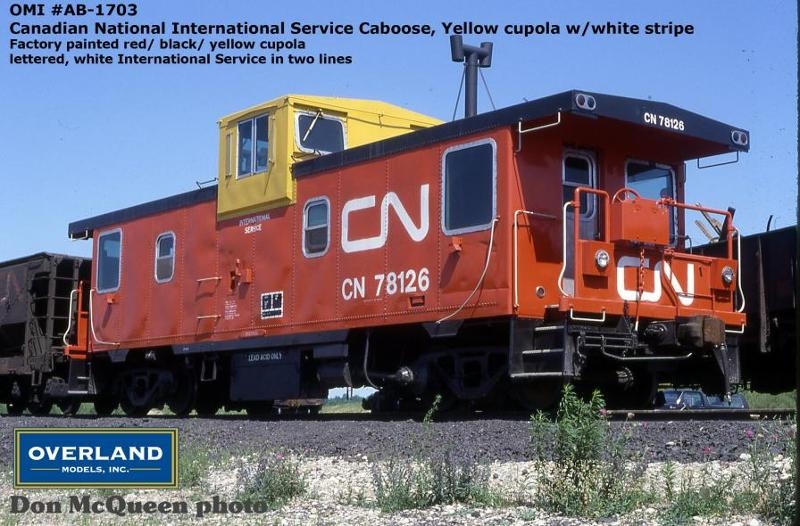
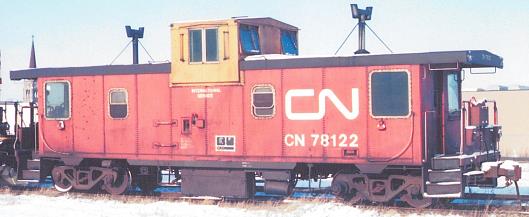
With the advent of U.S. Federal Railroad Administration Safety Glazing Standard Part 223 for cabooses operating in the United States, CN modified some of its 1970-74 built Pointe St Charles cabooses for international service, many drawn from the 793xx and 794xx ranks. Beginning in December 1982, CN glazed the windows of thirty cabooses, renumbered 78100-78129 to denote this new service. The FRA standard required such equipped cabooses to be modified by a June 30, 1984 target date. Later, CN 78130-78135 were also converted in 1987, followed by 78135-78140 (including 78139) in 1989. Visually, the cabooses were made instantly identifiable (and tempting targets for trackside photographers!) by painting the cupolas yellow and adding International Service lettering on or around the cupola.  CN 78106 tails a westbound freight at Kingston on June 30, 1983 (top photo by L.C. Gagnon)

Specific testing requirements for side- and end-facing glazing involved a 22 calibre long rifle projectile moving at 960 feet per second and a 24-lb cinder block impact! "Good morning America, how are you!?" The cabooses were used in service across the border to Maine, Massachusetts, and Minnesota; often seen in terminals like Sarnia, Montreal, Winnipeg, Niagara Falls and Fort Erie.

CN 78118-78120 were modified to fit through the tunnel between Sarnia, ON and Port Huron, MI. Operating thence on GTW between Port Huron and Chicago, the trains were cabooseless. (Also, CN 79719 shows similar, perhaps earlier modification.) Some of the International Service cabooses were equipped with central red marker lights, likely flashing, and the centrally-lettered road number moved to one side of the roof end. Some cupolas bore horizontal white striping.

Interestingly, CN 79548, 79549, 79550 and unknown others were lettered International Service with partially-yellow cupolas as early as 1973, for service on the DW&P. Kevin Toulouse kindly shared this photo of CN 79548 at Chatham, ON in January, 1981:
As time went by, and with the phasing-out of cabooses in the 1990's, the specially-equipped International Service cabooses were found on regular freights and locals, such as CN 4136-78132 at Kitchener in August, 1992 (below), and eventually even work trains into the new millennium.

Links:
My CN International Service caboose sightings with date, car number and remarks:

May x/83 CN 78100 and 78120
Aug 31/83 CN 79550 which I noted as 'Ex-I.S.'
Mar 9/84 CN 78108 on an eastbound freight at Dorval -- ironically on one of the last trains I photographed with my Kodak Hawkeye!)
Sep 18/84 CN 78111 at Symington Yard, Winnipeg
Sep 20/84 CN 78112 on a westbound freight at Portage la Prairie, MB
Feb 9/89 CN 78121 on a wayfreight switching Kingston's DuPont nylon plant
Jul 16/89 CN 79549 on westbound freight
Aug 25/92 CN 78132 at Kitchener
Jan x/94 and Jul 8/94 CN 78109 on wayfreight at Kingston
Oct 13/95 CN 78100 derailment on wayfreight at Kingston
Nov 5/95 CN 78100 on wayfreight at Kingston
Apr x/96 CN 78100 on wayfreight at Belleville

Interestingly, here's CN 78100 at Belleville in 1997 likely taken near the station, on the wayfreight to Cobourg - online auction site photo:
Additional online auction site photos:

CN 78100 at Bayview Junction in August 1983:
CN 78102 in 1986:
Oops! CN 78133 in January 1988 at London. It had been involved in a collision with VIA 6902 the month before near Komoka, ON:
CN 78138 in October 1989:
Another, undated view of CN 78138, not looking quite as minty:
78120 trailing intermodal traffic in well cars in 1985 at Bayview Junction:
CN 78113 in 1983:
CN 78113 at Ajax, ON in 1983:
Jim Parker kindly shared this undated view of CN 78124 from the Bill Grandin collection:
CN 78114 is preserved in Drumheller, AB (edited Mark Zulkoskey photo June 2026):

Running extra...

CANADA 150 is on, and July 1 is coming soon. Watch for Trackside Treasure's annual Canada Day post...150 great things about Canadian railways. Or if I get lazy in the nice weather, the consist of a passing 150-car CN freight! Thank goodness VIA did something, because corporate Canada constituents seems to be doing their own thing, virtually at the last minute! Kingston, being Canada's short-lived first capital city, features City Hall's clock tower:
There are expensive commemmorative coins and stamps being issued. For Canada's Centennial, my Dad reused the cardboard from an old Kleenex box to make his own presentation set box for each of us. A cotton-batten lined lower half contained the minted Centennial coins, while the upper section displayed the Centennial stamp issues. On the cover, our name emblazoned in commemmorative pencil on masking tape!

Tuesday, September 28, 2010

CN's Millhaven Spur

Ten miles west of Kingston, CN's 1.5-mile long Millhaven Spur branches off the south track at Mi 186.6 Kingston Sub. Loyalist Township has posted a 2013 map of the industrial park and a 1960s aerial photo:
For years, the spur only served the terylene and ammonia plants built by England's Imperial Chemical industries, opened by Canadian Industries Limited in 1954, and later known as Millhaven Fibres Limited. Once Canada's third-largest producer of polyester, and the Kingston area's sixth-largest employer in 1970, by 1992 it was the only Canadian producer of polyester fibre for clothing, carpets and tires. The plant location was chosen for its excellent road, rail and lake transportation links and access to large quantities of cooling water from Lake Ontario.
The continuous polymerization staple line was added in 1967, and the Heavy Decitex plant in 1968. Sold to Celanese, then KoSa, ultimately re-sold to Invista, the plant closed in 2009, after latterly producing PET plastic for pop bottles, and is being demolished in mid-2013. A dock, built by Liquifuels for ship-to-shore transfer of bunker C oil for the C-I-L power house and ammonia plant, is still available for liquid asphalt transfer to the Ashwarren then Lafarge, now CoCo Paving operation. The Enerchem Refiner is docked here on October 12/97:
As the plant grew, CN handed plant switching over to Cando Contracting of Brandon, Manitoba. Douglas J. Fear visited the plant trackage in November, 1996, photographing SW-1200 1003 and SW-8M 78 in the CANDO blue scheme:
Various switchers were stationed at the plant engine house, and their single-chime, US-style airhorns could be heard hooting miles to the east as they switched across Taylor-Kidd Boulevard. Cando's ex-PRR SW-1200 1003 is switching on July 31/97 (top) and had been joined by 1002 nose-to-nose in July/02 (below). Cando 1002 was the last switcher to leave the property in January 2010, billed by Total Track to the National Research Council in Ottawa.
Jim Snow Drive makes viewing of plant switching easier. Named for Ontario's transportation minister (1975-84), it links Highway 33/Bath Road with Taylor-Kidd Boulevard and the UTDC-Bombardier mass transit plant. The Bombardier plant was once served by the Millhaven Spur. And it is again. The plant was taken over by international transportation giant Alstom. Originally, polyester plant trackage comprised a tank farm on the east side of the plant, staple unloading at the west side, as well as boxcar unloading. CN crane 50472 and two flatcars were adding trackage on July 8/96. With plant expansion, a Trackmobile operated by KoSa employees was added to move cars at the PET resin plant expansion.
The Trackmobile supplemented twice-daily Cando switcher runs to the multi-track North storage-in-transit yard, parallel to CN's Kingston Sub. In 1982, a spike's-eye view looking west shows CN ballast cars stored on the lift/setout tracks at the North yard, with the County Road 4 overpass and Ernestown interlocking in the distance:
The asphalt operation added rail service in 2006. A two-track unloading area, including heating pipes to facilitate high-temperature product transfer, brought an end to trucking the product from the top of the Cataraqui Spur, an eight mile drive to the east. Branching off the spur north of Taylor-Kidd Blvd., then crossing it, the asphalt lead hosts tank cars for unloading during winter-spring months. Awaiting cars, freshly graded and ballasted looking south:
Looking north at the new spur:
With grass now growing in the Invista staff parking lot, and plans for a Millhaven ethanol plant still fermenting, CoCo is the sole customer on the Millhaven Spur. As of 2013, the Invista plant has been demolished, while wind and solar hydro projects have sprouted north of the CoCo property, across Taylor-Kidd Blvd. and slightly east. Interestingly, Bombardier recently built a 1 mile-long linear test track visible from County Road 4:
On June 27/94, 4119-4121-79549 hustle seven cars west through Napanee: the first two from Norcom and the last five from Celanese. Ault Foods' milk processing plant in the background later closed due to a strike.
Lone engine 4116 muscles 25 cars east out of Belleville yard as CN train 519 to Celanese on a snowy but sunny morning, March 1/01:
At the top of the Bath Spur on June 26/02, train 519 has only run as far east as KoSa, and is now entering the east leg of the wye to turn its train before returning to Belleville. KoSa cars are in evidence in the consist, as is a single ATSF boxcar for the Napanee Goodyear plant, now without rail service.
4122 and 4124 have just cleared the Kingston Sub:
With work in Kingston, train 519 has run around its train at Queens on August 30/02. After hooking on the TIBS, it's got the light at the home signal and is now hauling 18 cars uphill out of Queens on the south track behind 4132-4121. Next stop: Belleville.
Andre Gerow posted this awesome drone photo to social media taken at the top of the Millhaven Spur showing a VIA Venture at the switch to the CN Kingston Sub in July, 2025:

Running Extra...

Tonight's train 519 leaving the Cataraqui Spur is still Geep-powered. Train can make track speed to Belleville, even though the warranty on lead engine 4131 ran out in 1961.

Historically, Millhaven (on Lake Ontario) and Ernestown (a small hamlet on the CN line) were economically eclipsed by their neighbour Bath, which became the regional commercial and shipbuilding centre. The Bath Spur is actually west of Bath, and doesn't serve Bath at all. Not even the confusingly-named Bath Water Filtration Plant. Think about that.

Just listened to The Worry Cure by Robert Leahy. He suggests distinguishing productive worry from unproductive worry. So don't worry, it's OK to worry. No worries.

Wednesday, May 26, 2010

CP Angus Shops Vans

CP 's Angus Shops turned out one 'Angus' van per day starting in 1970, at a cost of $40,000 each. All-steel welded construction, insulated with spray foam, safety glass aluminum windows, cushion underframes, 35,000 BTU oil heaters fed by a 100 Imperial gallon oil tank, and Barber Bettendorf swing-motion caboose trucks made them a modern alternative to CP's fleet of steel and wood end-cupola, and earlier steel centre cupola vans. The steel cupola was constructed separately and later joined to the carbody, accounting for the nickname "saddleback" being applied to these vans. CP 434549 and 434646 head west and east on 107- and 132-car grain trains respectively (above) at Portage la Prairie, Manitoba in 1981.
Also at Portage in 1981, another pair of grain trains meet, with 434337 and 434175 on the tailend of the eastbound behind 8698-5546 meeting a 113-car train of empties behind single unit 5779 (above). Not all saddleback vans are Angus Shops vans. 434175 is a riveted-body, radial roof van to which a modern cupola was later added. CP often balanced the number of vans in terminals by deadheading one along with the working van. Freshly-painted 434554 is at Bayview Junction in Hamilton in June, 1981. A tall cupola meant even taller smokejacks.
Between 1970 and 1979, 435 Angus Shops vans were built, numbered 434300-434734. Steam escaping in front of 434425 is from the steam-heated passenger equipment on the cabooseless operation display train in Kingston's outer station on November 16, 1984:
Here are four van photos taken from the Dutch door of VIA No 1. In 1984, a tailend crew member is out on 434389 to inspect our train near White River, Ontario. Note the distinctive arrangement of marker lights, inspection lights, brake wheel, cushion underframe, vertical posts and high handrails.
Also in Northern Ontario in 1986, 434521 and a deadheading van bring up the tailend of an eastbound, with welded rail dropped along the mainline for impending installation. The cupola reaches to 15 feet, 7 1/2 inches, but even at that height is not tall enough to see over an "exceeds Plate F" trilevel autorack:
A Schreiber sunset in 1984 shows 434447 resting on an adjacent yard track with its storm door open, awaiting its crew for the next trip over the Nipigon or Heron Bay Subs. It's difficult to find a van photo with a closed storm door.
At Chalk River in 1985, we're getting an inspection as 434539 rolls east. Notice just how far down the carbody the cupola extends.
Friendly Manitoba. Heading north up the Minnedosa Sub from Portage in September 1985, 434341 is tailing a solid covered hopper train behind 5796-4202 as it passes over a farm crossing. The tailend crewman gives a friendly wave. Within five years, vans will disappear from CP's network as a cost-saving measure. Fewer then 80 Angus Shops vans remain in use by CP mainly to protect backup moves, and as "MOW Transporters" for use on work trains.
Paul Smith worked in CP's Winnipeg caboose shop located on Sutherland Ave., on the north side the yard just east of the Slaw Rebchuck bridge. Electricians, machinists, pipefitters and carmen performed scheduled maintenance on 16 vans per shift, including lights, refrigerator, stove, water system, running gear, doors and windows. Labourers cleaned the vans and replaced fusees, torpedoes, and spare knuckles. Once a year, vans were hand-washed with a bucket and scrub brush. The shop also maintained the Winnipeg Auxiliary, business car Strathcona, Pettibone mobile crane, reefer service truck and road repair truck. Paul was kind enough to send this photo of 434501 in Winnipeg:
Running extra...

Manny Jacob of Winnipeg has partnered with Athabasca Shops of Okotoks, Alberta to produce etched stainless-steel pairs of photo-etched storm doors including screen material, to fit Rapido Trains' Angus Shops van. The prototype doors were aluminum and plexiglas. Contact Athabasca Shops for details.

Coming soon to my van track: Rapido Trains Angus Shops van via Lark Spur Line in Merrickville. Sure to be another quality product from Jason, Dan and Bill at Rapido, with friendly, efficient service from Jeff and Pat at Lark Spur Line.

The TV week that was: Lost final episode (I'm still lost as to what really happened), Habs exit the playoffs, and American Idol winner to be chosen tonight. So long Simon, Seacrest out, hello reruns.

Saturday, February 27, 2010

CN Cabooses

Canadian National rostered over 700 steel cabooses. Featuring modern conveniences like electricity from axle-driven generators, improved seats and windows, two modern oil stoves, built-in markers, roller bearing trucks and cushion underframes. 79200-79349 were built by Hawker-Siddeley in 1967, and 79350-79897 were built from boxcars at CN's Pointe St Charles shops in Montreal in 1970-1977. These run-through cabooses were built to replace wooden cabooses built in the 1940's and 50's. 79558 is eastbound through Napanee, Ontario in early 1985 (above).

Go east (and west) young man. 79753 has an ACI label just to the left of the cupola, punctuating an eastbound freight at Portage la Prairie, Manitoba on July 24, 1978 (above). Four months later, 79532 is tailing a westbound through Kingston (below). Interestingly, 79532 has been preserved near Boston Bar, BC!

The H-S cabooses had smaller side windows, arched roofs with end posts, and cupolas angled out from the roofline. 79283 bears consolidated lube stencilling and is stopped at Mi 182 Kingston Sub on March 12, 1979. Nine cars ahead, a Pacific Fruit Express reefer has knuckle trouble.
High view at Bayview. 79218 is almost to Hamilton, passing through Bayview Junction on June 23, 1981.
Extreme closeup. 79290 is trailing uphill at Mi 183 Kingston Sub on a westbound in 1985, in the low sun of a winter afternoon.
Vanishing point. The cabooses operated system-wide, including the Prairies. 79301 is westbound at Bradwell, Saskatchewan in 1986, following a long train of lumber empties destined for the BCR.
Shop til you drop. Just renumbered and repainted with a smaller consolidated stencil, 79917 is one of 25 cabooses outshopped in 1982. Tailing a wayfreight switching the DuPont nylon plant on Kingston's Cataraqui spur on January 22, 1983.
Go your own way. A little farther up the Cataraqui Spur, 79569 has picked the switch to the terminal grain elevator in February, 1990.
A few good vans. By 1997, CN's fleet was down to 130 PSC cabooses. Remaining cabooses were in work (W) service, such as 79707 accompanying crane 50451, spending the weekend in the sun at Napanee in April, 1998. Ten years later, she's still escorting welded-rail trains on the Kingston Sub.
Take this job and shove. What's a Hornepayne-stencilled caboose doing at Kingston's DuPont plant? Working, that's what. Pushing back on the tank track at the plant, in the waning days of cabooses on the spur, the tail-end crew is watching the process of the backup movement in March, 1999. Formerly 79820, 77017 was renumbered in 1995.
Ghost rider, near the wye. Within two years, windows welded closed, doorways covered with steel plate, and used as a Rider Only car, 77017 shepherds a welded rail train at Queens in March, 2001.
Harsh light of day. Silhouetted in the glare of a summer sunrise in July 1988, the conductor in the cupola 79878 follows the leader 79574. Cabooseless operation is less than two years away. Recently, a Scotford (Alberta)-stencilled caboose was seen in Saskatchewan, protecting backup switching movements. Would you believe an ex-Illinois Central now working for CN in work service in Ontario and Quebec? Today, only 14 cabooses inhabit CN's roster.
Fade to black. 79733 is more primer and grime than little red caboose, bringing up the markers of a 14-car metals train behind 4406-4365, south of Hawkesbury, Ontario on October 29, 1988.
Running extra...
As the Olympic flame is extinguished in Vancouver, Canada has acquitted itself both as a team and as a host. CTV's coverage was entertaining, including CTV's Brian Williams meeting NBC's Brian Williams. The PM has enjoyed taken in quite a few events, having not managed to get the Olympics prorogued.
.
Did somebody say record number of 14 gold medals for a hosting nation? Also, a gold medal for that CP commercial, showing the CP Olympic train in some typically awesome Canadian scenery, along with representative employees.
.
CN Kingston Sub RTC Tim Ball is calling it a career as of this Wednesday. Tee...JAY...Bee enjoy your retirement and enjoy photographing what you've been dispatching.