Friday, March 3, 2023

CN IPO25 Heritage Units

On a sunny, 4-degree Celsius Sunday in early February, I got word that BCOL 3115 was coming east down the Kingston Subdivision on CN train No 372. Not snowing, no wind, nothing on my agenda, nice morning sunlight - of course I headed out to Mi 180 Kingston Sub, along the Kingston Railfan Walking Trail to photograph my fifth and last CN Heritage unit. I wondered why it had taken me so long to finally have such an opportunity - a combination of luck, weather, timing, and where CN had stashed 3115 since it was painted in this retro scheme, way back in 2020!

Canadian National celebrated the 25th anniversary of its November 17, 1995 Initial Public Offering (IPO), a very visible way. Five locomotives were painted in heritage schemes, depicting the railways CN acquired since the IPO. These were:

  • Grand Trunk Western 8952 light blue with red nose and GT 'wet-noodle'
  • Wisconsin Central 3069 in 'Burkhardt' maroon with yellow stripe 
  • Illinois Central 3008 in the black 'deathstar' scheme
  • British Columbia Railway 3115 in the red, white and blue 'hockey stick' scheme
  • Elgin, Joliet & Eastern 3023 orange with green-ball scheme
  • CN 8898 in the CN website scheme - not considered a true heritage unit and will be sadly ignored by your humble blogger for the remainder of this post.
GTW 8952 and CN 8898 were SD70M-2's, all the others were ET44AC's. Each unit bore a small nose logo signifying CN's transition from a Crown corporation to a publicly-traded company. Small enough to be overlooked, and cryptic enough for those viewing it to wonder what IPO25 was - perhaps a speed restriction? Technically, these are CN units with numbers that match CN number series, albeit totally non-sequential! I colloquially refer to them by their identities i.e. GTW 8952. Some say that not using a CN prefix is like breaking a basic railway rule. I also came up with my own three rules for Heritage units. These are called Eric's Three Heritage Unit Rules. 

Heritage Rule #1: It's Only Heritage When It Leads.
Heritage Rule #2: CN 8898 is not a True Heritage Unit.*
Heritage Rule #3: Veterans Units CN 3015/3233, blue BC Rail units and crappy old GTW Geeps still in their original paint do not qualify as Heritage units. **

The six units were painted at non-CN shops, reportedly the former Illinois Central shop in Centralia, IL, Quality Rail Service in Madison, IL with GTW 8952 painted at AMP in Dansville NY on Oct. 11, 2020.

The papered-over WC, IC, EJ&E and BCOL units deadheaded east on train 396, arriving Battle Creek MI on Octoer 24, 2020 on their way to Montreal. Rumours had been circulating for weeks, and as they often do, railfans compiled a 'real' fantasy list of 25 paint schemes that CN just had had to do - ranging from Central Vermont to Gulf Mobile & Ohio! "I'm happy to see the GM&O is being made", typed one rabid-but-not-realistic railfan. Hey, what about Northern Alberta Railway? A sketchy sketch showing some imaginative images made the rounds on social media: 
The six units were arranged on adjacent tracks at Montreal on adjacent tracks for the media on November 10, 2020. CN's CEO J.J. Ruest - Railway Age's 2019 Railroader of the Year -  posed with the units (and fresh rock dust spread everywhere! - reformatted Pascale Simard/Alpha Press photo):
The six units deadheaded west on CN No 105 on November 14, 2020. A stoppage and recrewing at Shannonville instantly converted the sleepy village on the Tyendinaga Mohawk Territory into a railfan mecca, with scads of camera-toting Ontario railfans going trackside, sometimes on CN property, to get photos while the units were stationary for most of the day. Like shooting fish in the proverbial pickle barrel. Then the CN Police showed up!

Minty BCOL 3115 led CN No 376 east down the Kingston Sub on November 15. The units entered service across the CN system, with WC 3069 reported in Vancouver on November 27, EJ&E 3023 in Kamloops on December 23, and BCOL 3115 in New Westminster on December 29.

I made a semi-serious quest to pursue and photograph these five units locally. Success would depend on several factors: time of day, weather, direction of travel, leading or trailing, my very relaxed schedule and just plain luck. With this past Sunday's snagging of BCOL 3115, my set of five is complete! So it took awhile...and while you've seen my results in Trackside Treasure header photos, this is the first time they've been featured in their own post. On an overcast, flurry-filled April 21, 2021 it was EJ&E 3023 leading CN No 376 at Mi. 180 Kingston Sub:
The green cab numerals don't contrast well with the orange body, especially under snowy, overcast skies:
An earlier photo of this or the BCOL unit would have shown their minty, silver trucks and underframe. Long-begrimed.
May 2, 2021 at 1610 - GTW 8952 led CN No 376 at Mi 180 in sunny weather just a few days later. 
More recently, GTW 8952 languished in the shops at Dansville, NY from April, 2022 to January 31, 2023 when it was sprung loose to grace the Kingston Sub, before taking up residency as the 'yard-switcher' in Truro, NS.
CN 2606 and Geep 7204 in the CN 'website' scheme completed the locomotive consist:
Hey, 7204! Your heritage is showing!
January 26, 2022 at a bright, snowy 0941, IC 3008 trailed on CN No 377 at Mi 179
I was actually out to catch GTW 2264 leading CN No 518 west, so this was a complete surprise! Behind leader CN 2955, and then a bush:
April 2, 2022  at 0909, WC 3069 led CN intermodal No 149 at Mi. 179 with fleetmate 3067:

Yes to a yen or a yearning for yellow? In the spring of 2026, several items were stolen from this unit. White-background number boards were the replacements!
February 12, 2023 at 1112, BCOL 3115 trailed on CN No 372 at Mi 180 (hey, better late than never).
I was so lackadaisically late to the fifth-unit party that I willingly broke my own Heritage Rule #1!
March 22, 2023 - I adhered to the rule. With CN No 122 reported led by BCOL 3115-CN 2888, I headed out to Collins Bay. Without quite enough time to get to my desired spot on the north side of Bath Road, I was lon the south side again, left with these shrubby, grubby grab shots of the go-go 122 going 65 mph!
It's easy to find a raft of stunning, colourful photos of these Heritage units on photo-sharing sites. Like the Norfolk Southern, Union Pacific and Canadian Pacific Heritage units, they just call out to be photographed! Even the crews notice a difference when they're leading a train with any special-scheme units - it brings out the overpass-and-shoulder-of-the-road crowd to get photographs! 

*I had a weak moment. Here's CN 8898 on CN No 377 on March 29 (image courtesy Railstream, LLC):
**I have made efforts to photograph CN's military units as well, however! CN 3233 on CN No 306 - March 18, 2021:

MAY 2023 UPDATE: By early May, CN had removed the IPO25 decals from the cab sides.

Lots o' links:

Running extra...

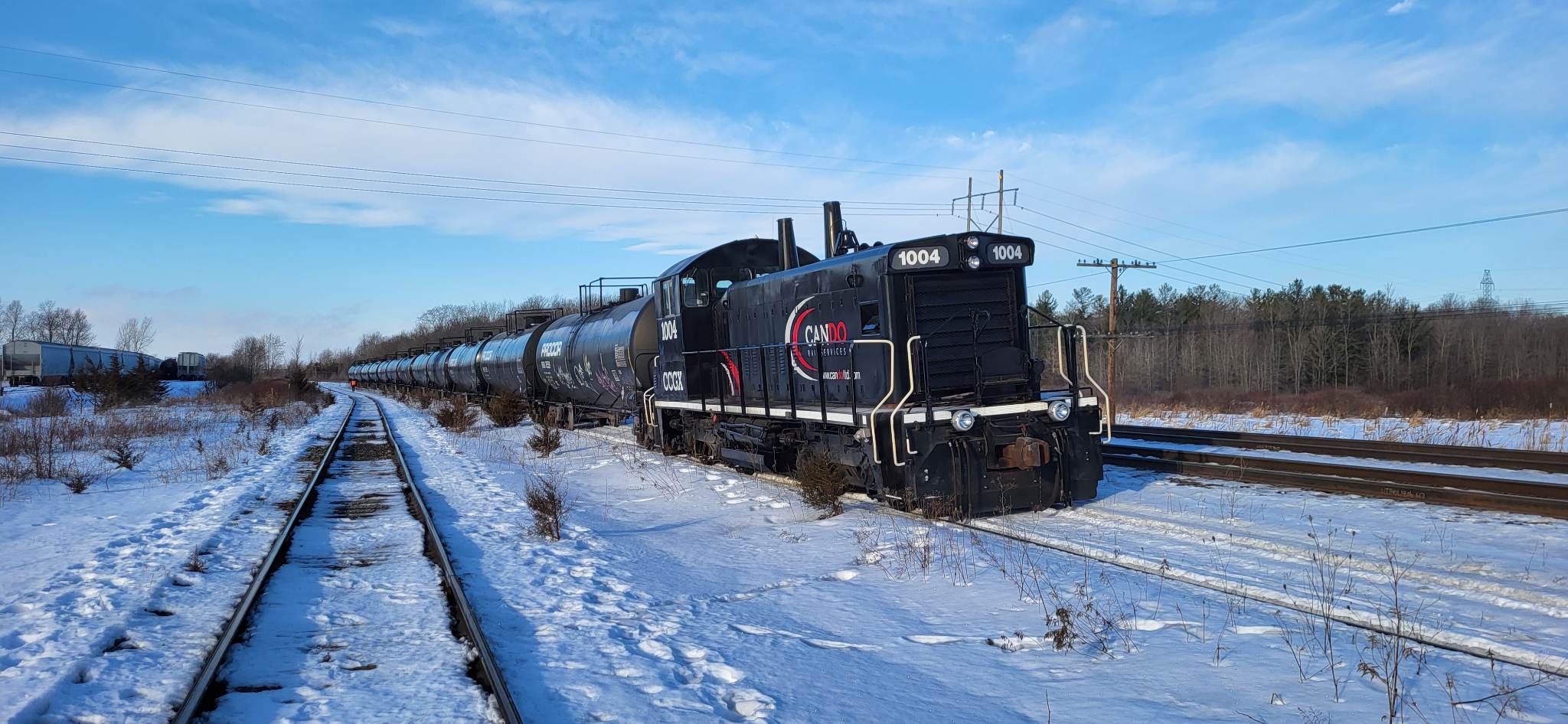
CANDO's Steve Bradley kindly shared a couple of photos of a recent trip up the former CN Millhaven Spur, now switched by CANDO. At the mainline, there is a storage yard and a connection to the CN Kingston Sub, regularly switched by the now-nocturnal CN No 519 Belleville-Kingston turn.
Looking east (above) and west (below). The CN mainline is at right:
Speaking of shortlines, Lesley Bernard emailed to say she had read my post about her Dad, Julian Bernard. She was inspired to start a blog of her own. I continue to believe this is the best way to share great stories, information and history, so I'm wishing Lesley well on this new venture!

I don't often watch Lance Mindheim CSX Downtown Spur operations videos, but when I do, it's this one.

Friday, February 24, 2023

The Bridges of Yarker

The Napanee, Tamworth & Quebec (NT&Q) Railway Co. was granted its charter on May 15, 1879. From a connection with the Grand Trunk Railway (GTR) at Napanee, up through the Napanee River valley via Newburgh and Yarker to Tamworth, with an option to extend towards the Ottawa River near Renfrew via Arden. Iron ore deposits had been discovered near Tamworth that year. The 28-mile NT&Q route would be U-shaped, from Napanee to Napanee Mills (Strathcona), Camden East, Yarker, Moscow, Enterprise and Tamworth.

Early construction costs led to financial difficulties in 1882. New management in 1883 included chief investor Edward W Rathbun of Deseronto. Rathbun, a local business magnate, already had a Napanee-Deseronto line, the Bay of Quinte Railway (BQR). Napanee would therefore become merely a way station of Rathbun's newly-envisioned extension west to Tweed, and east to the Kingston & Pembroke (K&P) line. Lennox Member of Parliament John A. Macdonald may have been instrumental in securing Dominion government subsidies of $3,200 per mile. Rail was laid to Newburgh by November 17, 1883; Yarker by the first week of December; and near Moscow by Christmas that year. Additional rock work at Yarker would be required to reduce the grade. North and west of Yarker, the line turned progressively from farmland to Canadian Shield. Maximum speed on the new line was 25 mph. The inaugural train traversed the line departing Napanee on August 4, 1884. A Whig ad published November 10, 1884 mentioned the station under Yarker Notes:
Three views of the Yarker station, showing the 'Wagar family' and the others looking toward Napanee:
A Kingston extension was proposed, to be a bridge line to bring material to Kingston: minerals, grain timber and ore. The first proposed extension to be built to Kingston would go through Wilton, Odessa, Westbrook, Collins Bay, and Portsmouth. Instead, in 1888, Rathbun applied to build a seven-mile branch from Yarker to Harrowsmith thence Kingston via running rights over the K&P. (The proposed line to reach the K&P would have saved 25 minutes of time and six miles of distance, compared to the NT&Q's eventual route to Harrowsmith.) A 22-mile extension to Tweed, later extended to Bannockburn after 1903, was also proposed, all intended to extend Rathbun's commmercial reach. Extensions to Harrowsmith and Bannockburn were secured by 1889. 

Yarker was chosen as the Napanee-Tweed mainline departure point for the NT&Q extension to Harrowsmith, three miles shorter than the originally surveyed point near Moscow. The branch to Harrowsmith did not incorporate a direct connection for traffic between Kingston and Napanee. This would save the expense of building another bridge across the Napanee River at Yarker. For expediency, the departure point was set just north of Yarker station. Harrowsmith-Yarker-Napanee traffic would be handled via a wye at the junction.  The only available location for the wye was west of the mainline at Yarker, just past the connection to the Harrowsmith branchline, due to the proximity of the Napanee River. Additional land had to be secured for the wye to be built. The wye required a seesaw movement of east-west traffic, for example from Napanee north past the station, back the train into the wye, exit south leg of wye and head east on branchline. Two trains having negotiated the wye, head east across the original bridge toward Harrowsmith. The second [one version colourized] and third views are vintage photos, the second is from a vintage postcard captioned 1908:
A westbound train traverses the bridge in the opposite direction, heading into Yarker: 
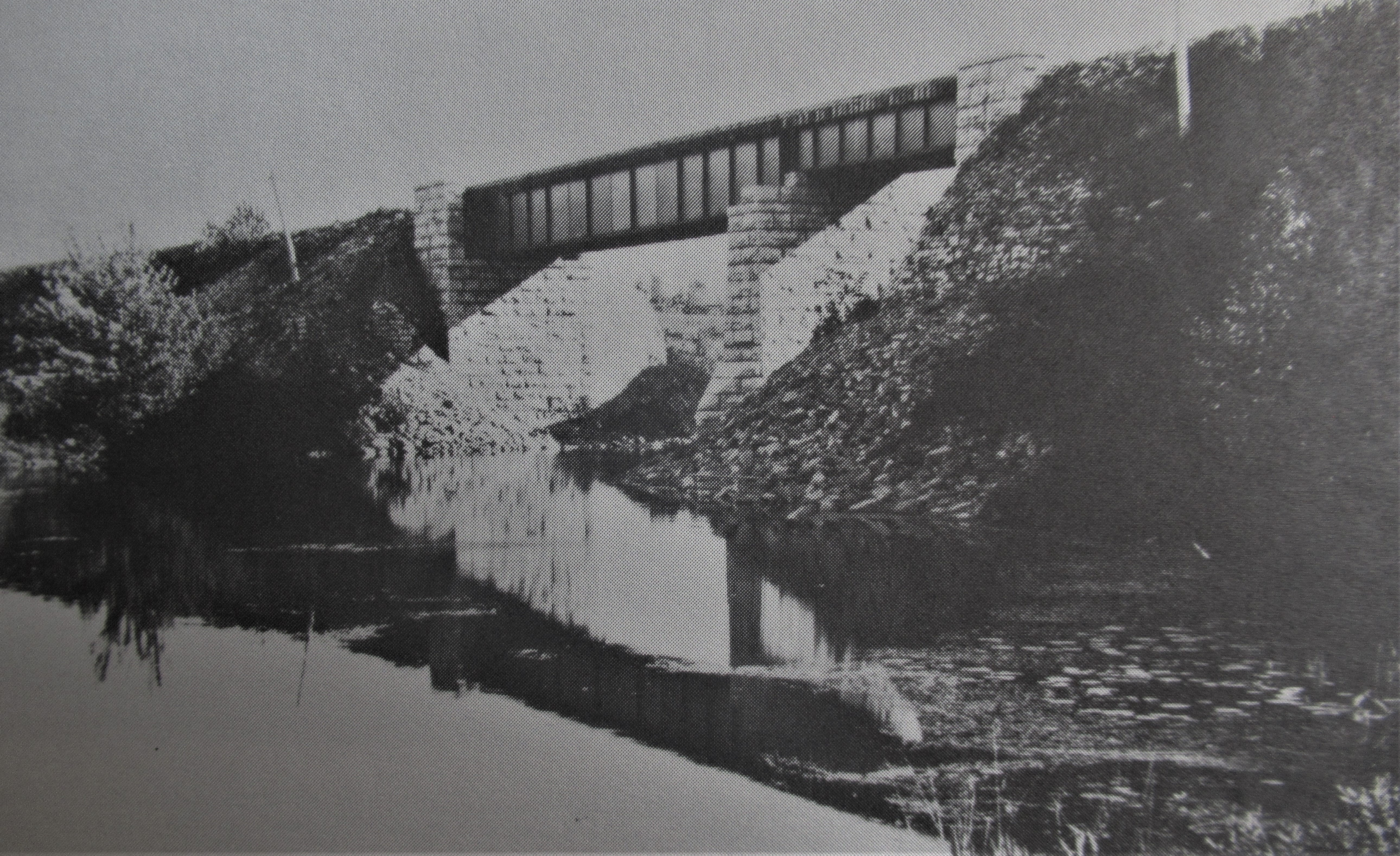
Cut stone abutments and the single pier for the two-span deck plate girder bridge began in the spring of 1889, spanning the connection running from just north of Yarker station thence eastward. The bridge was completed by November, 1889 (shown below in 1895).  The Harrowsmith branchline was fit for use by November 19. 1889, laid with 56-lb rail. The first train operated between Tweed and Deseronto on December 1, 1889, and the first Tweed-Kingston train operated December 2. 
The NT&Q changed its name to the Kingston, Napanee & Western Railway Co. on April 24, 1890. Traffic flow was Tweed-Deseronto, through two daily trains each way Tweed to Kingston, and one daily Deseronto-Yarker train each way. The K&NW was leased to the Bay of Quinte Railway on Sept. 24, 1891 then incorporated in to the BQR on January 1, 1897. When Rathbun died in 1903 at age 61, his empire rapidly disintegrated. 

In turn, the BQR was acquired by MacKenzie, Mann & Co. as part of their Canadian Northern (CNoR) Toronto-Ottawa line. They installed the missing link at Yarker, building a deck girder bridge across the Napanee River in 1912. This direct link, which left the mainline farther south, finally eliminated the time-consuming switching movements required by trains heading east to Harrowsmith. Two photos of the construction - bridge pier forms (Pinterest image) and installation of spans:
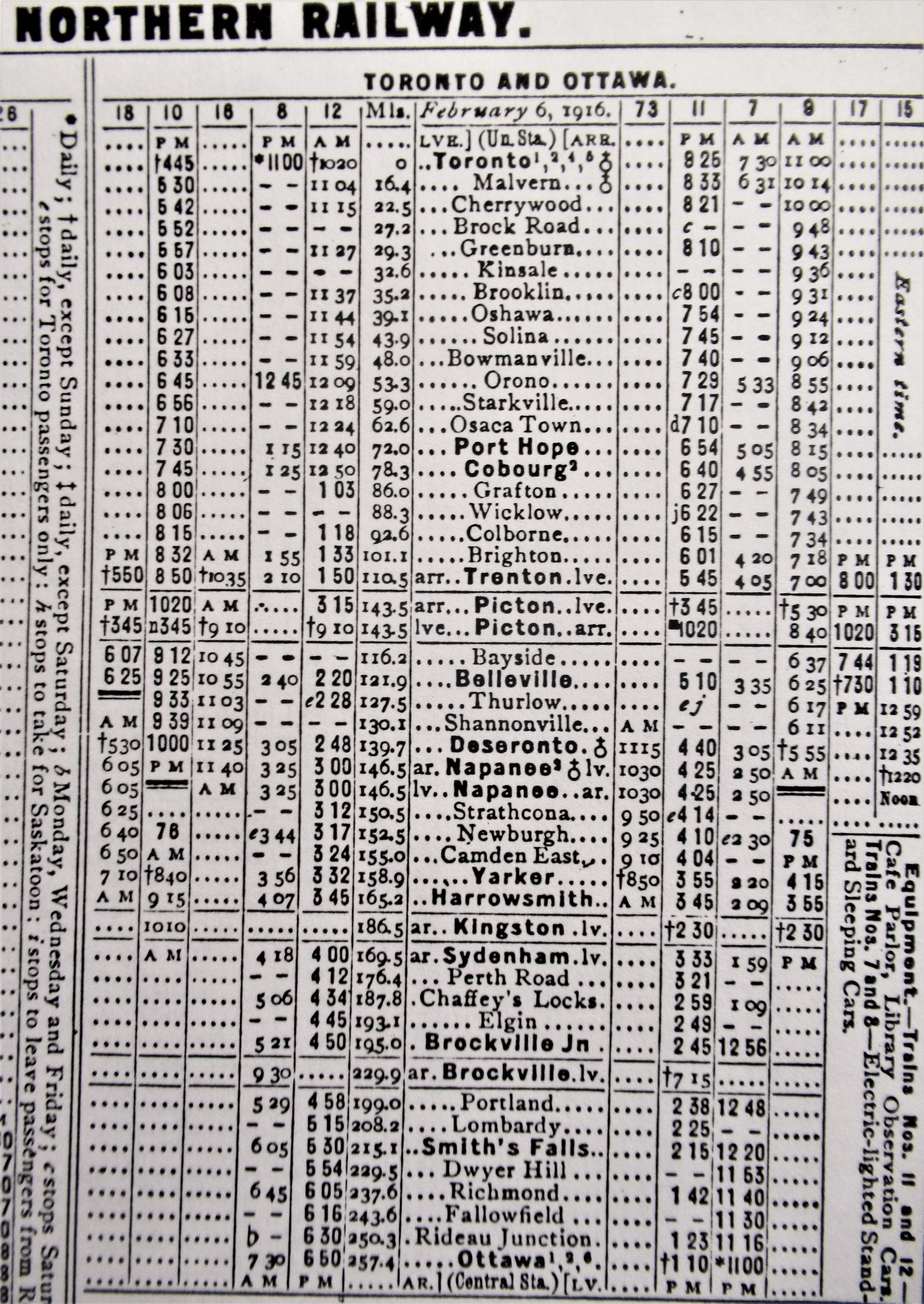
MacKenzie and Mann also realigned their line through Newburgh, moving it north away from the Napanee River in 1914. This realignment may have been due to potential flooding, or to bypass the town, though it definitely reduced the grade eastbound. BQR became part of the their Canadian Northern Railway (CNoR) on January 5, 1914, bought at 70% of its original value. Two schedules from the June, 1916 Official Guide of the Railways: Kingston-Yarker; Toronto-Ottawa; Deseronto-Yarker:
Kingston-Yarker; Tweed-Deseronto; Deseronto-Bannockburn:
CNoR's poor financial straits saw its progressive amalgamation into Canadian National Railways from 1917 to 1923. As a result, the NT&Q, K&NW, BQR disappeared into the national railway. CN abandoned the Yarker-Tweed segment in 1941, and the Yarker-Smiths Falls (extended via subsequent extensions from Harrowsmith to Sydenham and east) in 1986. I'm not sure when the first bridge's spans were removed, but it's likely they were reused elsewhere on the system.
Approach to the second bridge, in 1958 (above). Unless otherwise noted, photos in this post, most originally from the Lennox & Addington County Archives published in the excellent book: Lost Horizons - The Story of the Rathbun Railway Company and the Bay of Quinte Railway - by Donald Wilson, Mika Publishing, 1983.

Undated (likely late 1940's, early 1950s) aerial views Queen's University Archives, George Lilley Fonds: V25.5-48-78/79 Yarker; V25.5-48-69 Strathcona; V25.5-48-53 Newburgh:
Yarker (above) showing the second bridge at centre, road overpass and first bridge abutments, and the curve at left heading north to Colebrook. A second view of Yarker (top photo) shows the second bridge, with the right-of-way of the former Harrowsmith extension just visible, curving up to left.
Strathcona (above) with several CN boxcars at the mill and the siding along the line. Newburgh, with two boxcars just visible near top of photo on the relocated ex-CNoR line and the Napanee River at near bottom:
My son and family took a recent stroll along the Cataraqui Trail and across the bridge, which sparked my interest in finally putting in the work to research this well-known local bridge and its interesting story. As with all other railway engineering, nature is always vying for supremacy - grapevines spread their tentacles over the side fencing along the bridge deck. I wonder if my four year-old grandson, walking with my son, could imagine CNoR steam-hauled passenger trains speeding across the bridge a century ago? From here looking upstream, the central pier of the first bridge is still visible:

Lots o' links:
Lesley Bernard kindly shared this view of the piers and abutments of the first Yarker bridge circa 2007. Lesley knows a thing or two about the Tweed extension! 

Running extra...

On March 26, the Ottawa Valley Associated Railroaders are holding a model train event a.k.a. flea market Sun: 9am to 5pm at the Hellenic Centre, 1315 Prince of Wales Drive in Ottawa. Admission $5. Table prices: $20 for OVAR Members, $25 Non-Members.

This is Trackside Treasure's 800th post, and this blog's 15th August anniversary arrives this summer! The same day, I reached 800 follower on Pinterest. Pinteresting coincidence.

If only that 40-mile Communist convoy, presenting such a fat target, and a pathetic picture of poor military planning, on its illegal invasion incursion into Ukraine, could have been destroyed one year ago. I'll continue to raise my Ukraine flag in our front window each day until the final Victory. 

Slava Ukraini! Heroyam Slava! Glory to Ukraine! Glory to the Heroes!

Saturday, February 18, 2023

HEP Buffer Car Corridor Consists

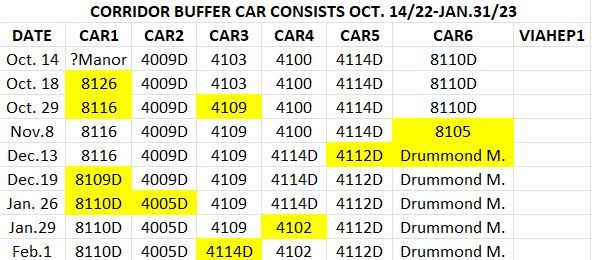
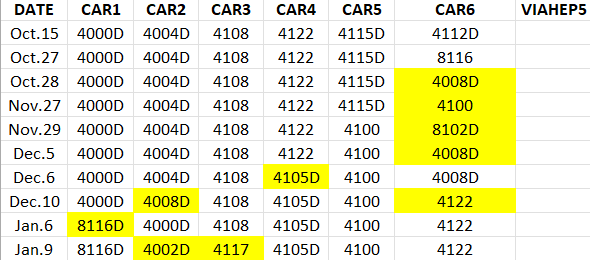
While tracking the VIA buffer cars in use not only in the Corridor, but across VIA's network, I noticed frequent changes in the unoccupied buffer cars as well as the passenger-carrying cars in the six HEP Corridor consists. The buffer car implementation began in mid-October 2022, and January 31, 2023 was the date by which the results of the NRC structural integrity testing of Chateau Richelieu and 8138, as well as the CAD tear-down testing of 4006, 6208, Alexandra and Chateau Rouville, were to be communicated to Transport Canada. So that seemed like a natural timespan in which to book-end my tracking of these ever-changing consists.

Included in the six-car (and a few five-car) consists are HEP1 ex-CP coaches: VIA 8102D, 8103, 8105, 8109D, 8110D, 8116, 8122, 8123, 8126 and 8129D, HEP2 Business Class cars 4000D-4009D (except 4006D long sitting forlornly at CAD in Lachine, QC in poor shape) and HEP2 coaches 4100-4122. In December, ex-CP Manor cars Brant Manor, Bliss Manor, Craig Manor, Drummond Manor and Lorne Manor were added as tail-end buffer cars. As always on Trackside Treasure, the 'D' after a car number pertains to "D&H" designation for the schemes applied to refurbished HEP cars: teal/yellow on coaches 4105D, 4111D, 4112D, 4113D, 4114D, 4115D (top photo) and the grey/yellow on the Business Class cars. Otherwise, the HEP1 cars have a blue letterband and the HEP2 cars have a yellow/blue letterband.
The consists presented below are randomly assigned the arbitrary designations HEP1 to HEP6, based on the order in which I first recorded them. Most mornings on the CN Kingston Sub, it's possible to catch up to five HEP consists on trains 40, 50, 52, 60 and 62. Some days, later trains 42, 44 and 45 (above, in December 2022), and still others in failing light later in the day. Some of the latter are heading westbound after being eastbound in the morning. While there is a somewhat-predictable Equipment Cycle that VIA uses, it is not ironclad, and can be altered by operational exigencies. 

Here are the six consists and their progression over the last 3+ months. Notes are at the end:


While some have taken the buffer car implementation as an opportunity to slag VIA, including me when VIA kept the initial issues under tight wraps, the buffer cars have actually made VIA trainwatching more interesting! Some day we will look back at the Buffer Car Bonanza as we do Operation Axle - as just another Hail Mary moment in VIA's history!


Running extra...

Charles Cooper's Railway Pages continue to be a useful website with useful information like upcoming shows, a railway newsletter archive and new railway books. Also an author, Charles kindly helped publicize my books on VIA Rail. He died this past Monday though the site lives on, at least for now.

Cries from the wilderness are already being heard, dreamers putting in dibs on Budd ex-CP Canadian cars. Summer cabin, tiny home, the possibilities are endless. All one needs is good road access, a heavy-equipment moving guy, local municipality approval (optional?), oh and some money. 

I was thinking this past week of someone I knew that had a nicely-outfitted 'grouch house' in his former garage, in which to do his woodworking. Source of heat/AC, concrete pad, electricity, and a bar fridge would do it. He was a Priest, and a father, and a brother, but he wasn't even Catholic, so I guess you could say nun of the above!