Friday, February 11, 2022

VIA Historical Association


INTRODUCTION TO THE VHA

The new VIA Historical Association (VHA) was the topic of our February Associated Railroaders of Kingston meeting, ably presented by ARK member and VHA Treasurer Andrew Jeanes. Andrew presented not only VIA's history, but also the genesis of modern VIA preservation by the Toronto Railway Museum and Exporail, and the extension of the Rapido Trains Inc.'s efforts by the VHA with its now-charity status.

WHY VHA? 

The VHA has its own website and Facebook presence. Here are some excerpts from their online mission statement:

The VIA Historical Association was founded in 2020 by a group of dedicated VIA Rail Canada enthusiasts and historians. Building upon the collection assembled by model railroad manufacturer Rapido Trains Inc., the VHA aims to assemble a representative collection of VIA train cars and locomotives to interpret the history of Canada’s national passenger railway.

Since its incorporation in 1978, very few artifacts of VIA equipment have been preserved for future generations of Canadian historians and railway enthusiasts to appreciate. 

In the next few years, the majority of VIA’s fleet will be retired and replaced. If we don’t act now, most of this heritage equipment will be either scrapped or dispersed across North America like VIA’s conventional fleet was in the 1990s. The VHA collection will allow VIA’s history to be preserved, and our aim is to maintain the equipment in operational condition according to Transport Canada regulations. We hope that the VHA collection will be used to celebrate VIA’s history during milestone events, such as VIA’s 50th anniversary. We also hope that VIA will use our collection to operate railfan excursions, charity events, VIP charters, etc. The collection will serve as a travelling museum and educate the public about VIA’s history.

The VIA Historical Association also looks forward to sharing VIA’s history through online exhibitions, printed publications, and in person at railway-related events across the country. 

WHY PRESERVATION?

Why do rail enthusiasts seem to have a core belief that many, many pieces of equipment should be preserved? Preferably one of each, (or more, like GG-1's!) of their favourite piece, favourite manufacturer, favourite railway. I don't hear this from ship or airplane enthusiasts, fans of apartment buildings, parking garages, baseball stadiums or other large, bulky objects. Most enthusiasts don't usually realize that preservation = labour. That's volunteer labour, usually at a museum, with bylaws, rules, cliques, an unclear collections policy, infighting and often failure, followed by scrappers coming in, and the demise of preservation efforts. Preserved trains require either indoor storage or ongoing, expensive maintenance if outside in the great Canadian outdoors. Both are expensive.

My mother-in-law told us the other day that she has 21 teacups. She doesn't use them, she just displays them. She treasures them all, but who knows if anyone else does? She hopes they will find good homes and continued treasuring! Such was the misapprehension of civic, industrial and museum bodies that assumed future generations would always maintain and treasure the hulking locomotives and other rolling stock they preserved at the end of steam.

                                              WHY VHA PRESERVATION?

Except for a few static displays, such as a Park car and F-unit in VIA colours at Exporail, and other ex-VIA equipment no longer in blue & yellow, the VHA intends to have the largest extant preserved fleet of VIA preserved equipment. There is a core group of current employees, rail enthusiasts, former employees and modellers that are willing to help. There is also centralization of preserved equipment and resources in the Greater Toronto Area.

In the course of creating my four books on VIA Rail, it became apparent to me that VIA is a very manageable railway history to document, and therefore a finite fleet to preserve. Unlike, say, the Pennsylvania Railroad! Preserving 'one of everything' on the Standard Railroad of the World would require greater museum space than already devoted to preserved pieces of the PRR fleet!

VIA is also recent enough for many still alive to remember (unlike the PRR!) and let's face it, VIA did most of the preservation itself as their aging equipment was rebuilt and refurbished in-house. Some have described VIA's fleet as a rolling museum.

WHY DONATE TO VHA?

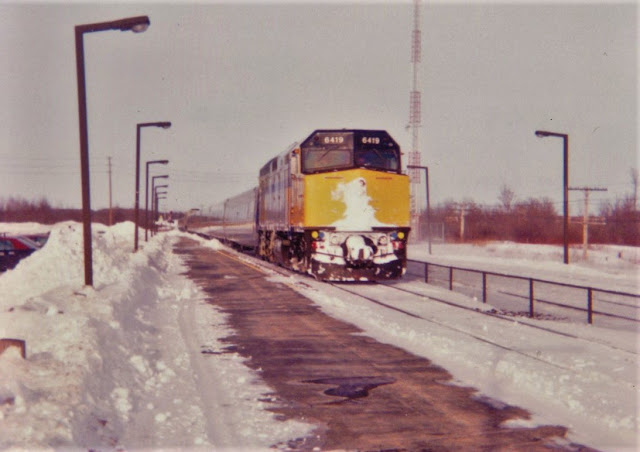
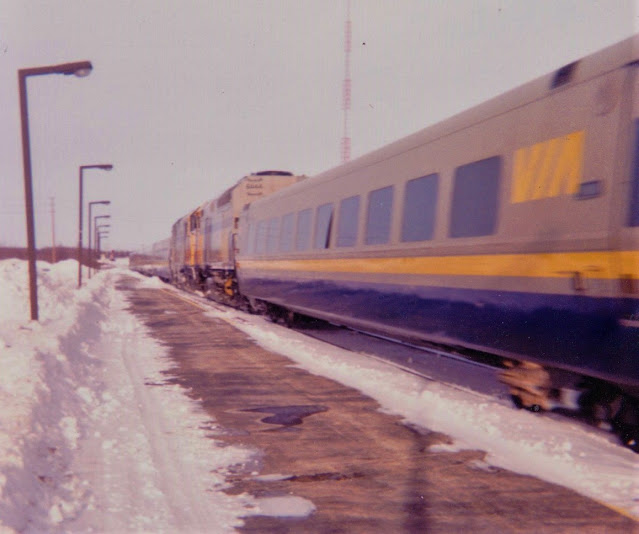
I don't usually promote 'causes' on Trackside Treasure. The first questions in readers' minds would be, 'well thanks for telling us to contribute to the cause, but did you?' I guess that's what social media influencers do. So, why this post? The day after Andrew's presentation, I came across an historic photo montage (top photo) from five years ago that I was preparing to use on the cover of my fourth book on VIA Rail.

It seemed to be a message to post a VIA good news story - one that matches my 2022 Year of Optimism masthead widget! And I do hope to forge ongoing meaningful connections with the VHA. Not in that scraping-off-old-paint way, but possibly through cross-marketing, submitting material, and blog posts like the one you're reading now! Speaking of  'five years ago', that's when I caught the freshly-wrapped Glenfraser CANADA 150 gliding through Belleville on VIA No 53 on February 11, 2017. It's a sign!

INAUGURAL ISSUE OF VHA'S MAGAZINE

Panorama issue 2021:1 of  the VHA's full-colour, bilingual, glossy paper magazine includes stories on the untimely demise of VIA's Turbos, origins of the VHA's present equipment collection, a restoration report on E-series sleeper Edmundston, and more on Mission 2028 - the VHA's planned expansion of its fleet to include a touring exhibition train for VIA's 50th anniversary. Panorama is distributed free of charge to donors, supporters and friends of the VHA. 
Thanks to VHA President Jason Shron, a copy of the inaugural issue came my way prior to the publication of this post. Here's VIA's boilerplate from its masthead: The VHA's unique mission includes preserving and restoring examples of VIA Rail Canada rolling stock and locomotives for public exhibition and operation; educating the public about VIA's vital role in Canada's transportation network; and documenting VIA's history through archival materials, exhibits and publications.

To this humble blogger, that sounds like a worthwhile, realistic and VIAble mission.

Running extra...

Your humble blogger has had the pleasure of meeting Jason on a few occasions. The first quite by chance - on June 19, 2008 as we headed east to Montreal in VIA1 on VIA train No 52/40. Hearing a conversation down the car aisle, a passenger with book in hand was chatting amicably with on-board staff. I put two plus Turbo together and realized it was none other than a certain model train manufacturer doing the kibbitzing. On his way back to his seat up the aisle, it was, "Excuse me, are you Jason Shron?" Surprise!

Thanks to my son-in-law for snapping this photo of the ideal Retired Railfan Reflection and Respite location along Coronation Boulevard, just east of Mi 182 Kingston Sub. A resin chair, trackside, waving to traffic between trains!

This week's should-watch includes a trans-Atlantic collaboration between James Hilton and my blog partner Chris Mears. - Bear Creek. The equipment lettering and presentation of the overall scene are masterful!

Friday, February 4, 2022

CN Derailment at Kingston, March 2005 - Part 2

Part 1 was the genesis of CN No 306's derailment at Mi 178 Kingston Sub on March 17, 2005. In this Part 2, we'll clean up the incident by covering the clean-up. There were eight derailed cars, atop the Gardiners Road underpass. I visited the site in the morning of March 18, though taking these photos into the morning sun at 1100 did not provide the best lighting! The worst was over and the derailed cars were already rerailed by heavy equipment. It's easy to see how a trespasser could cross the tracks here, as there are gaps in the right-of-way fences at the ends of the overpass and a subdivision south of the south track, east of Gardiners Road. Such a trespasser was the cause of emergency brake application that led to the derailment.
Before my arrival, that morning's trains past the site included No 105 at 0500, No 120 at 0515, VIA No 51 at station 0520, No 104 at 0630, and No 362 at 0715. 

At 0525, Work Extra 6023 arrived from the west (symbol W30031117), and was given a Form 564 at 0600 to proceed from Queens West to the derailment site on the south track.

At 0745, CN No 310 set out ten cars of slag ballast ordered from Toronto MacMillan Yard into track 1 at Queens.

At 0800, VIA No 41 was making its station stop, asking for a signal for the south track! Foreman Dave Reynolds responded there was no way, due to the cars on the ground in a big hole up here!

Foreman Reynolds was clearing all approaching trains with the following foremen also operating inside his Rule 42 limits: foreman Tammy Taylor stationed at the Centennial Drive overpass project, foreman Joe Whalen, foreman Dave Scott, foreman Dave Casano, equipment supervisor Mark Ethier from Toronto and Mike Taylor.

At 0820, foreman Mike Labelle is given a Track Occupancy Permit to take two spikers and a hi-rail truck west from Queens on the north track to Ernestown, then crossing to the south track and returning to work the west end of the derailment site.

At 0830, the crew bus is loaded up for Denny's. Some are not able to make it as they are still rolling the rail near Country Style, west of the site.

At 0845, foreman Randy Snarr replaces Dave Reynolds, though still running the Rule 42 under Reynolds' name, confusing to all including those who are good at recognizing voices! Reynolds is louder with folksy delivery; Snarr quieter and terser.

At 0900, No 305 is holding for spikers as well as VIA No 52 at Queens. The work train is lifting the ballast cars at Queens set out by No 310. Dan Ash was supervising the slinging panels over the north track, and truck driver Don Bainen was hi-railing to Collins Bay Road, working east from there unloading bags of anchors from his truck east of Mi 178.7.

VIA No 52 was held west of Collins Bay for 30+ minutes waiting for the hi-rail truck. The Rail Traffic Controller (RTC) was soon calling 'Dave Reynolds' to ask why!

At 1015, 'Dave Reynolds' reported a hanging bracket on one of CN No 305's boxcars, to be inspected upon arrival at Belleville. 

More passing trains: CN No 103 at 1030 and VIA No 53 at 1035.
Driving to the derailment site at 1100, I passed two spikers and the Trax hi-rail truck were operating across from Frontenac Secondary School. Later, a tamper and ballast regulator were operating around Mi 179 with a hi-rail pickup. Upon reaching the site, two Don Hart excavators from Napanee were operating on the south track on the Gardiners Road underpass. One was digging up ties, the other was lifting panel track into place from a float truck which had been backed up to the south track. Welded rail at this location had been cut and removed. Removing rails, lifting panel track (above and below):
The NOKL hopper had been removed. The NAHX and CN hoppers had been rerailed by Hulcher. The next CCBX tank car was off the rails, having been pushed east by a large Hulcher bulldozer, about to be rerailed. Two other Hulcher side-boom bulldozers were alongside. The other three tank cars and the RFMX hopper had all been rerailed. Side-boom bulldozer at left, another bulldozer pushes the last rerailed car (below and top photo):
North side view, looking west, with panel track and hi-rail truck on north track (below). The track formerly in the foreground was CN's Industrial Spur to the Northern Telecom plant.
CN flatbed transport truck with MK IV tamper, backed into an access road between Union Gas and commercial buildings on the east side of Gardiners Road south of the underpass (below). Numerous CN trucks, as well as a float truck carrying panel track, two CN Police cars and three Hulcher float trucks were in the field in the southwest corner of Gardiners Road.
Local railfan Tim Reid took this photo (purchased from Liz Reid) earlier in the day, with two side-booms lifting that CASCO tank car and panel track on the transport truck:
At 1100, Work Extra 6023 was leaving the east end of Queens onto the south track. It went west pulling ten ballast cars and coupled onto the three easternmost rerailed cars. 

Trains past the site: VIA No 57 at 1230, CN No 149 at 1240. The road repair truck was returning to Belleville.

Between 1400 and 1530, the following trains passed the site: VIA Nos 60, 61, 44, 45, and CN No 308. At 1515, CN No 363 expressed concern to the RTC about stopping its 167 cars, including 30 welded rail cars on the head end. Not wanting to put on the brakes on one that big because it might not get started again.

Foreman Randy Snarr (aka Dave Reynolds) was clearing all approaching trains with the following foremen: Tammy Taylor, Norm Primeau, Brian Mylks and Dan Ash. Foreman Brian Cooper and trainmaster Don Anderson were also on scene.

At 1530, track machines were left at the north end of the Cataraqui Spur for lifting by crane onto float trucks later. 

At 1600, a bus trip to Denny's was being organized, thence to the Comfort Inn.

The work train, directed by foreman John Shakel, was unloading ballast on the newly-laid panel track while also pushing the rerailed cars. The engineer wanted to get rid of the cars with blocks and chains on them. The answer was no. Would Shakel take responsibility for them, then? The answer was yes.

The spikers moved west of Frontenac Secondary School pedestrian crossing to Mi 179 to make headroom for the work train.

At 1600, No 309 was held at Queens with 13,000 tons and the lead engine dead due to no fuel, not passing the site until 1650.

Work Extra 6023 went into emergency heading back to Queens at 1715. CN No 377 was held in Queens 1 for VIA Nos 64 and 65, passing the site at 1830.

At 1730, CN No 306 was held in Queens on the north track for VIA trains.

Foreman Dave Reynolds is *really* back on Rule 42 Duty at 1800. As No 377 heads west, they express amazement that the derailment has been cleaned up already. Reynolds replies he feels sorry for the crew who had struck a child in Brockville just last month. He also noted that luckily, all the derailed ars had remained coupled and upright.

The RTC calls Reynolds to ask whether he can run trains on the south track. Reynolds is waiting to hear from Signals & Communiations. Two maintainers are onsite now, and when they confirm that track circuits are operating, they will call the RTC. There will be a 25 mph slow order on the south track at Mi 178. There was discussion between Reynolds and the maintainers regarding the implications of a 25 mph slow order on the timing of nearby crossing circuits.

At 1845, VIA No 47 passes on the north track at 5 mph. Reynolds reminds them that the maximum is *50* mph.

Trains past the site: VIA No 67 at 1930 and CN No 321 at 1940.

At 1950, the first train over the new track was CN No 376 with 15,000 tons and 10,000 feet. They passed by at 10 mph, increasing to 25 mph.

At 2010, VIA No 48 passed over the south track at 25 mph, slow order flags not yet placed. 

More trains on the south track: CN No 368 at 2020, 106 at 2200, 148 at 2300. CN No 519 is in the area at 2330, not able to enter the Cataraqui Spur due to switch.

At 2100, Reynolds contacts the RTC for confirmation of Rule 43 at the site:

Due to track conditions
Form B
specifying speed restriction of 25 mph
has been issued on south track 
Mi 178 to 178.1 Kingston Sub.

Rule 42 protection ends at 2330.

This was the second, albeit minor, derailment that has occurred on top of the Gardiners Road underpass. Watch for an upcoming post on the first one.

Running extra...

Time to do some online shipping, or perhaps, Jeff Bezos you little rotter 'damn that's a big boat' has a bridge too low for his mega-yacht to reach the open sea and maybe someday the Amazon. It's name? The Bezosmarck. Hey, whatever floats your boat!

CN Kinghorn and Caramat Subs in HO. One of the most realistic layout videos you'll ever watch. Here's a once-around layout tour - check out the realistic ballast pit and back tracks.
This past Tuesday's Associated Railroaders of Kingston Zoom meeting featured an informative presentation by fellow ARK member Andrew Jeanes on newly-formed VIA Historical Association (VHA). Andrew covered VIA's history, its preserved and to-be-preserved equipment, and the work of the VHA. Watch for an upcoming post on this VIAble effort!

Friday, January 28, 2022

CN Derailment at Kingston, March 2005 - Part 1

On March 17, 2005 CN Toronto-Saint John, NB freight train No 306 went into emergency due to a trespasser on the south track at Mi 178 Kingston Sub. The trespasser did not respond to repeated whistle blasts and jumped off the track at the last minute. VIA No 65 was approaching from the east, and did not see any trespasser despite some searching, nor any problem with 306's train. The head-end of 306 was stopped about one mile west of the Kingston VIA station. The first part of the train would have been on a 0.8% downgrade, and the rear of the train on a 1.0% grade up to Gardiners Road, a major north-south arterial in Kingston's west end. The consist was 130+ cars long.

 THE DERAILMENT

Shortly thereafter, 306 started to pull ahead at low speed. While driving west toward Amherstview, I briefly observed this attempt. It was then that several cars derailed. The crew called the Rail Traffic Controller (RTC) at 1852 reporting a loss of air, in emergency at the Gardiners Road underpass, Mi 178 Kingston Sub. There was slack action during the emergency stop, and was the cause of the derailment. 

Unusually for a Trackside Treasure post, I have no photographs accompanying the text. That's because this part of the derailment was in the dark! Kingston Whig-Standard photo published March 22:

The north track at the time of 306's call was clear, but the south was fouled by seven or eight cars on the ground. The rail was broken and torqued at least 50 cars behind the power. At 1945, 306 reported four or five cars off, 20 feet from the south track, 30 feet of broken rail, misaligned rail beyond that, and no further damage to the train. Also reported by 306 during '20 questions' with the RTC was the speed at initial emergency application of 40 mph, and the second loss of air (derailment) occurring at 8 mph. 

THE TRAIN
The cars involved were:
  • NOKL 821081 covered hopper of soybeans (74th car)
  • NAHX 481792  and CN 388609 covered hoppers also carrying soybeans
  • CCLX 1478, PROX 75987, PROX 75988 and CCLX 1469 tank cars all carrying corn syrup
  • RFMX 464358 (ex-Conrail) covered hopper carrying corn (81st car)
Here's how CN's consist for No 306, usually toting tank cars, covered hoppers as well as boxcars for lumber and paper to the Maritimes and various short line connections, was blocked from the head-end:
  • Coteau, Ottawa Central Rly.
  • Riviere du Loup or Joffre, Chemin de Fer Baie des Chaleurs
  • Edmunston, BAR Madawaska, ME
  • Moncton
  • Dartmouth
  • Saint John
  • Cape Breton & Central Nova Scotia Rly. 
So it's likely that the cars in the mid-section of the train were heading for Moncton. Today, 306 only operates far as Moncton, carrying on to Saint John as regional freight 406.

THE RESPONSE

At 1955, VIA No 49 passed by at restricted speed.

At 2000, foreman Mike Labelle arrived on the scene.

At 2020, the RTC told 306 to take the underailed cars on the head-end east to Queens. CN No 519 would arrive from Belleville to remove the underailed cars on the tail-end.

At 2025, VIA No 48 passed by at restricted speed. CN No 306 made slack for the cut, departing for track 1 at Queens, with trains passing on the north track not to exceed 50 mph. The head-end passed the Kingston VIA station at 2048. 

At 2050, VIA No 69 was westbound at Queens.

At 2055, 306 called to talk to the RTC about where to stop with its cars. The south service track at Queens could not be blocked, since overnight trains VIA 50/51 would have nowhere to go.

I went to the derailment site at 2100. The CN Belleville road repair truck was taking the Sensing-Braking-Unit (SBU) to the tail end of 306 at Queens. Two mobile lighting units to illuminate the site were arriving, already lit in transit!

At 2200, CN No 368 passed by, then No 148 at 2230 with lots of bell and whistle.

At 2300, CN No 519 arrived to pull the tail-end of the train clear. Departing Queens after the trainmaster had downloaded data from the engine, 306 continued east.

On duty at the scene were track supervisor Dan Ash, trainmaster Mike Taylor, trainmaster Kim Hum, trainmaster Pete Hopper, and foreman Dave Reynolds. Carmen were stationed 20 cars apart to watch the pullback of the 50 cars on the tail end. The pullback started at 2330, starting at less than 1 mph. with those in place again advised to watch as it pulled back, lest the train go on the ground. If it did, the movement was to come to an imnediate stop - fortunately there was lots of flange left on the rail. 

At 2335, SBU #32138 was attached for the movement of tail end cars for the trip to Belleville which proceeded west at 0015 March 18.

At 2345, foreman Dave Raynolds was given a Track Occupancy Permit on the north track between Queens and Ernestown to put up flags for his new Rule 42 limits between Mi 181 and 176. Foreman Dan Ash notified foreman Reynolds that trains passing the site were permitted in either direction, at a maximum speed of 50  mph.

CN Police called trainmaster Hopper inquiring as to the last known location of the trespasser.

A pow-wow was then held at the southwest corner of Gardiners Road. Nobody would be doing any work until the briefing was held, with the exception of section forces putting on their hi-rail  truck at Collins Bay Road, two miles west. 

THE END...for now

It was time to sleep. Well, for me anyway. CN crews and Hulcher contract crews continued to arrive during the night and go to work.

Kingston Whig-Standard photo of the clean-up, published March 19 (above). In Part 2, we'll return to the site to see clean-up underway.

Running extra...

Initial impressions of my most prized periodical publication of 2022 - Model Railroad Planning:
  • Neil Schofield's CP in Vermont made the cover and it's the best article within. I enjoyed matching the photo locations to the trackplan, though the caption for photo #9 appears to have no matching photo, and photo #9 shown is taken at Neil's North Troy. 
  • there are several big, and I mean b-i-i-i-g trackplans, perhaps continuing a trend  for MRP to resemble Great Model Railroads, Kalmbach's other annual. It's OK to show us below-the-layout and unfinished scenes once a year, Kalmbach!
  • blog partner Bernard Kempinski's nice Civil War modelling is featured (above) now that his Port of Los Angeles layout has been moved out.
  • I've seen lots of layouts that look like other modeller's layouts, taking someone's layout and techniques as inspiration. But Randy Decker sets out to replicate major elements of John Allen's oft-published Gorre & Daphetid. And that just seemed weird!

Saturday, January 22, 2022

Kingston-Montreal Return Trip, March 1993

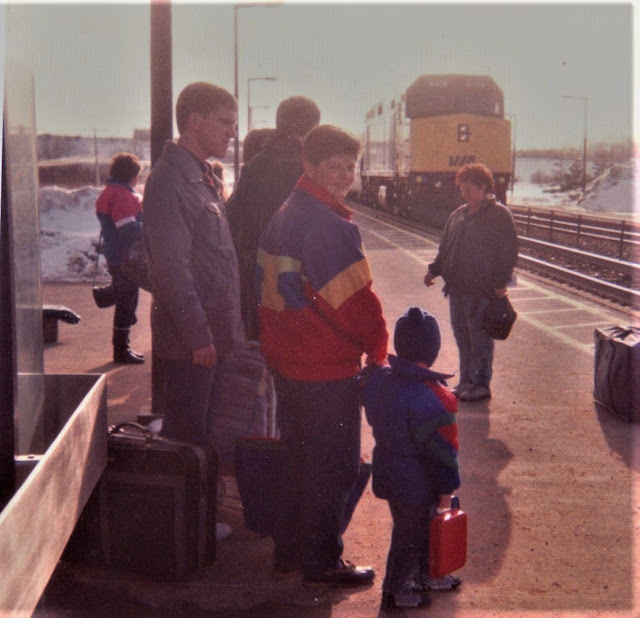
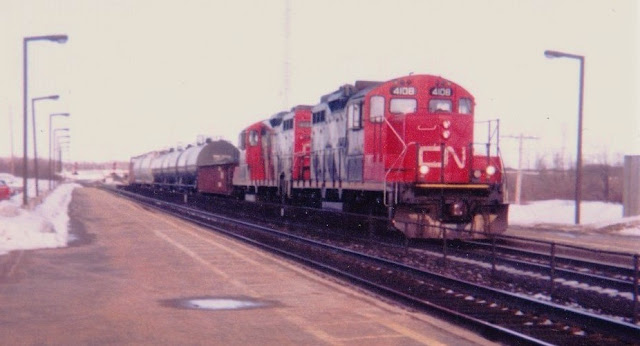
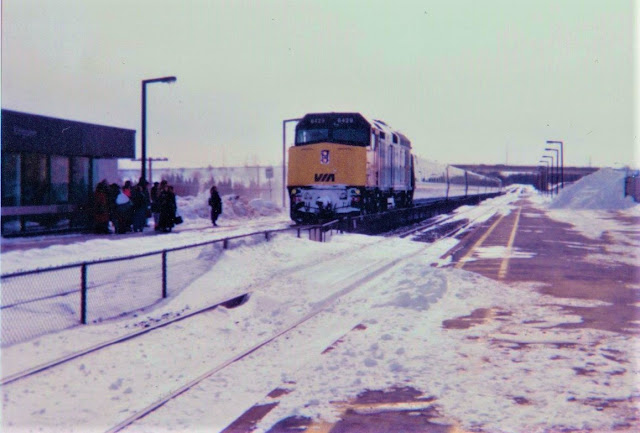
On March 11, 1993 our little family left Kingston aboard VIA No 66 for another visit to snowy Montreal to visit my sister. We were in one of three cars led by VIA 6428 (arriving - top photo. All photos in this post by L.C. Gagnon). While we waited, CN 4108-4123 backed one CN gon and five cars for DuPont plus caboose 79577 east into Queens (below), returning westbound with one CCBX covered hopper for Northern Telecom.

We were in south-facing seats 7-8 and 11-12, so our three year-old was playing 'peekaboo' a lot. There was a two-unit CN freight switching at Brockville, and we passed another eastbound west of Brockville. A tie pickup train was at Morrisburg. At Coteau, CN 7014-7075 (the latter in the CN North America scheme) were switching to the south. We met the outbound Montreal Urban Community Transit Commission (MUCTC) commuter parade: 1313 with 10 single-level cars at 1805; 1312 with 10 cars at 1808; and 1302 with 10 cars at 1812. Arriving in Montreal at 1830, the VIA train to Gaspe was alongside at Central Station

On March 14, having toured the Biodome and witnessed the Battle of Quebec at the Forum, the Cathedral of Hockey, we prepared to board VIA No 65: 6419-six LRC cars-6444 in the same seats, now on the north side, in coach 3321. The Habs had been beaten by the Nordiques, who passed us in the concourse of Central Station, likely on their way to board VIA No 22 to Quebec City. CN centre-cabs 6720, 6712, 6723, 6725, 6726 and 6727, as well as ex-VIA, now commuter coaches, 5452-5541 were on station trackage, as was CN switcher 1298. As we passed Pointe St Charles, CN 7238 was switching, and lots of ex-VIA cab units were in storage awaiting disposition. Some of the American stainless steel cars bought by VIA for its Head End Power program could be seen: one dome, two baggages and two others. Several CN freights were at Turcot: 9401-2107-2004; 9610-2332; 9670; 2028-CN North America (CNNA) 6008. Switching intermodal cars were CN 7067-7073 (CNNA). Passing Dorval at 1247, CP crane 414219, idler flats 301349, 342140 and boom car 421804 were trailed by ex-van work transporter CP 420991.

MUCTC 1301 led single-level coach 801 and gallery cars 926-925-922-900 at 1301. CN had a crane outfit at Caron: crane 50442 with boxcars 43077-545715 and fifty-foot boxcar 556697. Two westbound CN Laser trains were on the north track at Coteau, led by 9634-9633-9661 and 9541-9476-9549. It had taken us 90 minutes to get this far, either due to signal issues and/or accumulated snowfall. We met VIA 6409 with five LRC cars at Cornwall at 1405.

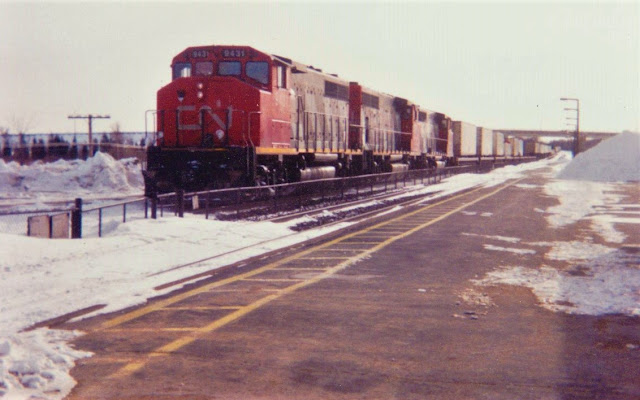
Things got interesting at Brockville, where we were stationary from 1500 to 1530. We pulled into the yard on the south track. VIA No 45 from Ottawa, due out at 1247, was on the north track at the station, going to be joined to our train. First, their crew had to change the knuckle of locomotive 6423. Another VIA train, 6405 with five cars went by, likely No 42 due out at 1359. We met VIA No 64 at 1537 behind 6429 with seven LRC cars and a baggage, then this eastbound CN Laser with 9431-9404-9468: 

The eastbound CN Laser (above) and VIA No 64 (below) that my Dad photographed while waiting for our train to arrive from Montreal. Look at those drifts. Of course he got there a little early to do some trainwatching and photography while waiting to pick us up.

Our J-train arrives with our No 65 leading No 45.
We arrived in Kingston at 1630. I had no time to lose, having to leave Kingston for Toronto that evening aboard VIA No 49. 

Running extra...

Some notable celebrity deaths this week: Louis Anderson, Bob Saget, Betty White and Meat Loaf. A lot of people don't know that early in his career, he shortened his name, the artist formerly known as Meat Pickle N. Pimento Loaf. I've decided that this is not the place to do a lot of entertainment industry commentary. Especially on Meat Loaf. I Would Do Anything not to. It would be Paradise by...well, you get the idea.

Betty White has been lionized due to her long career. Donations made in her name to animal causes were too numerous to cat-alogue. That lack of accounting has been dog-ging me and it doesn't seem fish-y at all. What matters is the total and the fact that many, many, mary tyler more donations might come in yet.

Louie Anderson? Not America's Funniest. Like Gilbert Gottfried, just one octave lower. Bob Saget...no room to comment, as this section is already a full house. Oh well, Two Out of Three Ain't Bad!

Sunday, January 9, 2022

Kingston-Montreal Return Trip, January 1992

In the bleak mid-winter months of early 1992, our little family took a trip to Montreal. My sister Allison lived there at the time. We rode VIA No 64 east, departing Kingston on January 29, 1992. VIA 6445 led four LRC cars and an ex-CP baggage car, departing on time at 1436. We met VIA No 65 Eng 6416 and three cars upon departure. We met a westbound CN Laser train at 1445. 

The CP freight shed and CP tracks at Brockville were gone. There were about 50 cars in the yard at Maitland, with Nitrochem's plant visible to the north. Prescott had empty container flats in the siding. A welded-rail train, an eastbound freight with CN 2417-2104 and a third unit, plus three locomotives and a caboose were all at Crysler at 1600. Cornwall hosted CN boxcar 480841, still proudly emblazoned with CN's maple-leaf herald. CN 4323 and 3563 were among several engines and cabooses at Coteau, at 1630.

We met a westbound LRC train at 1643, then a westbound freight before reaching Dorval. There, Montreal Urban Community Transit Commission (MUCTC) ex-CN GP9u 1312 led 10 single-level coaches westbound. We blew through Turcot at 1708, reaching Central Station at 1724, where GE centre-cab CN 6726 and switcher 1298 idled.

Our tickets to ride:

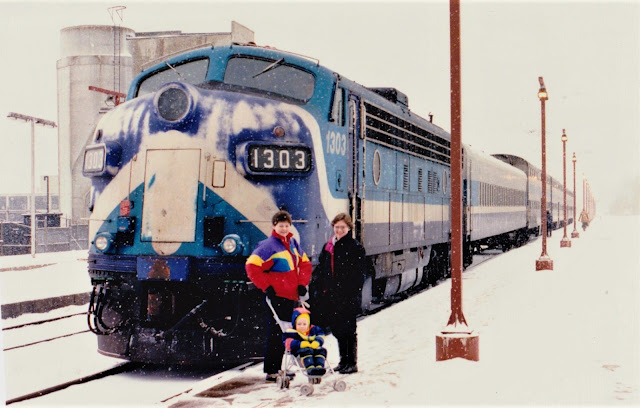
Two days after arriving,, and attending a Canadiens game at the Forum, we bought tickets inside Windsor Station (above) to ride a mid-day MUCTC commuter train to Valois, the site of many family visits to my Grandma's house. We boarded train No 13 at 1000 on the 31st at Windsor Station (top photo). The consist was ex-CP FP7A 1303 and coaches 809-926-921-925-901, the last four being Vickers gallery cars:

Vendome, at 1005, held the following MUCTC equipment: steam generator 601; ex-CP CC&F coaches 839, 804, 830, 832, 815, 826, 829, 833 and 801; Bombardier coaches 703, 729, 702, 706, 705, 708 and ex-CP FP7A 1300. CP archives display cars 80-81 hinted at this being the former CP Glen Yard:
Montreal West station:
During our hour-long layover, we walked through fresh snow to 11 King's Road, also noting a westbound CP freight at 1038: CP 5809-ACR 185-8242-45xx-1847; VIA No 33 to Ottawa at 1106 with  6412-3470-3346-3355-3320; VIA No 63 to Toronto 6438-612-3452-3331-3372-3370 and three more LRC cars. Waiting to board at Valois, we had a stroller but we could have used a sled!
Dashing through the snow:
Boarding MUCTC No 22 to head back downtown at 1130 with the same consist, we passed CP 1602-1689 switching east of Dorval, and we arrived back at Windsor at 1205. Inside the gallery car (A. Gagnon photo), your humble blogger is timetable-in-hand:

Returning to Kingston the next day, our seven-car No 63 waited to depart Central Station, as did an Amtrak Turboliner. This was Amtrak No 26/68 the Adirondack to New York City. An adjacent track held VIA No 33 to Ottawa behind 6418, and ex-VIA, now commuter coaches like 5490. The windows in these cars had been modified, now with small, half-height sliding windows.

Amtrak's Montrealer No 60/623 arrived from New York City at 1015: ATK 357-356-baggage 1159-2892-3109-4740-4606-4001, at the same time we departed. At Cape, one-of-a-kind articulated grain car CN 398000 was on an adjacent spur (below). Several Environmental Mode CN covered hoppers were at Turcot.

We met an eastbound grain train on CP near Valois, then passed several stored MUCTC commuter trains at Dorion. Soulanges Industries at Cedars held ex-VIA cars. We met VIA No 60 just east of Cornwall at 1143. An eastbound freight with CN 9541-exGO 9677-2029-3558-4279 was switching at Brockville, at 1218. We arrived back in Kingston on time at 1300.

Running extra...

Walk from the comfort of your own home! A nice Youtube video using a GoPro TimeWarp feature walking the Rural K&P Trail from south of Highway 401 to north of Jackson's Mills. Then through the high fill and rock cut from Orser Road to Harrowsmith that would fill in with snow, caterpillars and leaves, depending on the season!

It's been great working with local writer Lawrence Scanlan for an upcoming article on Kingston's Hanley Spur in Kingston's own Skeleton Press. We hear a lot about 'local' these days, but here we are putting that in place - local printer, local writer, local books and blogs, modelling local and making local connections!

His name was Luke, not Larry. What I did while waiting for the Cable Guy!

Sunday, January 2, 2022

Planting the Flag - 1980's Modelling in 2022!

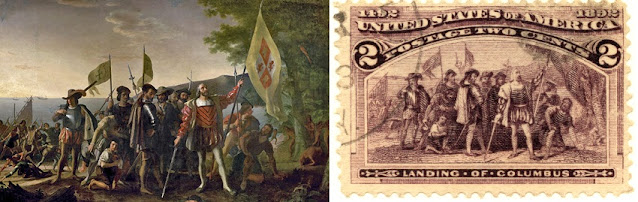
When neoclassicist John Vanderlyn painted The Landing of Columbus, commissioned in 1836 and installed in the U.S. Capitol in 1847, he only had five years left to live (*). His painting shows Columbus raising the royal banner (**) of Aragon and Castile, claiming the land for his Spanish patrons, with his right hand pointing his sword at the earth. Behind Columbus and to his right, the captains of the ships Niña and Pinta carry the banner of King Ferdinand and Queen Isabella, and a friar holds up a metal cross(***). 

ART APPRECIATION OR URBAN DICTIONARY?

Now you're asking yourself, "Has Trackside Treasure suffered mission creep and become an art appreciation blog?" Hard No. Nobody wants that (****). When the United States featured the painting on an 1893 Columbian Exposition stamp issue, the flag was cropped out (*****). Whether journeying from the Old Word to the New World, or landing on the moon, the flag is planted and a claim is made! In fact, the above artful deception included some starred phrases that pertain to model railroading, and I've listed them below:

(*) YOLO = You Only Live Once
(**) PTF = Plant The Flag
(***) FOMO = Fear Of Missing Out
(****) Groupthink
(****) Rule #1 = My Layout, My Rules

IS THIS AN EDITORIAL?

I've occasionally dipped my toe into the swirling tide of editorializing. It is a deep pool, not a wading pool, and it's not really what this blog is about. Trackside Treasure does not represent a clambake, the illuminati, or any other current buzzwords. There is no vaccine (most Googled word of 2021!) against editorializing, however, so for the first time since January, 2020 I'm putting on my water wings and hitting the editorial beach once again. In this post, I described the five phrases above in a modelling context.

PLANTING THE FLAG!

This year, as we reflect on one pandemic period while on the verge of another, I'm focusing on Planting the Flag. That means - where have I planted my modelling flag, and what does my layout represent? It's important to remember that as in football, we can move the flag up and down the field. We can even Capture The Flag! Or Move The Goalposts! Just as a good photographer never shows his bad photos, and a magician never reveals his secrets, I've trashed those maxims, and decided to show you exactly where I've planted my flag in HO scale on my Kingston's Hanley Spur layout room.

1980's TECHNOLOGY

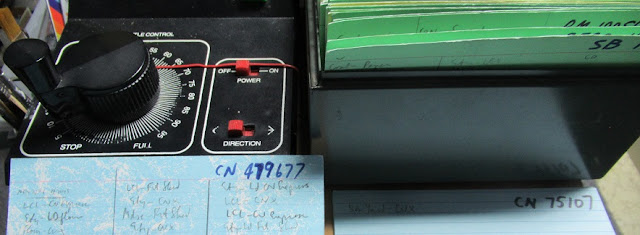
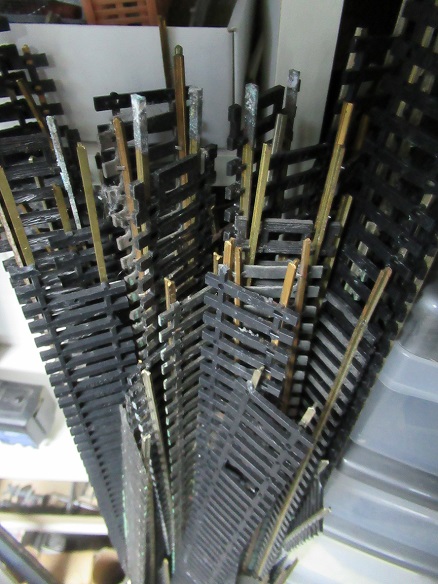
I remember watching one of Chris Lyon's layout-visit videos, where an older gentleman operated his layout with some old rheostat-thingie. He acknowledged it was outdated, but it was already in place and working well, so why not? Hey, I started with an MRC 'golden' transformer, but I now use an MRC Tech II. I operate with DC, not DCC. I use brass track, not even nickel-silver or any particular Code #. My cars have plastic wheels and X2F couplers. I don't use Vallejo acrylics or powdered weathering. I have only a few Super Trees and no static grass. So, by 2022 standards, I have planted my technology flag in 1980.

1970's PROTOYPE

My layout is based on a nominally-1970 prototype in Kingston, Ontario, Canada depicting CN and CP operations serving a sleepy waterfront with dying industries that would be gone within a decade. 

 STATE-OF-THE-ART TECHNOLOGY

Well, that's something I haven't adopted. In fact, that also include late 20th-century developments like switch motors, cork roadbed, four-part car cards, handlaid track, DCC, JMRI, modern throttles, a helix and more. Main reason for not moving the flag? Cost. Deneros. Drachmas I don't need to spend. Besides, what more do I need to really buy? Do I want to update and upgrade my layout to 2022? This is the most scenicked layout iteration I've ever had, so I have little motivation to uproot what I've got. At train shows (remember those?) I rarely bought rolling stock, mainly paper items instead. With freight cars well north of $50, DCC locomotives over $300, vehicles more than $20 a pop, I just can't justify more, more, more due to FOMO. (That's not to say that I don't aspire to, and get inspired by, excellent state-of-the-art modelling by Bob Fallowfield, Matthieu Lachance, Stephen Gardiner and others.

PSSST. IT'S ONLY A MODEL

So, instead of further decrying or describing the above, let's just enjoy a little trip back 40 years to aspects of my layout that graphically show my flag-planting. It's best to end an editorial with a call to action, so here it is, even if the call to action is really to take no action:
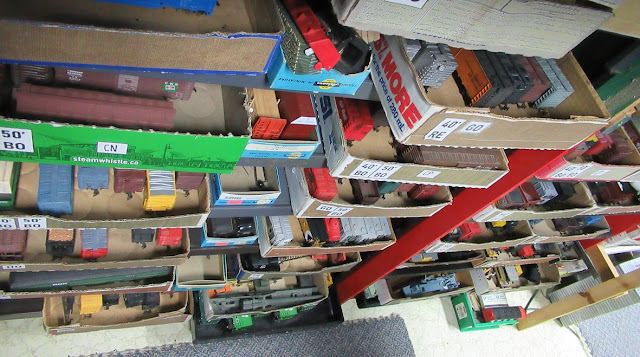
Car storage. Of pop skids 'n' plywood.
Here's the wiring for the whole layout. Concealed under a loading ramp.

Two freight shed tracks and one headed downtown. All end with X2F's.

Operation? It's MRC and file-card car cards for me.
This should keep me on track. Lots of it.

Power pop skid: Atlas and Athearn anachronism.

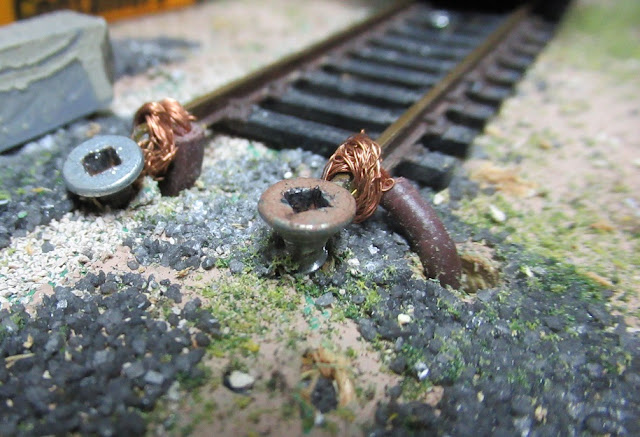
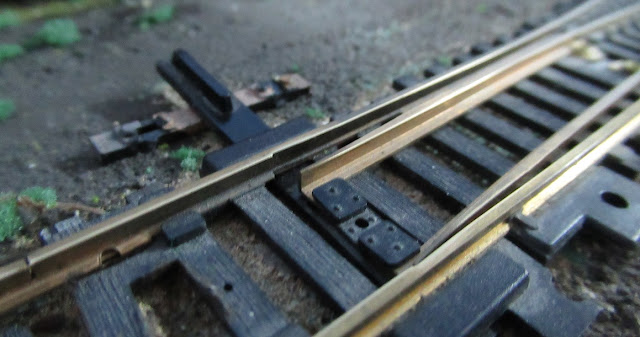
No switch machine. Spare tie holds points in place.
Of parts 'n' pieces. Reduce, reuse, re-coupler. 
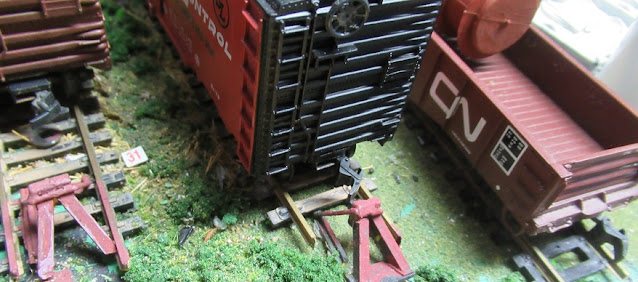
Fibre-tie track and flextrack. Robertson Securement System.
Let's hope 2022 will allow us to stay well, and enjoy our layouts in whatever way, whatever era, and wherever we choose to plant our flags. Oh, and I'm christening 2022 The Year of Optimism!
Running extra...

Fellow blogger Chris Mears got me reading this excellent editorial post about the effect of social media on modelling. 

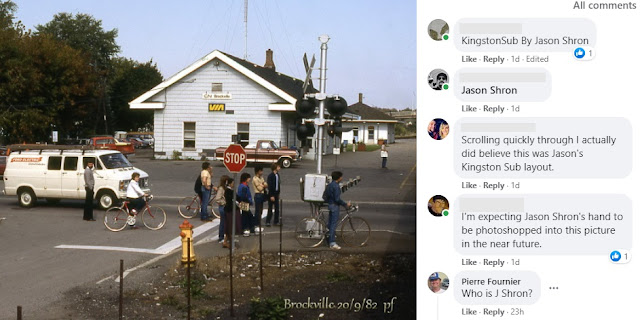
This Pierre Fournier Brockville photo and response gave me a chuckle. This view is associated with Jason Shron's layout, planting the technological flag in 2022 but the prototype flag in 1980!
My optimism to-do list of stories to follow, so far: CNN Films' Carole King/James Taylor concert, Vancouver Canucks' equipment manager melanoma, New Year's babies and Desmond Tutu's legacy.

Tuesday, December 28, 2021

Cataraqui Spur Woods, December 2021

It was Monday, December 20, just a few days before Christmas. Dashing through the snow, with a post-prandial delivery of my books to Kingston's Novel Idea bookstore. I knew there was a good chance that Belleville-Kingston Mon.-Wed.-Fri. turn CN No 518 would be down at the waterfront Invista plant on my way along King Street into King's Town. And it was. Belleville yard power has been GMTX 2323-2284 in December. The power was just leaving the tank track, as the crane for the Utilities Kingston sewer-pumping project loomed above the leasers:
I'd only been up the Cataraqui Spur past the end of King Street West once. This seemed like a good opportunity for a second visit. The Cataraqui Spur runs north toward Bath Road here, with Little Cataraqui Creek wetlands on the west and the Cataraqui Golf & Country Club on the east. The title of this post might turn out to be, "Over the Bridge and Through the Woods, It's Back to Belleville We Go!". A spur to Kingston's grain elevator used to diverge southwest from here. I started seeing ties east of the track:
There used to be a siding/runaround track here, designated KM10, that could be used for storage. Plus the spur to the grain elevator, located on the water south of Front Road/King Street West. Here's a December 30, 1988 view of CN 3640 leading its train up the spur, from the parking area/turnaround off King Street West.
After that train headed north, I walked up to the siding and photographed the 18 ballast cars stored there. The track to the grain elevator, north of King Street West, had been lifted already, and the rails appear to be sitting alongside the siding: 
Back to 2021 and more siding ties:
Sean Skerritt works at the Cataraqui Golf & Country Club, just to the east. After this post was published, he let me know that there was a switchstand extant at the south end of the siding. Still lettered KM10, it bears mute testimony to the existence of the right-of-way. It was likely thought to be too heavy to remove by a salvage crew! Sean kindly shared this photo:
This CN track schematic shows the siding, KM10 running off lead KM01 with the track to DuPont, KM35 heading west. The Cataraqui Spur can be seen heading north across King Street West, towards the top of the photo and its connection to the main line near Gardiners Road:
Removal of the siding left an S-curve where the siding used to join the spur. Also, check out the tele-enhanced dip ahead of that!
Siding sliding through the years, using the City of Kingston's Snapshot Kingston public mapping tool.  Through the ages, the original track arrangement is visible even in 1990. Some cars for (then-)DuPont were on the siding. The two 1990 photos fit together - if you can imagine the south end of the cars meeting the north end in the second slice below:
By 1998, the siding was gone, more visible in the pine-lined 2013 colour photo. Through the trees, I could just see 518 down at the plant pumping air. Another view of the siding ties:
Front Road  runs between the sliver of swamp and the tank cars, note the crane!
Some of the siding turnout ties remained, their snowy, shadowy silhouettes just visible:
The 'braaamp' of an 2323's airhorn announced its arrival. I got 'inside' the S-curve to set up a straight-on approach shot, then a going-away shot. To do so, I got away from the track into some swampside trees. Some of them had been felled by a recent night of strong winds, and there was evidence of recent chainsaw-work to keep the tracks untreed.
Here's the approach shot, with some branches near the branchline:
Going through the S-curve:
Here's a Youtube video I snagged between coming and going.
I perched on three not-so-sturdy felled trees. I was a sure-footed as a snake on stilts!
All empties:
The tail-end heads towards apartments along Bath Road:
Another grey area:
Walking back to my parking spot, I noted rail-wear on the curve. The cars would be lucky to have more than a loonie's-width of contact with the outside rail:
Moreso on the rail on the inside of the curve:
With that, the train would gain the Kingston Sub mainline and head west to Belleville. I was heading east!

Running extra...

Hoping you had a good Christmas, 
and that you can see your way clear to be optimistic about 2022! 
The change of year is always a time of looking forward and looking back.
--Eric
We bid a somewhat-fond farewell to the tail-end of 2021!