Saturday, December 9, 2017

Rutland's Howe Scale Co. Building

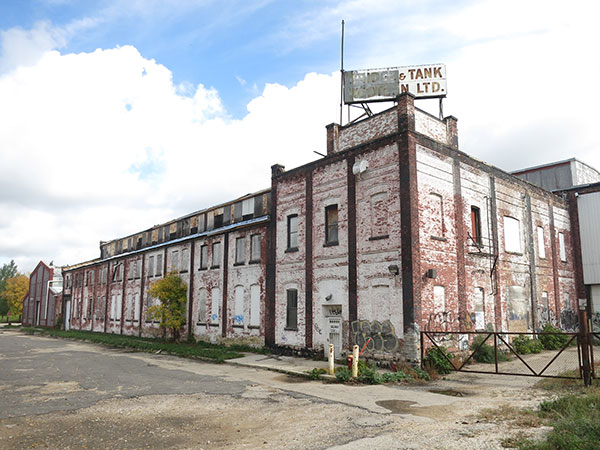
Even before I decided to model Vermont, one signature scene that just had to be included was this view taken from the State Street overpass in Rutland, Vermont. Rutland Railroad's interchange with Delaware & Hudson encompassed the 18-acre Howe Scale property and that large, trackside building (red arrow in top photo) always caught my eye. This well-known company produced large and small scales for years: track scales, coal tipple scales, kitchen scales, even physician's office scales. The Howe Scale complex was the backdrop to generations of neat photographed scenes that I'd admired over the years, perhaps to reproduce in HO scale...someday. Or as I call it, right now.
My Howe Scale building was going to be just like the prototype. Except for two things...it wasn't exactly the same, and it was going to be almost completely different*. I wanted to recycle two buildings that had each been used previously. The nearest was an enginehouse that I'd made into Winnipeg's Vulcan Iron Works (foreground); the other half was a Canadian National Express building (background) from Winnipeg's East Yard. Both had seen service on the Vancouver incarnation of my layout (as Dominion Bridge and Overseas Commodities, respectively).
*The prototype is of wooden construction, with shingled roof. My pre-existing buildings were brick, and would have metal roofing. I worked from photos of Howe Scale to add additional height to the two multi-storey parts of the model. The Howe Scale complex was so large that it had a vehicle entrance under the distant four-storey part of the building. Also, the building at left of the top view was the Howe Scale office building - across the tracks. I left it out of my scene because I didn't want to draw attention to my green, lichen-lined backdrop.
This was brick sheet on additional storey styrene. I had absolutely no intention to cut holes in the walls and fit expensive plastic windows in them. Instead, I would keep the walls as they were. I painted them to match the pre-existing structures.
The never-in-view angled end of the Express building was an asset (below). The track curving at the layout from the curve at the end of the Rutland trackage needed to pass around the building. The additional height would give the illusion of the building end being rectangular, when it was actually angled. Repainting was not necessary on this out-of-sight end.
The former Express building had it styrene roof removed. I added two spare enginehouse roofs to match the rofline on other half of the building. Those blue Pikestuff buildings on the horizon are Mintzer Brothers, located on nearby Strongs Street. Side views - before adding additional storeys:
 Additional storeys added and painted:
Windows added - taken from the catalogue of Caldbeck-Cosgrove Corporation - a building supplies manufacturer that was situated in St Johnsbury, Vermont! I 'copied/pasted' the window images, into  photo-editing software, darkened them, then printed, cut out and pasted. Voila!
An oblique view. Initially painting the brick buildings fairly bright blue, I toned down the colour by brushing on a wash of black paint thinned with water. The D&H interchange trackage is in foreground. It adds another loop of trackage on my layout, as well as providing up to three tracks for interchange, one being a spur and the nearest one a switching lead to three industries. Pre-window view:
This huge structure may not actually generate any traffic by shipping out anything in my modelled era. I mainly want it to be a backdrop to the operations around it. If I really want to, I can spot a boxcar or two on one of the three tracks that run behind it. In later years, the prototype track nearest the building housed stored snow-fighting equipment and other OCS cars. Closed in 1982, the Howe Scale complex was purchased and re-purposed to house 75 offices and small manufacturers. It's now marketed as the Howe Center with the mailing address of 1 Scale Avenue. A 'vintage' view with windows and near-end loading dock doors added:
The three ex-Rutland, now Vermont Railway System tracks disappear into the distance. I need to add the treed mountain backdrop. The Howe Scale Co offices are in the treed bank at left, then three through/interchange tracks, then the stored snow-fighting equipment is visible. Check out that track scale on the left-hand track. Wonder where it was built? Haven't added the rooftop gabled/dormered windows yet. D&H switches the interchange in this prototype view:
Colour view (below). I will be re-doing the backdrop above the mirror. Fun fact - the tracks holding the grey covered hoppers are dummy tracks. The through tracks curve to right behind Howe Scale, under that building overhang as shown above!
Some historical photos show lettering on the plant. I printed out some fonts, found one I liked and traced it on with carbon paper. Then I went over it with a fine black marker and weathered it in. Smokestack is now painted and will also receive vertical 'H O W E' lettering. Round smokestack will have to do till I come across (or build!) a square smokestack to match the prototype.

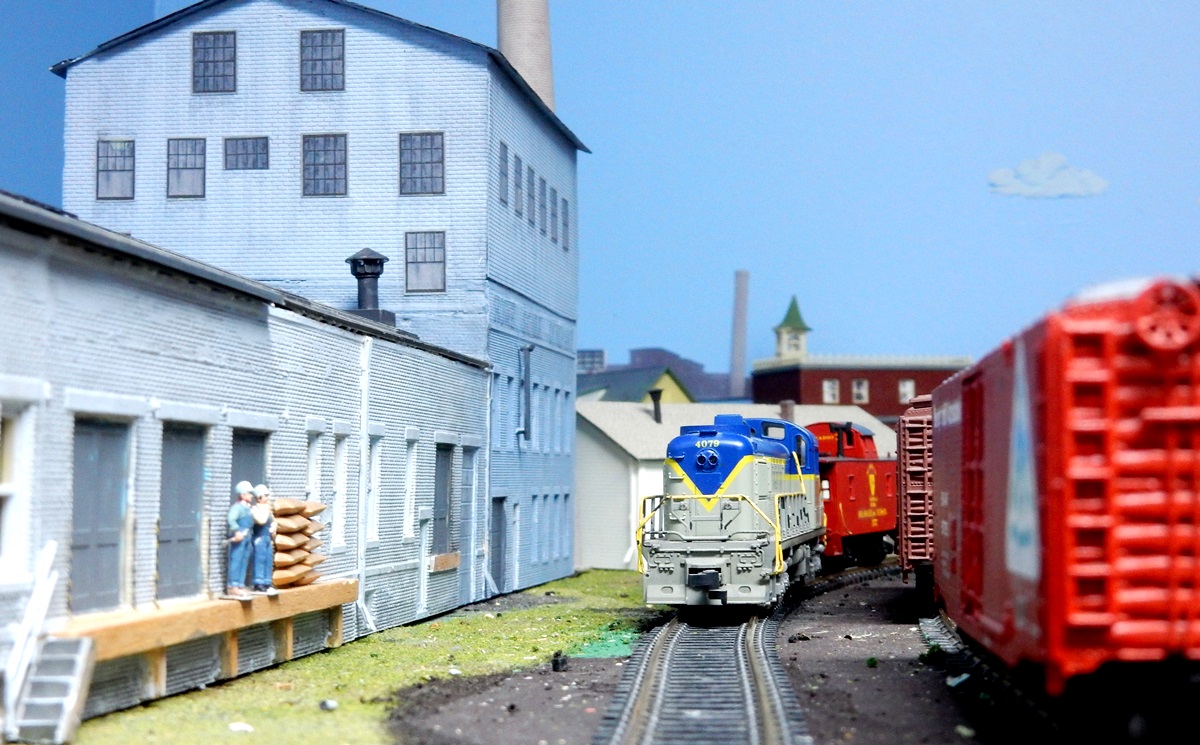
D&H caboose hop arrives, passing Howe via their interchange and going over to the Rutland interchange:
A bit of scenicking, trying to make the building blend in to the scene:

Another building now in place: the Rutland Tallow Co. I moved the painted-on-brick sign over to the track side:
Most of those classic Howe Scale photos were taken from the State Street overpass which I've added just to the left of the above view. Not wanting an 'overpass to oblivion', I've modelled the ends of the overpass into the surrounding scenery. Handy site for photographing the modelled prototype scene at Rutland, just the photographers who snapped photos that have inspired me for years!

Running extra...

Portage modeller and graphics guru took a cover mockup of my fall and winter project and added the tag line from each blog post. (Click the link to exercise your democratic rights to vote in the poll.) Hey, if you're standing right beside a grain elevator, you look up! And I look up (and forward) to Randy and his creations that come my way!
Since I have a lot of the writing and organizing of observations done for the book, over the Christmas holidays it's time to work on photo selection and editing. That sounds like a daunting, but very enjoyable part of the project! At that point, I'll be looking down. To the table, as I move the photos around and try to include a good mix of photos for the ten or so people that will 'get' this book.

I'll still have time to take in some TV Christmas specials. Pentatonix' special was OK this year, CMA Country Christmas was better with Jennifer Nettles than Reba, and Rockefeller Center tree-lighting had a platoon, if not the whole company of Rockettes. Looking forward to Christmas with the Mormon Tabernacle Choir! This year, hosted by Gloria N. Excel and her sister Dayo. You know her, Gloria N. Excel's sis Dayo?!

Saturday, December 2, 2017

Kingston-Portage la Prairie aboard VIA, 1981

On August 22, 1981 I departed Kingston aboard the morning RDC run to Toronto to begin a trip to Portage la Prairie, MB to visit relatives and of course, to watch trains. On this trip I would head west from Toronto on CN lines, as I had previously in 1978, returning east on CP lines from Calgary. As usual, I made notes on the scenery and activities observed trackside, using a log book I'd prepared with station names, subdivisions, mileages and dates prior to my trip, as well as my usual consists and numbers with pencil and notepad.

Rising at an early 0520, I boarded the waiting RDC consist at 0646, settling in window-seat 2 in VIA-painted RDC-1 6116. Anticipating a busy run, VIA had also assigned 6003-6135-6356 behind 6116, for a solid four-Railiner brace. Family members were trackside at Mi 182 to wave me off westward. Down six minutes at after crossing to the south track at Ernestown for our stop in Napanee, it was back to the north track, now ten minutes late into Belleville. We met an eastbound VIA train behind a VIA-painted FPA4 and striped CN RS18, arriving at Coboug 20 minutes late, with end-cupola wooden caboose CN 78245 on a yard track. Bear in mind this was track-work season on the busy, double-track CN Kingston Sub. We would stay 20 minutes late all the way into Toronto. I noted culverts stamped with the years 1912 and 1925 while paralleling CP's Belleville Sub. Our train was on the north track for our Oshawa stop. Being the eighties, Oshawa yard was still full of a plethora of brightly-coloured 86-foot auto boxcars: GT, CR, ATSF, PC, Southern, SP, MP, IC, C&EI as well as auto racks from many of the same US railroads.

Having 12+ hours' layover in Toronto, I made the usual stop at CN's Spadina shops to check out VIA motive power as well as passing trains: 7 MLW and 9 GM passenger units, 2 CN passenger Geeps, 7 CN RS-18's, 21 RDC's and a host of CN switcher-led consists, as well as Amtrak, Ontario Northland and GO equipment in the afternoon and evening. CP switchers bustled about with transfers and industrial-switching assignments, including CP C-424 4203 with 15 flat cars and vans 437076, 436991, 437229, 436993, 438591, 438536 and 437124. Boarding VIA No 3 at 2245, I continued watching inbound VIA trains. Prior to departure, I made a point of walking the entire length of the train to get the complete ex-CN consist: 6510-6606-6628-9663-Iroquois-5441-5500-761-5723-5725-Enterprise-Evangeline-Green Lane-1354-Reverie-Elliston-Ernestown-Eastport-9480. I travelled in Ernestown's roomette 8. The overnight Cavalier was also in the station: 6775-9613-5425-5226-5494-3024-108-Fortune Bay-Chateau Latour.

Our locomotives were being refuelled the next morning in Capreol and I went up to the head-end just in time to see them being coupled on to our train. We departed Capreol at 0835 and I stayed in the vestibule of Eastport which was now the last car, baggage-coach 9480 having been set off in Capreol. This was not to last - a barely-English-speaking porter spotted me and ended my Dutch door reverie 14 miles out of Capreol (top photo). We met two eastbound CN 3-unit, 80+ car freight trains between Capreol and Laforest, ON led by CN 9595-9404-9622 and 9419-9648-9563. Napped through a rainy Gogama.

The day was spent traversing northern Ontario's wilderness. The first sitting at 1215 - a good lunch and such good service that I noted 'everything was served slightly prematurely' but the waiter still received a princely 25-cent tip! Hornepayne was another refuelling stop (three photos - below), taking up 30 minutes before our departure at 1720, about 45 minutes late. The town's Hudson's Bay store, coaling tower and assortment of CN work equipment in the yard was on display. A long string of boarding cars, a concrete-tie-laying machine and a one-unit Jordan spreader/ballast car work train were on sidings. Interestingly, CN wooden end-cupola cabooses were in use: 79146 at Capreol, 78362, 75885, 78781, 78501 at Hornepayne and 78491 at Nakina. CN GP9 4569 was switching Longlac. At Armstrong we were 40 minutes late, departing at 2345. The Hornepayne Auxiliary train was moving cars around, including two smashed piggyback trailers on flat cars. 
CN 9521-9587 led an eastbound drag that was being serviced at Hornepayne (above)
 Head-end and tail-end views at Hornepayne
On August 24, our 0700 arrival at Minaki saw us 90 minutes late. Throughout the morning we made up some time, arriving 45 minutes late into Winnipeg at 0902. Of course this trip involved some Portage la Prairie trainwatching. VIA's Canadian and Super Continental as well as VIA No 90 from Thompson behind VIA 6506 on August 28:
Travelling to Calgary by car thence a return trip to Edmonton by RDC, it was now time to head back east in roomette 4 of Butler Manor. Fast-forward to September 3, boarding at Calgary at 2349 during the hour-long stop from 2323-0023. I noted that the station was 'very nice but a bit small'. Also noted 'CP cars mch better engineered than CN's, though the beds are smaller'. No 2 was well over 2 hours late. I was able to walk the train for the train's entire consist: 1407-CP 8516-1898-604-Innes-109-113-3218-512-5711-5746-Butler Manor-Osler Manor-Emerald-Wolfe Manor-Erwood-Elgin-Elderbank-Strathcona Park. 

CP 8634, one of the early 'chop-nose' (actually a replacement short hood) units was one of many CP Geeps working Calgary's yards east of downtown, as were many CP wooden end-cupola vans: 437182, 436985, and 436988. Waking up around Gull Lake, SK I headed back to Strathcona Park. Now we were operating three hours late. East of Moose Jaw, the dome was about two-thirds full. There were derailed boxcars, without trucks, at Qu'Appelle. The station at Indian Head was boarded up. CP was loading scrap into an eastward-facing train using two cranes near Wolseley, SK. Elevator workers came out at Grenfell to watch our train pass at 1213. 

Now two hours down at Broadview, we met a CP westbound with units 5969-4510-4217. Grain elevators were lettered for Parrish & Heimbecker, Cargill, United Grain Growers, Inter-Ocean Grain, Federal, Paterson and Sask Pool. Farm implement dealerships and fertilizer dealers also marked each town. Many towns rated three elevators, though Grenfell and Whitewood each rated five. Crossing into Manitoba just before 1300, we were miraculously only one hour late. Near Griswold, there was another of CP's unique hotbox detectors, and a CP track patrol started to push their speeder back onto the track immediately after our train passed. At Brandon, only five passengers were in the dome. Passing through Virden at 1408 on September 4:
The harvest was underway, and we passed large combining gangs working the fields as well as combines in transit on adjacent roads. We met our westbound counterpart just east of Austin: three locomotives and 15 cars. Gaining CN rails at Portage la Prairie, we met a westbound CN train of potash covered hoppers. Now on time, we actually had to wait five minutes to let our schedule catch up to us! I occupied the vestibule from the Portage station to East Tower to see my railfanning haunts from aboard the train, instead of trackside. VIA 1898 our third unit from Calgary to Sudbury. Here is one of Canada's two E-8's during our Winnipeg layover:
Arrival at Winnipeg was right on the advertised, and after our two-and-a-half hour layover, our departure at 2030 would be on time as well. Our three E-series sleepers were exchanged for three CP sleepers at Winnipeg, as was our diner: Emerald for Annapolis. Ex-CN power was evident: 6504-6603-CN 4104. We departed only after the loud, perfunctory public address system salutations which emanated from track-level loudspeakers: "Attention! VIA train No 2 heading eastward. Would all porters close vestibule doors! Conductor on train No 2! Your train is OK! All aboard!" We were now a pure stainless steel consist, save two Dayniters, with the same three CP engines still leading us.

Departing on time, we travelled through the maze of large interlockings and diamonds to reach CP rails. Meeting a three-unit hotshot west of Ingolf, we soon stopped for two minutes at Ingolf near its picturesque inn and bay. A wry line in my notes pertains to the urban non-sprawl of Kenora: 'reached outskirts of town 2325. Reached inskirts 2328.'

The morning of September 5 began at Thunder Bay, 30 minutes late. Brand-new orange-gold-brown Saskatchewan SKPX covered hoppers lined the tracks as brand-new bright blue ALPX cars had in Calgary. CN GMD-1's 1916, 1912, 1909, 1914 and 1915 hustled about. Three 'salties' waited in the harbour to load grain, while Algoma Central Marine V.W. Scully was tied up; lakers T.R. McLagan and George M. Carl were at Port Arthur Shipbuilders. Near Red Rock, ON we met a westbound three-unit CP freight carrying cars of Stelco pipe, then we scooped an eastbound work train, stationary track machines and strings of wood chip cars before meeting a CP autorack train at Nipigon. It was a thrill to ride through the tunnel two miles east of Cavers in the vestibule, and again at Schreiber, where the national flag, Ontario flag and CP Rail flags flew from the station. Sharp curve east of Jackfish:
A big meal in diner Annapolis left me 'thoroughly stuffed'. Probably could've done without the butterscotch sundae! The 415-foot, 1974-built tanker Leon Simard was at the dock in Marathon, ON. I'd seen this vessel in late August at the dock in Millhaven, just west of Kingston. An afternoon nap ended at White River, where two CP units were switching paper cars. The steward came through at 1530 to make dining car reservations for dinner. We passed the Algoma Central-CP diamond and interchange at Franz an hour late, where I noted 'new CP sidings'.

At Dalton, a rusting Plymouth locomotive on a short segment of disused track and another locomotive in a ramshackle, tin-clad engine house were visible. These likely marked the site of the former interchange between the three-mile narrow-gauge railway linking the lumber operation at Dalton Mills on the Skikwamkwa River to the CP main line. In the 1920's, this was the largest lumber yard in northern Ontario. At Wayland, we took the siding for a westbound CP freight which held the main, and CP 6014-5720 were in the siding with a single box car and a van. 

Chapleau yard hosted wood chip cars, the auxiliary train with all its cars in a 'brand new paint job', an eastbound four-unit freight behind 4553-5572-5799-5964 with piggyback traffic, and four wrecked cars: a flat car with a damaged deck and three crushed CP script reefers without doors, each revealing McCain Foods products. In an attempt to make up time, we were doing 65 mph out of Chapleau before 'cooling down to 60'. Bingo in the dining car around Cartier included some fiercely-competitive passengers. At Sudbury, a westbound CP freight included 14 cars of Stelco pipe on the head-end. The Sudbury van track held ten vans, only the last two centre-cupola: 434028-434033-434026-434030-434063-434027-434044-434025-434597-434728. Only 40 minutes late, I got some fresh air on the platform while new power 6542-6633 was placed on our head-end.
A rainy, overnight run put us into Carleton Place, ON on time at 0650. The interesting track arrangement between CP's Chalk River and Carleton Place Subdivisions hosted a CP freight with units 5953-4226-5016. Pulling into Ottawa, we met CP Dayliner 9066, perhaps headingfor CP's Lachute Subdivision. I also took a walk to the head-end (above) at Ottawa - this was the only time I'd travel from west to east through Ottawa aboard VIA. The red-and-white Discovery Train consist was parked across from the station. 

We continued to Montreal on CP's M&O Subdivision, on time at Vankleek Hill and five minutes late reaching Rigaud, the latter featuring a large Catholic cathedral, Depanneur Laberge, a wye, CP single-level and gallery car commuter consists.  We hit 73 mph before Hudson, where there was a large CP station and Studebaker service shop! At Vaudreuil, four commuter trains were lined up behind CP F-units 4040, 4070, 4075 and 4072, along with a CP snowplow and Burro crane outfit.

Parallelling the CN mainline, we were doing 60 mph at Beaconsfield, meeting a four-car VIA train led by 6532 at 0955 and a two-car train at Dorval. We passed two New Jersey Transit coach buses on the parallel highway before backing up 'about a mile' at 30 mph onto the CN at Dorval. We stopped on CN's north track at Dorval before continuing east for an on-time 1030 arrival. A two-hour layover in Montreal preceded boarding my train to Kingston Imagine my surprise - reading in my notes that I travelled in exx-Reading Crusader car 303, occupying seat 26. Now knowing how rare these ex-CN cars were, I should have expended more film during my ride! Heading west now at Dorval, we also made this station stop on the north track, soon hitting 83 mph at Ste Anne's, QC.

At Coteau, we met an eastbound passenger train and passed several CN MLW units and cabooses: 76603, 79700, 79638 and 79879. Tracks at Regis were full of CNIS and DWC International Service bulkhead flat cars. Meets were plentiful this day on CN's busy Kingston Subdivision. On time at Cornwall, we met an eastbound VIA train, then an eastbound three-unit CN freight just east of Brockville. Another eastbound VIA west of Brockville had two units and seven cars. Then an eastbound four-unit CN freight at Mallorytown, . An eastbound local freight passed by just east of Kingston, perhaps CN Toronto-Montreal No 318 pulled by 2517-3240-3707-1310. We paralleled Highway 401 doing 90 mph for an on-time arrival back in Kingston. 


Massive cuts to VIA's network loomed, taking effect a scant two months after my trip. I was indeed fortunate to experience this CN-out, CP-back routing while it was still provided by VIA.

Running extra...

It's taken a while to get some of these 1980's trips aboard VIA Rail documented. Guess Im a slow starter! But finally, finally, 36 years later, here we are. This is the value of book and other projects that force me to properly document notes and scan photo prints. Check the top of my right sidebar for my fall & winter project. Predicted to appeal to ten people, the number is now up to over thirteen! Can sixteen be far off?

Arctic Crossing is a unique two-person show featuring Canada's Susan Aglukark and Survivorman Les Stroud. Highlighting some visuals of wild country and proud people, both performers sang and spoke of our Arctic wilderness and its effect on them as artists. Susan is humble and soft-spoken, though a powerful singer. Les is energetic and used to have hair. He plays a mean harmonica and a powerful acoustic guitar. Recommended!

Friday, November 24, 2017

Sask Pool in Stranraer, Part 2

In Part 1, I rolled up on the Saskatchewan Wheat Pool elevator in Stranraer. The elevator agent kindly gave the run of the place! Having joined him atop a 'Coke can' car he was loading, I made it down to the driveshed floor. Grease gun, tools, bin diagram and signage are all in their proper places:
The data management centre and scale:
A second farmer arrives to unload. This farmer was older, though his truck was younger! The agent again samples the grain by letting it run through his hand:
Business done, but it continues in the office. The farmer lights up a cigarette. He was a man of few words. Check out the coffee/refreshment area on that white table:
Down in the valley - Stranraer's remaining elevator, the four loaded cars and the one the agent was working on. Notice evidence of tie replacement:
Stranraer's valley location was shown in this newspaper photo. CP work train is in town:
Stranraer by satellite...look at those chiselled river valleys:
Postcards home. The postmistress in the cabin-like post office must have wondered.
Links:
Famed photographer of trains and the Prairie scene Chuck Bohi shared a photo of Stranraer's school. Chuck visited the village in August, 1980 and noted its unique valley location. Ah, the inexorable nexus of transportation and geography! Note elevators in the background:

Running extra...
Stranraer will be one of many locations profiled in my upcoming Trains and Grains project. As the title suggests, it will be a mix of...trains and grains. Due out next spring, I'm spending this fall and winter putting the pieces together. Be sure to check the Trains and Grains blog every so often, right at the top of the right sidebar! I'll be drumming up interest in the blog (photo, above) for the ten folks that will be interested in this project.

American Thanksgiving Thursday, Black Friday, Small Business Saturday, Cyber Monday...Time-out Tuesday. This weekend will be a blur for most. We did our bit to keep the economy going, sure. But why not stay home and work on my Green Mountain Lines when not practising retail therapy? Latest addition to my HO scale layout was the repainting of my green Beaver Lumber into Vermont's Allen Lumber Company: 


Saturday, November 18, 2017

Sask Pool in Stranraer, Part 1

While driving the backroads of Saskatchewan in 1986, I decided I would drop in to an elevator. It occurred to me at the time that these wooden classics would not always be accessible. I pointed my Saskatoon rental car northwest from my second overnight stop at Rosetown.

Stranraer - its name just had a neat ring to it. It's named after a town in Scotland. Fun fact: the Supermarine Stranraer was a British pre-war flying boat! Stranraer still boasted three Sask Pool plants in the 1978-79 crop year - of  2470, 1820 and 1310 tonnes capacity. Located at Mi. 69.5 of CP's Kerrobert Subdivision, about 15 miles from the also-interestingly-named Druid. If there were Druids in this part of Saskatchewan, they'd have a challenge finding trees to worship!

Anyway, I'd never done this before - let's see and photograph the inner workings! The agent was busy receiving and shipping grain - four brown and yellow Government of Canada cars were already loaded, and he was working on a fifth - a red Coke can car! But he was not too busy to allow me the run of the place while he was working! 
A young farmer drove a classic grain truck into the drive shed and started unloading. He chatted with the agent as the grain flowed. Grabbing a handy bucket, the agent did an initial test. Look at that 'air-conditioned' trucker cap!
The farmer shovels out the last of the load:
After the farmer left, the agent headed out the front of the elevator, trackside. Ascending the latter to the top of the Coke can car, he manoeuvered the loading spout and more grain started flowing!
Joining him atop the car, he noted the danger of falling in! Remember, he would normally be working alone with no safety harness, no personal protective equipment except for steel-toed boots, and in the pre-cellphone era!
Back inside, I wandered around snapping some photos. Here is the main leg, with bin selector wheel:
To load the car, the agent filled the hopper with several hundred pounds of grain, weighing and recording each hopperload. Then he pulled the handle, releasing it downwards by gravity to the pit below, where it was elevated and directed out the car loading spout.
Another view from below. Note the trouble light and bin access hatches:
Looking up to the 'attic' of the drive shed, it looked like a logical place to climb to next:
This vantage point allowed me to get photos down to the drive shed floor, including the work desk and weigh scale at left:
Similar view from the drive shed floor. Let's just take in the myriad details in this view:
In Part 2, I'll complete the Stranraer elevator tour with some exterior views and an update.

Running extra...

Train and Grains. What could be more Canadian? Have you heard about my upcoming project dealing with these two iconic Canadian symbols? Probably not. It's at the very top of the sidebar at right. It's kind of hidden there, though. Perhaps you scrolled right past it. I've been keeping the project quiet. Shhhhhhhh. I'm not really sure what it's going to become. Don't tell anyone about it. There are probably only ten people who are interested in it. Oh, maybe 11 now!
Well it's about time Jeopardy host Alex Trebek received the Order of Canada. What can be more Canadian than a game show host wearing a CANADA 150 jersey? Alex hosted the Tournament of Champions this week, as Buzzy Cohen, New York music executive garnered $250,000 in prize money. What is...a lot of money? Governor-General Julie Payette did the honours at Rideau Hall. I'll bet they shared a few potent potables and maybe some potpourri!