Friday, August 27, 2010

Rail Changeout Unit: New rail for Old


Tamper/Canron's Rail Changeout Unit was a $2 million, 221-foot long, 170-ton beast used to replace jointed rail with welded rail in the early 1980's. Based on the P-811 concrete tie replacement machine, CN operated 505-51 and one other RCO, while CP had RCU 5001-01. The RCO and accompanying track machines were spotted for the weekend at Kings, Mi 162 Kingston Sub in April, 1985. The first section power car rides on the old jointed rail (above), and the second cantilevered section support six work stations suspended above the ties. The unspiked jointed rail is moved aside for the tieplate magnets pickup rollers , spike hole plugger, and sweeper:

The welded rail is threaded in after the adzers prepare new tie surfaces and creosote is sprayed onto the new surface:

The plate dropper deposits new tie plates via lower conveyer from one of the supply gondolas, which also receive the old tie plates via upper conveyors:

The third section rolls on the new welded rail, which is lightly spiked to hold the gauge:

The upper and lower conveyors handle tieplates from the orange, formerly brown supply gondolas following the RCO. Track machines work ahead and behind, including Speed Swings, spike pullers, rail heater, spikers and speeders in the years before hi-rail trucks.


On May 4, the RCO is being pulled east through Queens at Mi 175 after a day's work, by 1329 and caboose, along with its flat car for supplies, former baggage car now workshop 70783, and conveyor-equipped gondolas such as 90576 and 90625:


Once tucked away in the former Hanley spur, just off the mainline, a crane operator will go to work removing old tie plates and dropping into other waiting gondola cars. The RCO train also included 4 to 6 more gons, another caboose and two tank cars of fuel.


On a drizzly day in May, the RCO is working near Mi 179, pushing a flatcar ahead of it upon which four sectionmen throw spikes after they've been pulled. 1329 and caboose 'shadow' the RCO at far right:
A foreman talks on the radio while he monitors the tie preparation, threading out of the old rail and threading in of the new rail:

Working at 1500 to 2000 feet per hour, the RCO's crew of 100 could replace up to three miles of rail a day, surely one of the biggest production gangs of its day. Now that wholesale installation of welded rail is complete, short lengths of welded rail are replaced by regional steel gangs as needed. At least one of the CN power units is operating independently as propulsion for CN's TEST train. Most of the RCO was cut up at Transcona after being contracted by Harsco to Metro North in New York possibly in the 1990s.

Here's a link to a nice selection of RCO photos from CN's Halton Sub in 1982.


Running extra...

A round trip to Toronto one week ago aboard VIA train 651 (the coffee was hot) and train 48 (the Sleeman cold and the pretzels fresh). Scooped a westbound CP freight at Brighton with pure SD40-2 power consist: 5765-5773 Dual Flags scheme-6020. Gondola THB 2674 tagged along with numerous CP gons in the train.

Schnabel car CEBX 800 finally departed Toronto for Kansas with a gigantic Hooper Welding load aboard CN train 915 Eng 5528. Walter Pfefferle posted some excellent stills of the consist here, and Crazeejay posted a video of the train in sumacs at Strathroy here. Schnabel, loosely translated from German to English is "frickin' humongous".

Make sure to visit my brother's new Tumblr site Selling Canada (see link in sidebar) for Canadian history you never knew. Jack Granatstein asked Who Killed Canadian History? in his 1998 book title. Well, Dave is definitely applying the paddles and attempting to resuscitate it.

Thursday, August 19, 2010

Postscript: Trackside Treasure Second Anniversary

Thanks to everyone who tried rail-ly hard to track down the correct answer to Trackside Treasure's second anniversary contest skill-testing question. Elijah from Saskatchewan sent in the first correct answer and associated research, and wins the prize pack. Pictured above: Canron's Rail Change Out unit (RCO). Congratulations, Elijah!

Honourable mentions go to: Robert from Washington-Canion/Tie Cranes, Bryan from California, with the most possible (and most hilariously arrived-at) answers, and even my sister, who by osmosis has apparently amassed a surprising amount of railway knowledge, allowing her to come up with the right answer. Sis, I'm no nepotist, but this one's for you: a CP blog. (Spoiler alert: it's not the same CP you might expect me to link to.)

Watch for an upcoming post on the RCO. Indeed a clever collection of readers and guessers. Weld Done!

Wednesday, August 18, 2010

Trackside Treasure Second Anniversary

Two years ago, I gathered together photos and notes I'd taken over the previous 32 years and called them Trackside Treasure. Alliterative, yes. A catchy title, maybe, but has this blog proven to be interesting and informative? As a reader, I'll let you be the judge.

Looking back retrospectively from the Skyline toward the Park car over the past two years, we can also look forward from the locomotive cab to see the track ahead for this little corner of cyberspace.

Over 40 readers and searchers visit each day. Your comments contribute to what I've posted and keep the blog interactive. Posts have been picked up by Trainorders.com, Runningtrades.com, Railfans.ca, Rapido Trains' Telegraph newsletter, and even US-Modellbahn.net, a model railroad forum in Germany. Blog and web partners Steve, Robert, John, Scott, Dave, Matt, Chris, Byron and Jason link to my blog and vice versa. In nearly 100 posts, I've found the reminiscing, research, writing, scanning and template design for Trackside Treasure engrossing and enlivening.
Any chance I'll run out of material? That'll be a frosty Friday in February . There are dozens of potential posts percolating, with new ones being hatched hourly. I know there are better photographers and writers out there, but I'm going to continue unearthing the story of Canadian railroading as I've seen it play out in front of my camera lens and coach window.
And now to our annual contest. To win the somewhat-coveted Trackside Treasure prize pack, the first correct answer by email to mile179kingstonATyahooDOTca, or as a comment to this post wins. The question? In six easy steps:

1. The first three letters of the named train in the first photo.
2. The second initial of the Canadian-designed passenger train in the second photo.
3. The first two letters of the the reporting marks of the railway shown in the third photo.
4. Add them all together to make a six-letter word.
5. Take the fourth, first and fifth letters from the word in step 4 to form a three-letter word.
6. The correct answer is a nine-letter, two-word name of a piece of CN maintenance equipment to be featured in an upcoming post.

Good luck and as always, thanks for stopping by,
Eric

Thursday, August 12, 2010

Vestibule View of Calgary, 1986

VIA No 1 has arrived at Calgary's Palliser Square station. At 1730, a third unit is being added before the train enters the foothills of the Rockies. Ex-CP 6651 is getting lots of attention from the white hats at the station. 6308-6614 have been fuelled and all three will soon head west on this overcast afternoon in May 1986. I was able to document our progress past Ogden Shops, Alyth Yard and into beautiful downtown Cowtown from an open Dutch door.
Painted on the end of the Power House: "Even one accident is too many". The Air Brake Shop is sans slogan, and the Locomotive Department tells us "Think, don't take chances". Brightly-painted safety slogan tank cars, three SD's, one switcher and black Conrail GP38 7764 wait outside. Named after I.G. Ogden, a Vice-President of Finance, the complex includes a car shop where dump cars, gons, coal cars, vans and a well-ventilated grain car congregate:
The CN overpass at Ogden Road marks the entrance to the west end of the Ogden Shops complex. As we roll by, 1526 will soon drag those cars in, once the brakie lines the switch and radios the engineer to start pulling.
Vans 437047-437309-437012-437162-437022-437046-437166-437045-437149 are classic CPR end-cupola wooden wonders:
Alyth is named after its namesake village in Perthshire, Scotland. As we pass the east end of the yard, it opens out to the north, with three yard jobs including 1507-1506 and 1503-1525 near the Pulldown Control Tower. A crew walks into the yard, and three tracks over, a cut of covered hoppers comes into view.
Western Co-operative Fertilizers WCFX 4566:
The yard is busy, with heavy equipment for export to Russia, tank cars, yard job, grain cars and wooden and steel end-cupola yard vans visible from the vestibule:
The Calgary skyline, including the 627-foot Calgary Tower looms over another small yard. The tower marks the location of the VIA station and the Palliser Hotel, and our one hour servicing stop.
Back in the vestibule west of Calgary, the snow-capped mountains approach faster than the summer solstice, but it's still light as we enter the mountains. To quote Van Horne, "If we can't export the scenery, we will import the tourists". What better way to be imported than with the wind whipping past an open vestibule?
Running extra...
Gananoque's train show this past weekend allowed me to double the size of my S-3 fleet for my HO scale Vancouver Wharves layout. 6516 in script now joins CP Rail 6528 at the 'N' Yard switcher track. Also a matched set of Patrick C. Dorin volumes on CN and CP for a low, low train show price to add to my railway library.

Gan once had a flourishing industrial waterfront, served by CNR. Unfortunately, even the last customer, Gananoque Steel Forgings has closed and the track that ran south from the Kingston Sub at Gananoque Jct. and underneath Highway 401 was removed some years ago. (That's "Gan-an-OCK-way", by the way.)

Monty Python: Almost the Truth (Lawyer's Cut) on Bravo! Canada this week. Behind-the-scenes details last night about The Life of Brian. The unflappable Michael Palin gives the most reasoned and balanced account of the difficulties of making a parody that parallels history, about a wished-for Messiah.

Friday, July 30, 2010

The Lilies of the Field

Lilacs frame a brace of five MLW's: 4720-4724-4236-4500-4212 as they depart CP's yard in Smiths Falls, Ontario on May 20, 1991.
Foreground. Subject. Background. These are three components of any photograph. Foreshorten the foreground, or block out the background, and the subject is accentuated. Railways are geography and trains operate through a landscape. The landscape is overwhelmingly natural, occasionally urban. 5798-6014 and an eastbound freight with the same lilacs on May 9, 1998:

By submerging oneself in the foreground vegetation, it's like being in a submarine diving to periscope depth. At periscope depth, a ship on the surface is still visible, even if an occasional waves cross the field of vision. It's the same with trains. Once in a while, placing the camera "down in the weeds" yields a different view of the train, with the lilies of the field in the foreground given prominence equal to the subject. On July 24, 1999 CN 5293-9416-5352 lug all of train 301's 130 cars uphill at Mi 183 Kingston Sub:
“And why worry about your clothing? Look at the lilies of the field and how they grow. They don’t work or make their clothing, yet Solomon in all his glory was not dressed as beautifully as they are. And if God cares so wonderfully for wildflowers that are here today and thrown into the fire tomorrow, he will certainly care for you. Why do you have so little faith?" From the Sermon on the Mount, Matthew 6 NLV - the inspiration for this post.
Queen Anne's lace, lilacs, goldenrod, milkweed, thistles, chicory, clover and sumac provide interesting foregound fodder. 2010 is a banner year for Queen Anne's lace in our area. Train 366 leaves Belleville behind 5403-GCFX 6062 and 6061 (above)Fall foliage. 9505-2115 with train 307 approaching Mi 180 Kingston Sub at 1400 hours October 5, 1997:
The engine crew may be wondering what that guy's doing in the weeds. Train 308 to Dartmouth with power 5348-9649 heads through Queens East interlocking on August 1, 1998:
Wild prairie grasses. GMD-1's 1067-1012 assemble their train in CN's Portage la Prairie, Manitoba yard on September 18, 1985:
Field crops and orchards. Train 301 heads for Toronto, passing a field of soybeans west of Trenton on August 24, 2000:
Poison ivy, burrs, surprised wildlife, groundhog holes and uncertain footing lurk in the undergrowth, but ah, as the results burst into bloom... VIA engine 907 at Queens East on June 2, 2002:
It can be the same old location, same train, but the angle gives a whole new perspective on what's passing by, adding visual interest, unique framing and a new plane of focus. CN crane 50472 with pile driver heads down the Cataraqui Spur on August 28, 1996:
Parting the grass and flowers like a ship sailing across a vast sea, guided onward by a succession of telegraph pole "lighthouses". Train 307 behind 5369-5133-7305 at the Bath Spur wye on August 17, 1997:
Running extra...

Noted American railroad photographer Wallace Abbey injected life and activity into many of his photos. Often shooting the train from head on, the subject is given prominence, a sense of motion and depth. By manipulating three different elements as foreground, subject and background in many of his photos, each photo is like three pictures in one. Check out some of his famous shots here.

The Flowers of the Forest is played as the official solo pipe lament of the Canadian Forces, written to commemorate the Battle of Flodden Field in 1513.

Hungry for some railway-theme eating? Try The Junction on the main street in Stirling, Ontario - a former CN point. Framed railway prints inside the restaurant, a patio sign showing a diamond-stacked One-Spot, and UP 3985 on the menu cover, make it a fine place to enjoy a cool beverage and a chicken club sandwich with sweet potato fries.

Friday, July 23, 2010

Postscript: CN's Craik Subdivision

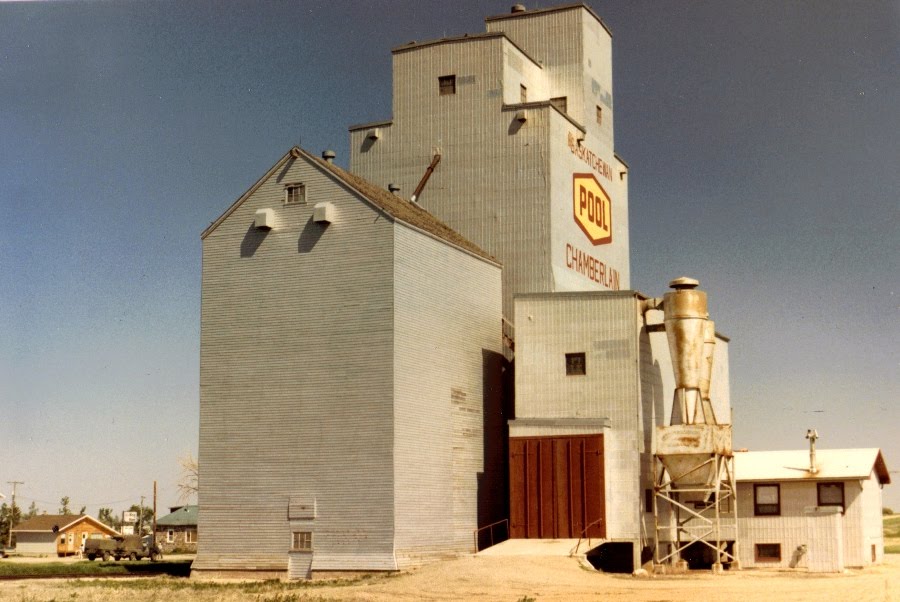
CN's Craik Subdivision (see this previous post) was often photographed by agricultural news photographers, probably because of its proximity to their newspapers' editorial offices. In April 1994, CN 5500's were spotting empties at Davidson (above). In 1995, cylindrical and newer ACF-type covered hoppers were being loaded at Chamberlain:
In December 1994, Aylesbury's Pool elevator was taken down:
Till the cows come home...Aylesbury's remaining elevator and townscape in January 1998:
Aylesbury's P&H elevator meets the morning sun in 2002:
A reflection of things to come...Craik Pool A was only cleaning, not receiving grain in April 2001:
Craik's three remaining elevators witnessed winter, with sectionmen digging out switchpoints:
Due to rationalization of the elevator network and the ceaseless march of time, of the towns I photographed in 1986, Davidson has two wooden elevators remaining, while Chamberlain and Craik have only one. Dundurn B was taken down October 22, 1998, with some of the structure reclaimed for use in the Mennonite Retreat Centre near Waldheim:
CN still operates the Saskatoon-Davidson, northern portion of the Craik Sub, serving the large elevator terminals at Davidson. From Davidson south to Bethune, near Regina, shortline Last Mountain Rail operates the southern portion. (Any resumption of passenger rail service between Saskatoon and Regina is unlikely, notwithstanding the highway paralleling the tracks.) There's also the complication of condo-owning NIMBY's near Regina, not wanting LMR's initial ex-Santa Fe GE's and recently-arrived ex-WC SD40's passing by with grain drags.
Dave Slater of Regina shared these shots of LMR motive power. Typical LMR operations include Monday and Friday interchange runs to CN at Davidson, with online elevator shuttles on other days. A new bulk terminal at Aylesbury will likely bring LMR more cars to move. Of interest is MobilGrain's 25-car mobile grain cleaning operation, recently set up in Meyronne, comprising some ex-Milwaukee and other covered hopper cars, loading one car per hour into outbound grain cars, here are some photos. MobilGrain is one partner in the new shortline, Saskatchewan's tenth.
Running extra...
Special thanks to Dave, Mark, Ken and Trevor for their assistance with LMR updates, because Kingston is a long way from Kenaston. To join the Yahoogroup for more up-to-the-minute news from the Land of Living Skies and Friendly Manitoba, click to join the MB-SKrails Yahoogroup in my right sidebar.
Last Wednesday, NBC'sAmerica's Got Talent guest starred Train (it's a group) with their runaway ukulele riff-laced hit, Hey Soul Sister (sample lyrics: I'm so glad you have/a one-track mind like me/you gave my life direction) Ever notice those big X's they give the acts on AGT look like crossbucks? .
CN's ex-UP units that I blogged about in this post are being repainted by CN and entering service, mostly on CN's U.S. lines, although some have made it as far as Mac Yard in Toronto. The repainted units bear a striking resemblance to Little Obie, the CN parade unit from Memphis.

Sunday, July 18, 2010

CN's Craik Subdivision, 1986

CN's Craik Subdivision runs 154 miles between Saskatchewan's two largest cities, Saskatoon and Regina. In 1979, the line hosted Railiners 680/683 and thrice-weekly freights 865/866. From November 1981 to June 1984, the Craik Sub was the CN portion of VIA trains 109/110 between Winnipeg and Saskatoon, profiled in this post from February/09. In May 1986, I took three days in the Saskatoon area to photograph grain elevators. More in this Craik Subdivision postscript.

After a Saturday morning of CP subdivisions, by late afternoon I reached the lower third of the Craik Sub, emerging through some trees at Mi 45 to later find Findlater's elevator track. Two CNWX covered hoppers had been loaded by Sask Pool. New ties had been dropped trackside as part of CN's track renewal program. CN Lines Vol 10 No 1 has a great series of photos taken here during the steam era. For another, helicopter-borne view of Findlater, start at the 40:30 mark of this Helicopter Canada National Film Board film.

Chamberlain's single SWP elevator was the usual nine miles from the next town. A Canadian Forces truck convoy was headed south, likely returning from a training exercise at CFAD Dundurn's ranges. CN's 1993 employee timetable showed a 2.2-mile spur branching off the Craik Sub at Mi 134 to serve Dundurn.

The only semblance of a train on the Craik Sub this day was a string of 40-foot grain boxcars in the siding at Aylesbury, Mi 62. Sask Pool and Parrish & Heimbecker elevators baked in the afternoon sun. A spike's-eye view shows that the agent has left the office windows open to cool it off for Monday morning:

Craik's location at the midpoint of the Craik Sub at Mi 72 rated five elevators: Pool A and C, 2 Cargill and 1 United Grain Growers.
The section crew's speeder shed must've been just out of the picture near the shade of some trees at right:
Girvin's 4710-foot siding was second in length only to Davidson's. SWP and UGG elevators at Mi 80:
Davidson at Mi 89 was my rest stop for the night. A room at the Jubilee Motor Inn set me back $27.00, a dollar less than the Rosetown Motel the next night.
Elevator row was impressive with six installations: seven elevators and eight annexes of various sizes. Two SWP, two UGG, one Cargill, plus Pioneer's massive 8,110-tonne capacity elevator with its two annexes accounted for eleven covered hoppers. A second elevator track was in use at the far end, closest to the station. See below for a 1979 photo at this location, elevators and all!

After checking in, I drove out to Bladworth at Mi 98 as the evening shadows lengthened. Its two SWP and one Pioneer elevator basked in the beams of the setting sun:


Today only the northern portion of the Craik Sub remains in CN hands, with shortline Last Mountain Rail operating the southern portion.  Here's a Keith Bowler photo showing a southbound ex-CN RDC 6350 at Davidson in 1979:

Running extra...

Just saw "Grownups" with Adam Sandler, David Spade et al. Funny scene in which the wives of the group ogle a lifeguard. When he approaches them, he speaks in an annoying, squeaky voice and says he's from Canada, specifically "Saskatchetoon".

Enough with the Saskatchewan jokes, already. Saskatchewaners can't help it if their province is so flat it can all be seen if standing on a chair, plus it's so flat your dog can be seen running away from home for a week. Any others?

A visit to CN's Belleville yard yesterday included DPU train 350 handling an RJ Corman RR boxcar, and two dimensionals: CAT dumptrucks on flatcars. 372 setting out seven cement etys and two of plastic, lifting six. 305 was DPU also, but a long 149 wasn't.