Tuesday, November 5, 2013

The RDC and Me

November marks the 60th anniversary of the introduction of the Rail Diesel Car in Canada. I rode VIA RDC's on three routes, though I'd hoped it had been four. I also watched their shimmering silver shapes streak by from trackside. The RDC's adaptability, flexibility and universality kept it in use from coast to coast on VIA's network until the 1990 cuts. With no suitable replacements upon the enacting of the massive VIA cuts of 1990, VIA's fleet found work elsewhere, in Quebec, Dallas and Cuba. Exhaust spews skyward from 6204-6114-6001-6110 at 1600 on February 15, 1981 at Kingston (above).

When I began observing and recording trains in earnest, some of my first observations were Montreal West Island CP commuter RDC consists of three to eleven Budd cars in July 1975! At the age of 12, early mornings trackside along CN's Kingston Sub often began with the westward Ontarian at 0730. Returning on an afternoon run from Toronto to Kingston, the eastbound VIA No 652 arrived at Kingston at 1545, exchanging passengers and departing for Toronto at 1615 as VIA No 655. In 1976, those times were a little earlier, and this train was a little late, so it only stayed at Kingston for 21 minutes, from 1550 to 1611. The engineer is settling into 6116 for the return trip, with 6002-6115 in tow:
Braces of two to four RDC-1s, RDC-2s, RDC3s and RDC-9s would rocket out of Kingston station for Toronto, in full cry by the time I'd see them 12 miles to the west.  On September 9, 1979 6116 and 6121 (still in CN colours) are whizzing westward through the superelevated curve at Mi 183 Kingston Sub. Oh, for a saw.
The Ontarian was a convenient link to Toronto, for day trips there or to begin trips farther west on VIA to Winnipeg. Blasting along CN's Kingston Subdivision, I counted seconds between mileposts.  
On August 31, 1981 I rode the single Budd car RDC-1 6129 (above) from Calgary to South Edmonton, meeting southbound VIA train 196 with RDC-1 6124 at Innisfail. A 15-minute stop at CP's Red Deer station allowed passengers to buy snacks from vending machines at the station! Less than a year later, I would make 6124's acquaintance again, this time at Winnipeg's East Yard near Union Station. Coming out second-best against a truck, the hard-luck car was sheathed in plywood awaiting repairs on June 10, 1982:
6124 was on the last Calgary-Edmonton train in September, 1985. Watch for a future post on the dangers of this high-speed intercity western run! A 1 hour 15 minute trip to Lachute, Quebec on Montreal-Ottawa VIA train 171 in May 1981 was not to be, replaced by a CP F and conventional equipment, though a deadhead Dayliner tagged along behind. The following month, I was able to see Toronto-Niagara Falls Railiners skirt the shoreline at Bayview Junction, some still wearing CN's black windowband. On June 22, 1981 6121-6356 were on VIA Nos 639-640 between Toronto and the Falls.
I also rode VIA train 663 (6113-6005-6123) from Toronto to London in March 1984 on a Corridor Canrailpass. Returning from Toronto to Kingston, one of our three-car brace (6211-6004-6132) on train 656 caught fire at Belleville! Overnighting at Kingston's Outer Station on Montreal Street, the Ontarian was a local fixture, with the service eventually replaced by an F-unit and blue & yellow coaches. Disc brakes equip 6110 at Kingston:
Though some excellent books have covered RDC's in detail in Canadian service, I took the opportunity to update information in my second book, Trackside with VIA: Cross-Canada Compendium, including the renumbering and rebuilding of CN and CP RDC's for VIA. I also added RDC consist information on RDC's used by VIA in service on Vancouver Island, Alberta, Northern Ontario, the Corridor and Atlantic Canada.

I enjoyed riding the RDC's as a dynamic, convenient form of transportation. While railfans will ponder and discuss the impact of the RDC on Canadian rail transportation now - sixty years later - the spiderweb of lines across Canada that heard and felt the throb and rush of RDC's was extensive. Urban and rural communitites, CN and CP, commuters and daytrippers alike were served well by this versatile vehicle. The fact that a few RDC's still serve VIA Rail today speaks to their enduring nature! Budd Co. ad from 1954:

Interestingly, a unique RDC move took place on October 29, as recently-completed 6219, 6208 and 6251 and LRC cars 3310, 3320 and 3362 from CAD/IRSI were added behind the Park car of an otherwise Renaissance-equipped VIA No 15 from Moncton to Montreal. Terry Muirhead kindly supplied a Chris McMahon photo of these cars taken at Moncton awaiting their lift and trip westward. These RDC's have been made accessible, with heated lifts, interior tie-downs and washrooms. The $2 million cost even included snowplows. In July 2023, and maybe for some time before, 6251 was in the deadline at VIA's Montreal Maintenance Centre.

Running extra...

As a regular reader, all remaining items in the Trackside Treasure November sale can now be claimed at 20% off by mentioning code "20"  in your email message. Many unique items still available!

Speaking of enduring, storied careers, here's Yahoo's take on the career of the great #4, Bobby Orr. Having just released his autobiography, Bobby is conducting interviews on his short but stellar career. At the zenith of Bobby's decade-long career, I was somewhere between 4 and 10. When playing on the driveway, road, pond or rink, I did not own a Montreal jersey, I did not wear a Toronto jersey. I proudly wore a kids' Bruins jersey.

Permit me a personal tribute to my late next-door neighbour as Remembrance Day approaches, Lieutenant-Colonel J. S. MacAulay. Born in Cape Breton, Stu was a member of the Black Watch (Royal Highland Regiment of Canada), serving in Germany and Cyprus before retiring as Admin Officer for Canadian Forces Base Kingston. Stu is front and centre in this photo of the 1965 Canadian Army Rifle Team at Bisley, England. A blue jay seen from our window speaks to us of you, Stu.
NEMO ME IMPUNE LACESSIT

Tuesday, October 29, 2013

November Sale

Need something new for your bookshelf, DVD collection, railroadiana collection, or train room wall? Full steam ahead for the semi-annual Trackside Treasure sale! First email received indicating interest in each item to mile179kingston@yahoo.ca means the item is yours. Each item will be shipped well-protected via Canada Post, upon receipt of payment. Shipping cost will be actual postage...bundle and save! Payment by cheque, money order or well-concealed cash. Thanks for browsing, and I hope you find something you like! - Eric

ITEMS SOLD SO FAR: 1, 8, 12, 17. THANKS!
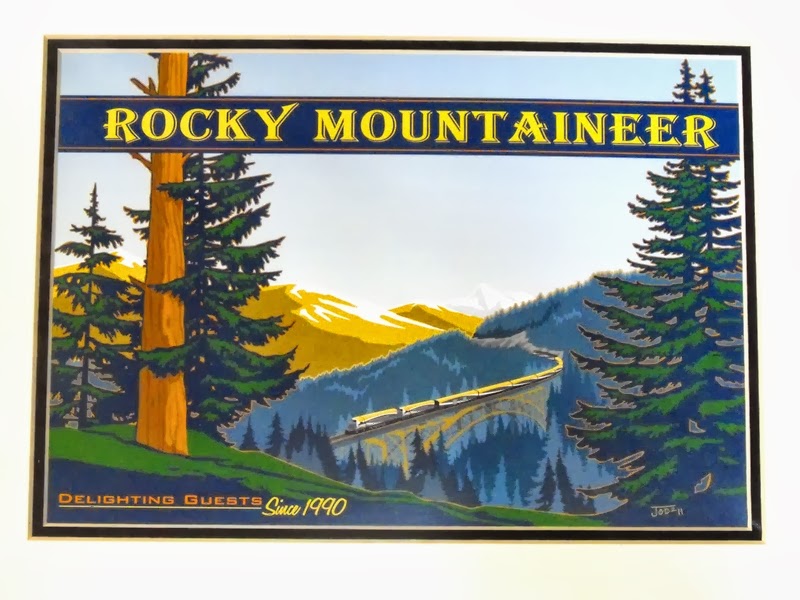
An absolutely beautiful set of prints showing the Rocky Mountaineer operating through the majestic mountain and canyon scenery of British Columbia and Alberta. Matted plastic-sealed prints,  this set of two vertical and two horizontal format ready for framing, or enjoy them as they are. Item 1, sold as a set for $50 ...NOW $40.
Image size is 7"x10", total size with Arctic white mat is 11"x14". This set makes a great Christmas gift!
"Classic Retro art prints illustrated by world-renowned artist Jode Thompson bring the Canadian Rockies to life - with a twist of nostalgia." (Reflection from plastic is in my photos only.)
Two CN steam classic 8x10 black & white fantrip prints: CN 6218 at Belleville and CN 6153 at Turcot roundhouse. Item 2 and 3, $5 each.
Framed colour print of CN 76650 transfer caboose at Belleville 1978 Item 4 $10; Classic Trains Summer 2013 special expanded Interurban issue Item 5 $5, January 1977 Rail Classics has colour photo of CPR 8010 and Budd car at E&N Victoria engine house and B&W photo of L&PS box motor L1 Item 6 $2.
Canadian railway books...Steam Into Wilderness, story of the Ontario Northland Railway by Albert Tucker 1978, hardcover 214 pages, dust jacket, illustrated Item 7 $10; The Last Stop by Ron Brown 2002, fascinating Ontario station histories, softcover 192 pages, illustrated Item 8, $6.
Inside Railroading published by AAR 1957, tells the story Inside of Caboose, Railroad 'Navy', Dining Car Kitchen and  another dozen locations, printed in three colours, illustrated, colour cover Item 9 $6; CN Express Heated Service book of 50 orange adhesive stickers, original, Item 10 $7; Saint John in the Golden Age of Postcards, softcover 128 pages includes bridges, stations, rail lines 11 $6; Bytown Railway Society 1999 Trackside Guide, colour covers, softcover 1+ inch thick! Item 12 $5.
Three Souvenir Folder colour print folios, postcard-sized, early 20th century: Rutland VT, Land of Evangeline NS and Fredericton NB. Please specify, Item 13, $5 each. All three for $13!
Close up of mailable covers (below), colour views on both sides, only one side of each shown (above):
Framed print copy of CP passenger train at Morant's Curve 21 inches wide, 17 inches high, Item 14 $15.
CN original, mint-condition metal car seals, Item 15 $3 each:
Only a few sets left! From the Operator's Desk, CP Rail Ignace, Ontario 1981. Includes train orders, clearances, train lineups, train journals, messages. Contents of a sample set shown below. Item 16 $14 each:

VIA FP9ARM 6304 replica piggybank in plastic, 9 inches in length. Made in Canada VIA Exclusive Licensee Canadian Sports & Marketing (lacks stopper) Item 17 $8.
Canadian Pacific Hudson 2816's inaugural run on Disc 2, 2-year rebuild on Disc 1, each DVD 60 minutes, Item 18 $10 set of two.
Railway System Maps, most full colour (except C&NW and Chessie three-colour): Item 19 $9 C&NW 1985, Item 20 $9 Southern Railway System 1975, Item 21 $9 Norfolk Southern 1989, Item 22 $9 Southern Pacific undated, Item 23 $5 Chessie System Michigan Carferries 1976, Item 24 $10 CN 1980. All 6 for $48! (See Top Photo)
Running extra...some recent links you might like to click, visit, explore and enjoy:

Tangent Scale Models has introduced a new tank car model. Though I detest the use of the word 'cute' for anything train-related, this 6,000 gallon, 3-compartment is darn cute

Chris van der Heide's comprehensive Canadian Freight Car Gallery appears in Trackside Treasure's sidebar. Chris also blogs about his future Algoma Central HO scale layout. Until it's built, the blog will feature various  rolling stock and other projects.

Amtrak has a nice Photo of the Week page on its Official Blog. Be sure to check out the short video of their new sleepers, diners and even baggage-dorms.

Reefer madness at Sugar Junction - a motor car trip in Colorado happens upon a veritable museum of former Milwaukee, San Luis Central, Amtrak and PFE reefers.

Thanks for taking in the Trackside Treasure November sale!

Tuesday, October 22, 2013

Ode to a Stack Train

I once heard that a good story begins in the middle, and with that in mind...
No whistle to hear, singing rails make train appear,
No air horns at this crossing, let tracks do the talking,
CN Number 149, westward daily 'round this time,
Two units plugging, stack cars lugging,
Profile-hugging, effortless tugging,
Well, well, well cars on the centre track we go,
Keeping the centre of gravity low,
Back-hauling to China we now disappear,
For another load of goods we used to make here,
Initials: MSC CMA CGM TTX,
Short stacks of cans, one car after the next
ETU flashing, midday peace crashing,
Now restored. Westward you go,
Westward you go.
And now the beginning of the story...
On October 15, I found myself in Shannonville once again. A westbound CP hi-rail truck let it be known there would be little traffic on the Road of the Golden Rodent, so I concentrated on CN and VIA. Since my last visit, the earthen berm just south of the CN triple-track has grown up in waist-high weeds, so I stayed closer to trackside. A headlight far to the east on the undulating hog-back profile of the Kingston Sub, east of Belleville looked like a long freight. CN No 149 soon popped over the Shannonville Road crossing, where whistling is prohibited.

My usual thought process kicked in: stack train = boring. But with a digital camera, I can merrily shoot pictures all day with no consequences, which is what I did. In case I never print these photos, I'll share them here. Since I don't want to subject Trackside Treasure readers to "Here's a bunch of random, uncaptioned stack train photos I took", I decided to put a modicum of energy into it and caption the photos as prose - not my first attempt at doing so, but not something you'll see a lot of.

So, now I've finished the story. Thankfully, CN is not overloaded with stack trains as some of the US railroads are, running one manifest per day each way on certain service lanes. Here it's just the opposite - we have many more manifests than intermodal trains.

Running Extra:

Bryan Martyniuk of Thunder Bay has a .pdf list of timetables for CN and CP, ACR pamphlet schedules and a small variety of railway publications, primarily CN marketing - free to a good home! You can email Bryan at bryanm@tbaytel.net to see what he has on offer.
There is slightly more ex-CP Budd stainless steel equipment in Kingston than there is in Thunder Bay. Three cars more on Sunday the 20th when 8608-8505-Evangeline Park deadheaded west on the tailend of train No 659. Dome lights on! Just like previous years' domes on the Kingston Sub! Non-tripod platform view (above) and non-time exposure flash photo (below). That's not a third marker, it's the 'ping-pong paddle' in the coupler.
Thanks to Chris for the heads-up! Chris' early-evening photo at Ottawa also shows 659's classy conclusion:

Wednesday, October 16, 2013

CP's Magical Multimark

Have you ever tried to draw CP's multimark, or apply it to a model?  Is it just a curved line and a triangle within? Nope, though it certainly looks good facing various directions! Chairman N.R. 'Buck' Crump and President Ian D. 'Big Julie' Sinclair (below) conducted the debut of this curvilinear creation of Lippincott and Margulies while D.B. Wallace, CP's general manager of public relations and advertising reported directly to them on its application. A portion of a square = stability, a segment of a circle = global activies, a triangle = motion and movement. Gradually applied to train order forms, matchbooks, soap, airplanes, timetables, ships, notepads and all manner of items that could displaya logo:
No corporate logo is merely doodled or drawn. It has dimensions, proportions and colours that it can and cannot appear in. There is some geometric science to it, so grab your protractor and ruler, and enjoy this how-to from a CP equipment paint diagram book (though the multiimark was at 40 degrees, locomotive nose stripes were at 45 degrees):
There are rules - lots of rules, paint diagrams and style sheets. The font predates the fonts currently available in most software, but is close to Helvetica Bold Oblique or Swis721 Black BT Italic. Applied to 1,100 locomotives, 800 passenger cars, 87,000 freight cars, 20 aircraft, 24 ships (liners, cargo ships and bulk carriers), and 5,000 highway trucks, in a variety of colours... red for CP Rail, orange for CP Air, sea green for CP Ships, blue for CP Transport, CP Express and Smith Transport, grey for CP Hotels and yellow ochre for CP Telecommunications.
CP's multimark was unveiled on June 17, 1968. Out went the script signature, beaver, goose and checkered funnel of Canadian Pacific's land, air and sea services. Applied gradually, perhaps more gradually than CN's get-a-paintin' attitude shown in this 1967 Maclean's magazine cartoon...many non-enthusiasts don't get it the first time. Thanks to Glenn Gillis!
It's hard to ascribe the iconic status of CN's wet-noodle logo to the multimark. The multimark arrived later and disappeared sooner. (Wait a minute - unlike CN's logo the multimark also appeared on airplanes - that was cool, but then again CN and CP logos both appeared on ships' funnels). I will not refer to the multimark as 'Pac-Man'.  That's an insult to the multimark, actually also to Pac-Man, and by extension also to the beautiful and lithe Ms. Pac-Man.
Strangely and inexplicably, the multimark publicity models included a red tank car and black locomotive. All other publicity models' colours were later painted the same on the prototype... black for hopper cars, green for newsprint cars, aluminum for temperature controlled cars, yellow for insulated/heated cars and vans. The display train that toured Canada (behind C-424's 4239-4242, green newsprint box 81030, mechanical reefer 286138, red 40-foot box 56767, cylindrical hopper 382632, yellow insulated box 165140, 50-foot combination-door box 202199, red mill gondola 342846, flat car and caboose 438850) famously photographed for postcards and lunch boxes in iconic CP locales such as the Laurentians, Lake Superior and the Spiral Tunnels) appeared in Canadian Pacific's 1968 Annual Report, with an MLW blurred locomotive with multimark similar to Michael Berry's photo (top - CP 4563 at the Canadian Railway Museum in St Constant QC).
There are a couple of exceptions to the usual application of the multimark as seen on a Microscale Decals HO sheet (above), on rolling stock.  CP's forty-foot double-door 'exceeds Plate F' appliance boxcars are one (check out Chris van der Heide's model in progress)...
and CP's riveted, centre-cupola cabooses, such as CP 434102 at Winnipeg (Paul B.Smith photo) are another:
The former had a soaring vertical space to fill, and the latter had a window placement issue. (No-one wants to see a munched-out multimark!) CP's fifty-foot insulated, excess-height 167500-series boxcars had a multimark that didn't go all the way to the top.

I believe CP bastardized their own original CP Rail paint scheme by removing the oh-so-expensive-to-apply multimark, beginning with SD40 5513 in 1987. When the even-more-expensive-to-apply and shorter-lived 'Golden Rodent' scheme was unveiled after much secrecy i.e. some units being released without it applied, beginning with AC4400CW 9581 in 1997, the locomotive number font was retained but a new one was introduced for the 'Canadian Pacific' and 'C:P' on the nose. CP 5617 'glistening rodent' trails two SD's in the also short-lived Dual Flags scheme at Trenton, Ontario in August 1999:
VIA's reversible logo chased the multimark off the letterband of CP's stainless steel equipment, just as the multimark had scared away the beaver a decade earlier, leaving the cars pockmarked and bullet-holed where the beaver-on-shield once proudly posed.

CP's car painters had multimark stencils available for each car type.  CP's smallest multimark was likely the one applied to the letter-band of their passenger cars.  Flat cars? Forget about it, no room!

Running extra...

Wonder what a multimark would have looked like on a plow wing. Here's a surplus 1926-built plow that CP is offering for sale in Kief, ND. It makes me feel very, very comfortable with my HO scale decalling efforts:
You have just celebrated a milestone, having read Trackside Treasure's 250th post. No special celebrations planned, just a prolonged release of air as I slump down, suspiring in my easy chair to contemplate the havoc I've wreaked in cyberspace so far. Vampirestat, bloglovin (whatever they are, but I wish they could turn their evil into good - my blog visit numbers are now completely meaningless), spammers "This is a really good post. You have raised some good ideas. I have some ideas I'd like to share on Singapore Apartment Furniture, click here" and Google images (actually useful) have found me.

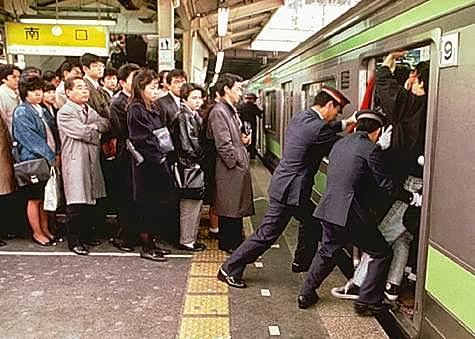
Suddenly sentimental, I saw a romantic news story tonight on a young Japanese couple who held their wedding ceremony in the very same subway car in which they first met. Do you think I could find it on Youtube? Nope. Instead, I offer a photo, also from Japan, that's representative of how I cram even more content into each Trackside Treasure post:
Arigatou for joining me on the ride so far!
Ride on happy Japanese couple in your subway of blissful happiness, wherever you are!
-Eric