Sunday, November 27, 2011

Railfanning from the CN Tower

When the CN Tower was built on railway lands in downtown Toronto, it was surrounded by major facilities used by the railways: Union Station, CP's John Street roundhouse, and CN's Spadina roundhouse and coach yard.
While most visitors to the world's tallest tower (1,815 feet in height) enjoyed views to the horizon from the observation deck (1,136 feet - Hey look! I can see Hamilton!), I preferred the view below, where I could see train movements taking place. The trains could also be viewed from ground level, but it was more interesting to watch and photograph trains wending their way through the terminal trackage, often featured on tourist postcards often featured the tower from various angles and altitudes (above & below):
From the outdoor observation deck (1,122 feet) the tower's shadow falls between the safety bars onto the white skirting that covers satellite dishes. Upper Canada Railway Society's private car Cape Race is next to the steam plant. Stored CP intermodal flats, 40-foot yellow insulated boxcars and Service boarding boxcars line the coach yard tracks nearby in May 1980:
Looking east along Toronto Terminal Railways trackage, the Union Station train shed is visible between the bars. An inbound GO Transit train races past a CP wayfreight beside the Gardiner Expressway, which runs beside the postal terminal near Union Station:
Pointing my Kodak Hawkeye straight down, a VIA F-unit and a yard switcher with coach in tow both head west. Rapido Trains' president Jason Shron will be depicting such scenes on his HO-scale Spadina-CN Kingston Sub layout. That's our school field trip's school bus beside the F-unit:
Looking west from the outdoor deck, a bidirectional GO Transit train slides past Spadina coach yard, while at least two CN switchers drill passenger cars. Compare the view to the third photo in this Canadian Railway Observations article by Walter Pfefferle. Today's view is markedly less-railroady and more Albert Speer-esque, as wide avenues guide condo owners home to their high-priced birdhouses along the lake. In both views, historic Fort York is visible at mid-top of photo:
What a difference a telephoto lens makes. While a scruffy ex-CP VIA F-unit peeks out from the trainshed, an eastbound CP transfer powered by two switchers hauls 13 gons, four covered hoppers, two boxcars and five tank cars in September 1986:
The stainless steel roofs of three RDC's glint in the late afternoon sun:
Farther west, two short F-led VIA passenger consists and a brace of RDC's pass Fort York at Bathurst Street:
Forty-foot CP Rail boxcars, ex-baggage Service car, and two tank-bearing flat cars are stored:
An end-cupola van, piggyback flats and 'roundhouse queens' TH&B 72, 74, 401, 402, 76 and 77 await conversion to CP's 1680-series with chop noses, reposing on CP's trackage:
Rail & transit: A Toronto Transit Commission Peter Witt car is on an afternoon excursion:
You'd never see this while railfanning in the vicinity of the CN Tower: an artist's fanciful conception a four-track (in reality, only two-track) flyunder to be constructed west of Spadina Avenue. A CP F-unit hauling a boxcar meets the LRC prototype, two GO single-level and two double-level consists, a CN RS18 hauling Tempo coaches(?) and the Turbo near Spadina's coaling tower, all in one view from UCRS's November/December 1976 newsletter. Now that's railfanning CN Tower style!
Running extra...

Most modellers just buy models and kitbash, paint and decal them to match a specific prototype. Jason Shron started Rapido Trains to produce the cars he wanted, and oh, to sell a few to fellow modellers in the process. Rapido's recent announcements include MLW's FPA4. Schenectady serendipity and MLW melodrama in all-encompassing ALCo-mania.

How many Torontonians does it take to screw in a light bulb? Just one, then five more to hold a panel discussion about what a world-class event it was. Why doesn't Hamilton have an NHL team? Because then Toronto would want one too.

Toronto takes a few jabs, but it still features some world-class railfanning opportunities. Be sure to check out the blog partners featured in my sidebar: Chris Mears' Prince Street Terminal features GO Transit among myriad other subjects, and Adam Walker's Walker Express featuresa recent visit to GO's Willowbrook yard.


Saturday, November 19, 2011

But it's a TRAIN

The 30th anniversary of the 1981 VIA Rail cuts got me thinking...there's still lots to see trackside. Instead of wallowing in nostalgia about the F-unit era, it's important to appreciate what's still rolling by. To express this, it seemed appropriate to publish a post on this very topic. The Turbo, Rapido, Atlantic Limited are all gone, but VIA rolls on and although the rolling stock has changed, it's DIFFERENT, but it's a TRAIN.

This is Trackside Treasure's first multi-media post. Instead of simply including photos, I did what anyone who appreciates what VIA has offered us over the past 35 years would do...I produced a rap video.

Enlisting the services of Spadina-based rapper E-series and his crew, here is the global premiere of "But it's a TRAIN". Enjoy. Youtube link here!

Saturday, November 12, 2011

Modelling a CN auxiliary crane

My previous post on the 1993 derailment at Mi 180 Kingston Sub reminded me of the modelling I'd done after viewing the derailment clean-up. Over the next year, I kitbashed/painted/decalled a new 7-car auxiliary train. First of all, I'd decided it was time to modernize my HO scale CN auxiliary, bringing it up to date from CN's basic black scheme of earlier years.
To do so, I brush-painted my Athearn 200-ton auxiliary crane in CN's striking, high-visibility scheme with orange sides, silver roof, yellow deck and broad black & white stripes on both ends. I also added some details to the roof: air horn, spotlight and a muffler. Opposite side:
I also thought CN 60329, the idler car was neat and modelled it as well. Of course, 50016's boom needed a prototypical resting place, as well as providing a place for the crew to get out of the weather if needed.Details I added to 60329 (not sure why I decalled it 60239) included rerail frogs, yellow-painted ladders, smokejacks, lighting along the deck, deck-mounted fuel tank and various supplies such as blocking timbers and chains carefully stowed and ready for use. My car is unweathered, and does not include those interesting cutout sections on the side of the flatcar deck, no doubt for additional storage. CN engine 5595 is seen switching the auxiliary train, a common occurrence that would take place in the siding nearest the derailment, to place the train's cars in the order needed for the job at hand. Clothes dryer/generator car CN 43699 provides power and creature comforts to the train and its crew:
A tool/cable car was also included in the 1993 consist. I used VIA 9070, a Con-Cor baggage car I'd picked up for this project. I cut out one door, adding a crew member who is retrieving some important piece of equipment from the car, which would also carry cables and slings for special lifts. Underbody details include timbers for blocking the auxiliary outriggers and more rerail frogs. Rerail frogs are heavy. You can never have enough of them, and they need to be readily available and stored as close to track level as possible.
Another crew member keeps an eye on the passing scenery on the idler car. I lettered both these cars for the 'Winnipeg Auxiliary' with CDS VIA car lettering. This was before my reading-glasses era.
Of course the full auxiliary train needs to be filled out with more cars: accommodation, dining, lighting, track panels, trucks and axles and more. Click on the Derailments tag in my right sidebar to find more derailment posts including auxiliary train consists I've observed in action.

Saturday, November 5, 2011

Derailment at Kingston, May 1993

A 93-car westbound CN freight derailed at 2200 hours, Thursday, May 13, 1993 just west of Kingston, Ontario. The derailment was in an interesting location, at Mi 180 Kingston Sub: at the Collins Bay Road level crossing, bordering the playground of Collins Bay Public School. Four loaded auto racks derailed from the north track, across the south track and into the trackside pole line and schoolyard fence. CAUTION tape was deployed, and wrapped around two track wrenches that had been driven into the schoolyard. This kept the young students away from the site at recess, but we could still hear them yelling "Mister, get away from the train! It's going to crash! It's going to explode!" No doubt merely an expression of youthful, enthusiastic hyperbole. Arriving at the derailment site, three auto racks had already been rerailed, with CN 711931 remaining. The Toronto Auxiliary was at the scene:
Consist of the Toronto Auxiliary:
CN 5358 (NA map scheme) -5355 - 250-ton auxiliary crane 50008 - idler car 60329 - tool (ex-baggage) car 60337 - hazmat boxcar 57948 - generator boxcar 43621 - crew sleeper 72909 - ?coach - ?coach - 3 flatcars with panel track - gondola 59110 with spare trucks - 60305 - flatcar 57935 - flatcar 57551 with portable lights - caboose 79902. The auxiliary worked the west end of the lift, while Kershaw road-rail crane CN078836 worked the east end. A 20 mph slow order was in effect between Mileages 179-182, with trains passing the derailment site at no more than 10 m.p.h. The auxiliary's outriggers have been blocked with timbers sledge-hammered into place, and a freight car truck rolled into place for the lift of the errant auto rack:

The auxiliary train's consist had been re-marshalled placing 50008 was at the east end, with the idler car, tool car and boxcar ahead of the power. As the Kershaw crane held the east end of the car steady, the west end was lifted up and over the south track, shown in this series of photos:


Once rerailed, the timber blocking was lifted by the crane onto the adjacent idler car:

A CN hi-rail truck brought some additional rails to the site, and VIA train 60 passed at 1100, 6902-3461-3346-3368:
The auxiliary's boom was lowered, and the auto rack chained to its east end coupler for the trip to Ernestown, to be set out there (below and top photo). There, the train was likely re-marshalled before returning to Toronto via Belleville. CN 50008 was the Belleville auxiliary in 1961, rerailing 23 cars that derailed into the Trent Canal near Trenton Junction.
More trains continued by after the auxiliary left. As often happens once the track is fully open, the floodgates open and trains start to flow through as fast as the dispatcher can get them going, with passenger trains and high-priority freights having precedence:
1402 EB VIA: 6428-3468-3362-3360
First freight past the site: WB CN Laser 9570-9526-9441-77 platforms
1420 EB VIA train 42: 6429-3475-3371-3329
1440: EB CN freight 9425-2317-2333 - 71 cars
1505 WB VIA train 65: 6407 - 4 LRC cars
1508 EB VIA train 64: 6414-3339-3366-3350-3331-3471-8622
1517 WB CN train 391: 6001 - exCNW NRE 882 - 5031
1533 EB CN freight: 9443-2324-3548

A newspaper photo from the Kingston Whig-Standard (above) shows an early morning view of the accident scene, while Kingston This Week (below) shows the Kershaw crane at work, later in the day. 50008's boom is visible in the background, while the road-rail crane is blocked and in position.
One day before the accident, a crossing accident fatality occurred one mile east, at Mile 179. This was the ninth crossing accident in the Kingston area in seven years. The private crossing was in use by a mechanic who was going to work on a car located at the house on the north side of the double-track mainline, when his Olds Cutlass was demolished by VIA train 68. This crossing, two other private crossings between Mi 179-180, and Hillview Road crossing were subsequently removed.

Running extra...

Lots of speculative discussion online this week after VIA's train 692 took some last-minute measures to clear the track for CN train 853 on CN's Togo Sub in Manitoba. Only those involved know for sure what happened, but it reminded me of the events leading to the CN-VIA Hinton, Alberta collision/derailment twenty-five years ago. Fortunately, no such calamitous event ensued.

I still can't believe a Canadian senator suggested replacing the beaver with the polar bear as Canada's national animal emblem. Is this some kind of an ONR (polar bear) vs. CPR (beaver) competition? While the polar bear is a majestic ursine animal citizen of Canada, there's no animal as clever, resourceful, family-minded and handy as the Canadian beaver. (No wonder it's the emblem of the Canadian Forces engineering branch.) A dam dumb idea if you ask me.

Remember Canada's fallen this coming week - John 15:13. The average age of surviving World War Two veterans is 85 years of age, with the average Korean War veteran being 76 years of age. Age shall not weary them, nor the years condemn. At the going down of the sun, and in the morning, we will remember them. Nous nous souviendrons d'eux.

Sunday, October 30, 2011

Train-to-Train Photography

Train-to-train photography happens rarely. It's comparatively easy to photograph trackside scenes or equipment from the train, or trains from trackside, but imagine photographing one moving train while aboard another. That's right, two moving trains. Standing cuts of cars or stationary trains don't count. Train from another railway? Bonus. Vestibule views are the best, but sometimes that other train just appears seemingly out of nowhere, and you've got to grab a shot through dirty or rain-streaked coach window or a scratched dome panel. A few examples follow.
The Fraser and Thompson Rivers are the happy hunting ground. CN and CP lines parallel each other on opposite sides of the canyon. On May 29, 1986 (top) the entire consist of VIA train No 2 is visible on CP tracks, across the Thompson River east of Boston Bar, with three units and thirteen cars. On September 22, 1985, things are reversed as we're aboard VIA No 1 chasing a CN Piggyback train westward, west of Spuzzum BC at 0730 (above).
Later that same day in September at 1850, we're meeting CP westbound coal across the river behind 5809-5836-5971. Helpers 5715-5767 and van 434208 follow:
CP also parallels CN for quite a distance between Belleville and Oshawa, Ontario. On May 17, 1994 I grabbed a shot of a CP westbound to the south with 5729-5747, from VIA train 61:
On a trip from Kingston to Montreal, we met CP freights north of us, in the starting blocks near Dorval ready to head west. There's also this slow-moving eastbound behind CP engine 9513, photographed from VIA train 52/40:
On a drizzly September 17, 1985, I'm in the dome aboard VIA No 1 as we meet an eastbound CN freight of paper cars behind 5207-5053, paralleling us on tangent track near Hurkett, Ontario:

Around the same area on May 21, 1986 we're meeting another CN eastbound behind 5148-5057 with 50 cars and caboose 79723, as seen from the lounge of Strathcona Park:
On May 23, 1986 at Basque Junction BC, still aboard VIA No 1 but running a disappointing four hours late, we meet a two-SD eastbound CN freight. It's half grain empties and half sulphur bathtub empties, all wrapped in the canyon dawn:

Another passenger-passenger train-to-train photography opportunity presented itself on June 9, 1984. Aboard VIA train No 2, we'd taken the siding west of Franz, Ontario. After enjoying the afternoon sun on the spruces for awhile, No 1 edged around the curve behind 6531-6633. While both trains were stopped, there was an exchange of supplies for ex-CN diner 1340, which is shown just ahead of MacDonald Manor:
VIA No 1 is smokin' it up behind ex-CP 1414 and two CP RS10's (hence the smoke) as it meets our No 2, east of Marathon, Ontario. The photo is taken from the vestibule of Butler Manor, and needless to say that at the speed No 1 was travelling, 1414 was the only number I was able to get before I quickly drew my head in!
Running extra...

Another nice round trip Kingston-Toronto this week, courtesy VIA trains 651/46. On the trip home, I enjoyed reading Rails & Rooms by Dave Preston. Dave travels across Canada sampling VIA routes and former railway hotels. Dave was travelling VIA 1 in the Corridor, as was I. When the warm towels were brought, I was reading about that. Then, both my seatmate and I selected the salmon entree, and when I turned the page, I found that Dave and his seatmate had done the same. Sounds fishy. I kept reading just for the halibut.

Even though it was raining, I stood under an awning for about 10 minutes, watching the Toronto Transit Commission CLRV's roll along Carlton Street. Even in the evening, there was rarely a span of more than one minute that at least one CLRV wasn't visible.

It took me over 70 years, but I finally viewed Gone with the Wind this week. Combined with a recent trip to Virginia, and a Trains magazine article on the US Military Railroad and other Civil War railroading efforts, I'm just about ready to start work on a Civil War model railroad. I can see it now...a little 4-4-0 pulling a train of munitions into a fortified arsenal with horse and mule teams standing by ready to ferry materiel to the troops at the front. (Oxymoron...civil...war. It's like...jumbo...shrimp) Bernard Kempinski's site serves as inspiration.


Friday, October 21, 2011

CN's Double Deck Auto Transporters

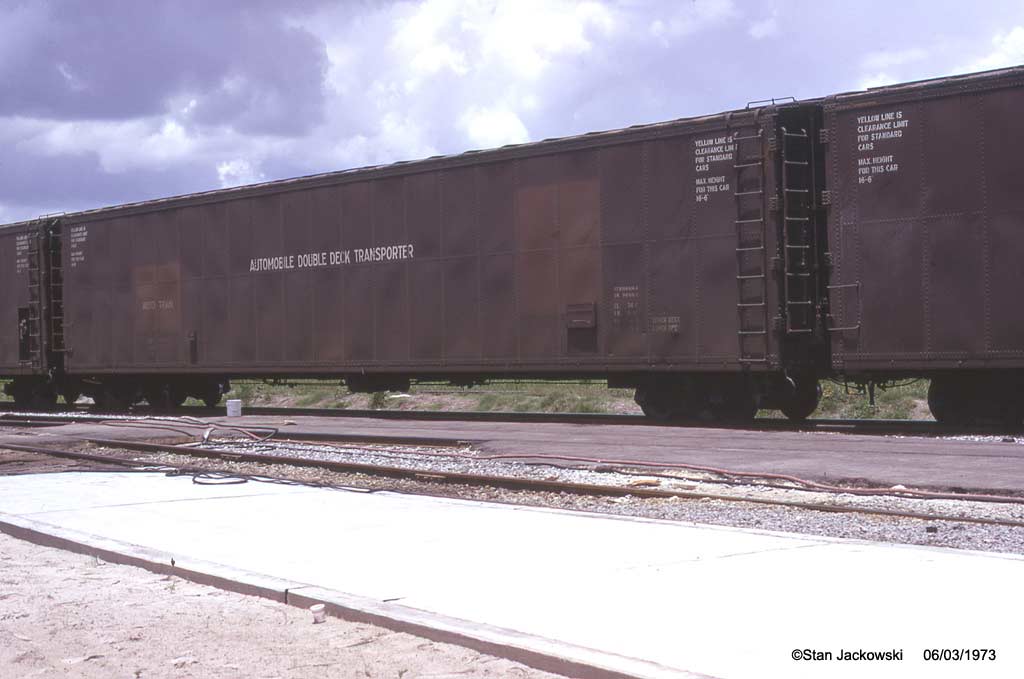
CN's double-deck auto tranporter fleet comprised 150 cars with 9-foot end doors built by CC&F: 25 75-foot cars built in 1956 (CN 570400-570424 renumbered CN 730000-730024 in 1966), a further 50 75-foot cars built in 1959 (CN 570425-570474 renumbered CN 730025-730073 in 1966), and 75 57-foot cars built in 1959 (CN 570700-570774 renumbered to the CN 720100-series and equipped with tie-down troughs in 1974. CN 730034 is shown at CN's London Reclamation yard in 1989 (Peter Mumby photo - above). Note: due to the use of flickr and cnrphotos photos in this post, I've included 9 links to the original photos on their respective websites.

The 57-foot cars included some like CN 570717 that were painted in an overall blue with large CAR-GO-RAIL lettering to publicize this new service in 1963. Through the lens of Peter Cox, we see beautiful blue(!) CN 570717 at Vancouver in July, 1963:
Otherwise, both series of cars were delivered centrally lettered 'Double Deck Auto Transporter' in the CNR maple-leaf scheme, with some 57-foot cars later receiving the CN wet-noodle logo. Both types of cars had double decks each approximately 6 feet in height. The 57-foot cars carried six autos, and were built to offer more flexibility to shippers than the a-little-too-large eight auto 75-foot cars. An undated photo of CN 720105 with French lettering "Wagon Porte-Automobiles a Deux Etages" and English Canadian National, from the Bill Grandin collection via Jim Parker:
Revolutionary at the time, the oversize dimensions of these cars bridged the eras of 40-foot double-door automobile boxcars and open bi-level and tri-level auto racks. Providing all-weather protection, the 75-foot cars were even equipped with interior lighting. A nice black & white example: CN 570438 at Vancouver in 1959 (City of Vancouver Archives photo CVA447-1706.1)
Due to their large dimensions, these cars were not interchanged to other railways, being stencilled with instructions 'Do not load off CN lines in Canada'. Ten 57-foot cars were renumbered CN 15501-15509, retrucked for narrow-gauge service, and sent to Newfoundland in 1971. Returning to the mainland, retrucked with standard-gauge express trucks and repainted, CN 9500-9507 entered Auto-With-You service. Their eye-catching black & white scheme with red CN logo included a 'cutaway' drawing of three autos. Photos show these cars were equipped with steamlines, and I've only seen one photo of such a car not on the tail-end, instead between two CN passenger cars. CN 9501, 9504 and 9506 were definitely equipped with steamlines.
Some 57-foot cars remained in service for many years, such as CN 720127 at Churchill in 1987 (D.J. Gagnon photo - above). Between Wabowden/Thompson and Gillam/Churchill, the road network was poor or non-existent. For this service, the upper deck was removed, enabling single-level ramp loading of vehicles larger than autos. When the Hudson Bay Railway assumed operation of the line, such cars retained their original numbers with HBRY initials added to the reporting marks. Mark Fidelak kindly shared this photo of one such car that even includes an Hudson Bay Railway logo. Ex- CN 720100 at Churchill, June 2016:
Fifteen cars were converted to unique Auto Loaders for service on CN narrow-gauge lines in Newfoundland in 1975 - CN 18020-18034. The cars' roofs were removed, and large 'portholes' cut in the lower deck car sides. Here's CN 18032 at Corner Brook in 1981 (online auction site photo):
Here's another 57-foot car derivative - double-deck stock car CN 179000 also with six portholes, three compartments and moveable steel slats, built from CN 570767 in October 1964, photo courtesy Mark Perry.  Lower deck 5'7", upper deck 5'4".This one-of-a-kind car was later repainted silver with black lettering, renumbered into CN's 8xxxxx-series stock car numbering scheme as CN 820000 at Transcona in August 1968, and was off CN's standard-gauge roster by 1975. This car was featured in the October 1979 Railroad Model Craftsman. Interestingly, CN 179000 became CN Newfoundland 18032 in 1975! As Conrad Steeves pointed out via a comment, this car had the six 'portholes' in two pairs of three, while the other fourteen cars had the portholes evenly spaced. Dan Dell'Unto mentioned that the provenance can be confirmed - 18032 being the only 18000-series car with a door sill.
Mark Horne kindly shared this unique photo of a CN 820000-->179000-->18032 double-deck stock car, early 1970's in Vancouver to complete the puzzle: 
Some Auto-With-You cars were renumbered back to their earlier freight service number series, still wearing CN passenger paint, such as CN 9501 renumbered to CN 720045 in 1987. Another such car was CN 720026.

Other cars were used by CN in maintenance-of-way service, including CN 9503 which was converted for the masonry gang at Belleville, Ontario's car shop, equipped with roll-up doors and renumbered CN 72026.  (Kingston Rail photo - below):
I kitbashed an HO scale Bachmann auto transporter to represent CN 75107:

I came across CN 75107 at Gananoque Jct in 1994, with roll-up doors and retaining its original initial '7' numeral (both sides shown above and below). This car was also converted at Belleville in 1993, for use by the regional steel gang.  Note repainting around the new doors added side ladders, ACI labels and car end electrical plug-ins.
Eric Potter kindly shared these two photos showing both sides of CN 75107, as well as an end-door view, taken at Port Hope in 1991:
This was prior to the roll-up door being added!

story of ex-CN 9500 and its use in moving construction materials. At least 64 75-foot cars were sold to Auto-Train in 1973 for Washington-Florida service. When first delivered, the cars retained their CNR maple-leaf scheme, with reporting marks and logos painted out: AT 36, and AT 32, later repainted in the garish white-purple-red Auto-Train scheme. CN found other loads for the remaining few cars, such as boats and tent-trailers, until the last of the 75-foot cars also left the active roster in 1992. If you have the May 1979 issue of Railroad Model Craftsman, Protofile 3 written by Stafford Swain is a good source of information on both types of double deck auto transporters. Thanks to Claude and Roman for your kind assistance.

With the advent of auto racks, the 57-foot cars were off CN's active roster by 1992. Here's an interesting


Running extra:

VIA train nos. 651 and 48 took me on a round-trip from Kingston to Toronto this past week. Delayed about 30 minutes eastbound into Belleville, for two westbound VIA trains, a westbound freight, plus the unseen freight we were following. Delicious key lime truffles, strong coffee, plus cognac made the delay much more palatable. Bring on the triple-track!

Thanks to readers who participated in last week's supreme passenger scheme poll. Can I conclude from the voting results that we are dealing with a 'younger' readership who appreciate the fifties CN green & black scheme, as well as VIA's blue & yellow, but whose votes are solidly behind CN's 1961 black & white?

It's that time of year when advertisers are using hokey seasonal slogans again. Rocktober, Sales Spook-tacular, even the clucking bunny with its Cadbury Screme Eggs. Q: What kind of car does a ghost drive? A: A Boo-ick.