Saturday, March 20, 2021

Loose-Car Railroading on the Hanley Spur

The concept of  'loose-car railroading' is just about gone. Going miles to lift of set out one car to a shipper or consignee? Can we make money doing that? Well, on my HO scale Hanley Spur layout, it's still happening, albeit in a modelled era being nominally 1970. (Don't bother telling me it's a '73 Ford or a '76 Trans Am. It's nominally 1970, though I include industries and operations just before and just after that date.) This post covers 10 feet, took about 20 minutes, and resulted in 150 digital images. (Are you ready to see all 150? Don't worry, you won't have to. A good photographer doesn't show his bad pictures, and there were...many.). At Wellington Street crossing (top photo), the freight shed lead leaves the Hanley Spur and heads downtown and to Canadian Locomotive Co. We're waiting for our train. The conductor is ready to flag the crossing.
Still waiting, we walk north to River Street, where the CP Kingston Subdivision crosses CN's Hanley Spur under the bridge there. It's a tell-tale location!
The wooden end-cupola CN van pauses between Millard & Lumb and the coal piles at Anglin's (above). Lots of material at M&L to be welded and pounded into shape. The conductor must know the M&L guy! This train was in no rush and I was able to walk along neighbouring streets and the right-of-way. I'm on the limestone ridge at the Imperial Oil warehouse at North Street where CN Geep 4530 lifted Penn Central boxcar 77040:
Just before that, I was at water level where the lift was being made. The trainman ambled back and forth from caboose CN 78257 as they seemed to be deciding how loose this loose-car lift was going to be time-wise. I had time to switch to my other black & white camera:
I clambered up on the car just before it was lifted! The tank car unloading track is at left:
The trainman is on the front of the unit as the unit chants and creaks out of the spur.
I cross over to the CP and got a soaker walking across the poorly-drained low ground! Their spur at right leads to a spur serving four customers.
It was reedy. It was swampy. That's why they call this part of Kingston the Swamp Ward, I guess.
I clambered up on the River Street bridge and two locals were up there to see the goings-on. It looks like CP is down from Smiths Falls, just up ahead by the Woolen Mill on Cataraqui Street. My lucky day!
The train sat there and sat there. I walked over to Rideau Street and got this photo between a couple of garages:
Black and white view while walking down the River Street bridge.
At Cataraqui Street, I was on the east side of the CN, with CP on my left. The local section crew was out shimming some ties:
The caboose toddles by:
Another pause. As CN sits on the Cataraqui Street crossing, I walk up to Rideau Street again, beside the Bailey broom factory. The Woolen Mill is in the distance, with the National Grocers building at right:
View from the back of the broom factory. The trainman appears to be flagging the crossing, letting a VW Bug resembling our '61 cross:
Nope. He was just sitting there. 
The conductor comes down from the cupola to appraise the situation:
The train eventually started to move, beating CP at a walk. And I mean walking speed!
Switching over to black & white for the approaching caboose:
The back of the Whig-Standard warehouse was my perch for the final view of two of the slowest trains on two of Canada's largest railways taking their own sweet time! On to Ontario Street!
Oh, I could roam 'round and round on this layout snapping photos. It's not difficult to add tens of photos to the SD card in no time! One benefit - reviewing the photos away from the layout show some things that can be improved. I'm a little hesitant to post too much of this 'snap'photography, because there are only so many locations where I can get the point-and-shoot camera low enough, and I don't want these to become too 'recognizable'. The wonders of digital photography!

Running extra...

Check out the latest editions of the Platforum podcast on Youtube just released: Episode 14 and Episode 15 "RTC, Over..." with Metrolinx' Joe Zika and RTCDave Parker. Dave has a fulsom Flickr feed! Their discussions reminded me of the wise witticisms of CN RTC T J Ball.

Hard on the heels of the previous post on Sydenham, Rian Manson sent along this long-lost photo of CN 3715 at Sydenham, likely taken near the Old Dairy. 
I wrote in my diary about this week's pandemic dairy modelling - a Wilmots milk truck. I skimmed a tanker cab, military truck box, and wheels from a Tyco trailer to make the whole thing. Just contributing my two percents. Those motorcyclists look like they're rushin'.
Did you know there's a variety of watermelon called 'Cream of Saskatchewan'? I didn't. It's yellow in colour! It was apparently brought to North America by immigrants from Russia. 

Saturday, March 13, 2021

Harrowsmith, ON Part 5 - The End


My wife, my niece and I visited the Harrowsmith railhead marking the end-of-steel for the CN Smiths Falls Subdivision on April 9, 1989 (top photo). In the past four posts in this series, we 'tracked' the genesis and history of the lines through the village. The line's removal by CANDO Contracting began a week earlier. The remaining CN trackage can be seen at left, with a skeleton car, and the CP, already dismantled, would be about where the bulldozer is sitting, behind two piles of rails. At the time of our visit, a crew was working a mile or two east of Harrowsmith. A bucket loader was at the Page farm, while the rail it was removing was stacked here at Harrowsmith for removal. Equipment in use: 

  • Trackmobile - operable on road or rail.
  • Skeleton cars - basic trucks, collapsible with a central pole attached by drop pins, removable/collapsible for transport. An assembled car, and the ends for another skeleton car are visible in the top photo. 
  • Bulldozer - with forklift attachment for stacking the rails.
  • Bucket loader - to lift rail onto the skeleton cars at end-of-steel.
  • Spike pullers - powered by Honda engines.

The procedure for removing the rail started with removing track bolts with pneumatic wrenches or cutting torches. One bolt was left in place. Spikes were pulled by spike pullers. Rail was lifted onto skeleton cars by the bucket loader. Skeleton cars were pulled to Harrowsmith railhead by Trackmobile. Bulldozer unloaded and stacked the rail for removal.

The foundation of the interlocking tower was still discernible in the brush to the right, ahead at the joint section (above). A few telegraph poles and wires still parallelled the north side of the CN right-of-way. Having walked past the joint section, this view looks west, with CP now at left, CN at right, and the village of Harrowsmith in the distance. Meeks Lumber barn-roof warehouse is visible at centre.

Semaphores at Harrowsmith were dismantled and moved to the Smiths Falls Railway Museum in 1986. My brother and his wife visited the site the same day, this photo taken from near the skeleton car, north of the CN track looking west (below - David J. Gagnon photo):
A Kingston Whig-Standard newspaper article published April 1, 1989 profiled the CANDO Contracting crew lifting the CN Smiths Falls Subdivision between Forfar and Chaffey's Locks. The Brandon, MB firm had submitted the lowest bid. Their work had begun on March 24, and encompassed 46 km of trackage to Harrowsmith. At the time, the Rideau Valley Heritage Railway Association had hoped to have a steam-powered dining train beginning operation in 1991. Their $14 million plan was pared back to $3.5 million and the distance shortened to Smiths Falls to Otter Lake, a distance of 15 kilometres. A June 3, 1989 Whig-Standard article updated the work:
A CANDO Contracting crew of sixteen, mostly newly-hired younger local workers, was overseen by Foreman Victor Rochelle. A backhoe with claw was lifting 900-lb rails (70 lb/yd) onto a flatcar. Removal of ties and hardware was by hand. Quicker progress could have been made, but the trees that had grown up between the ties hampered progress. Local man Doug Knox of Perth Road watched the crew's progress. His father, Henry Knox of Sydenham, had been CN section forman for a crew of three maintaining a 13.7-mile stretch of CN track.
Trackmobile and bulldozer blade (above). The skeleton cars were an interesting design: two basic trucks, attached to each other by a central steel pole secured with drop pins - like those used on farm equipment - removable for transport. U-shaped brackets on the ends were made of old rail. One end of each skeleton car had a knuckle-shaped piece of steel welded on for coupling to the Trackmobile. 
Progress was further hampered by an industrial accident on May 19, 1989. Seventeen year-old Doug Bell was stopping to drink from a trackside spring when a piece of rail fell, according to fellow crew member Robert Gower of Harrowsmith. The incident was two miles east of Maple Road, at 1420 hours. The spring banks actually absorbed much of the rail's descent, though Doug Bell was taken to Kingston General Hospital by ambulance.
Since speed limits were now a thing of the past, I recklessly endangered my 'great with child' wife by perching her on my shoulders with the socket wrench, souvenir-hunting east of the joint section (above). At another location - the Boundary Road grade crossing just west of the village of Sydenham - here are two views of the dismantling stopped for the weekend:
East toward Sydenham with rails intact (above) and west toward Harrowsmith with rails removed (below).
Drainage and maintaining flangeways were a thing of the past. Thanks for accompanying me on this journey through time - from a century in which railways were the next big thing, until their declining relevance and road construction led to their nadir in the ensuing century. A sixth post traces the Canadian Northern line that passed through Harrowsmith.

Running extra...
Thanks to faithful cross-border Trackside Treasure reader Kevin Ingraham for telling me about this stretched cabooooooooooooooooooooose. Doesn't that just look like any ol' run-of-the-mill, plain-jane crummy, hack...NOT. This sticks out like a sore nuclear thumb! Here's the rest of the story!

Who owns RDC's in Canada?
  • VIA Sudbury 6105, 6208, 6217, 6218, 6250, 6251.
  • Rapido Trains/VIA Historical Assn. 6110, 6113, 6133, 6214, 6215.
  • Waterloo Central Railway (new) 6111, 6135, 6138, 6148, 6205.

Bringing up the tail-end of one year since COVID shut so much down. Trainwatching was largely unimpacted, and model railroading experienced a boom. Much was lost, much was learned. Many things delayed, many will make up for lost time. Welcome to the Roaring Twenties of the twenty-first century!

Speaking of The End, good morning to you, too! I make every effort to finish what I start. There are potential authors who accumulate material for projects they may never complete. (This can lead to disillusioned, even angry photo contributors. Not a good way for an author to build a reputation. I endeavour to handle contributors to my books and other successful authors ethically, and most importantly, to respect them.)
To see what Greg Gormick's On Track Strategies has been publishing recently, I tried to access the site but was directed to ED medication and my anti-virus strategy issued a warning. I won't be back!

Saturday, March 6, 2021

Harrowsmith, ON Part 4 - On To Sydenham

Now we'll continue east from our third of three posts through time in Harrowsmith. Canadian Northern Railway (CNoR) built a Smiths Falls to Sydenham connection. The initial Harrowsmith to Sydenham line was planned to be three miles, but due to a grade between the two communities, a greater distance was more advantageous, resulting in the building of an additional 1.3 miles. The CN line enters the 1962 aerial photo (top) at mid-left, passing through Harrowsmith, then continuing east after the CP splits off to the south and Kingston. The CN hugs the top of the cliff overlooking 'the flats' to Sydenham, as the road descends to the level of the swampy land that extends south toward Murvale. The sharp curve on the CN line, engineered to ease the grade, is visible at top right. 

Colebrook Road enters the photo from mid-left below the CN. Rutledge Road continues east from Harrowsmith in a west-east direction into Sydenham mid-photo. A close-up of the 1962 aerial photo shows the S-curve in the road at the subway hill, with the CN track cutting across upward-diagonally from bottom left to top right. This was before the 1964 realignment with new steel bridge and completely-straightened road alignment toward Sydenham:
Another aerial view, undated but likely earlier and labelled (below). The CN Smiths Falls Sub can be tracked (!) left to right from the Lennex[sic] & Addington County/Frontenac County Boundary Road to east of Sydenham Lake. The rail lines have been drawn onto the map in black.
A close-up view showing the Harrowsmith-Sydenham segment:
The line between Harrowsmith and Sydenham was a continuous 1% downgrade along the edge of a bluff one mile east of Harrowsmith. From there, the line almost doubled back upon itself over 12 degrees via a high embankment in a series of reverse curves, opened on November 2, 1893.
In 1912, the CNoR relocated the subway hill slightly to the west and somewhat higher, with a resulting 0.5% grade. In 1965, under CN ownership, the grade was again moved westerly and higher again to accommodate the straightened Harrowsmith-Sydenham road, crossed by a new steel girder bridge. At least two of the earlier-alignment limestone bridge abutments are still visible on Rutledge Road between Sydenham and Harrowsmith. Now that the CNoR had a through route linking Ottawa and Toronto, overnight trains were advertised:
In June, 2000 as part of the Experimental Aircraft Association's Young Eagles program giving teens and pre-teens flying experiences, my son and I had the opportunity for a flight from Kingston airport. Our pilot was pathologist colleague Dr David Hurlbut and he asked us where we wanted to go! We headed west to Amherstview, north to Harrowsmith, east to Sydenham, south to Kingston Mills and back to the airport. These views are from high-wing Cessna C-GNHQ at about a thousand feet:
Harrowsmith from the northwest, with Highway 38 cutting diagonally across the photo, heading south to Kingston at top right. The joint section is at very top of photo and the former CN/CP lines cut across the top right corner of the photo (above). A view from the southwest (below) over the road from Wilton shows the former railway line paralleling the bottom of the photo. Meeks Lumber and the station were located just above the plowed field, with the former cheese factory on Rutledge Road, leading east to Sydenham at top right:
Flying on to Sydenham over Rutledge Road, my in-laws' farm and farmhouse are identifiable from a thousand feet by their (then) red roofs. They lived so close to the 1965 realignment that the exhaustive limestone blasting cracked and broke their house and barn windows. The former CN cuts across the bottom of photo. Standing here, there is a panoramic view across 'the flats' with the CP line to Murvale in trees at right, extending east to Sydenham at left with the CN just over the brow of the bluff. On a walk across Rutledge Road, and the former right-of-way, to the fields below, I once found a three-inch square lump of coal that I believe fell off a CN tender or footplate in the steam era!
Looking back toward Harrowsmith, we see the whole sweep of the Harrowsmith (top) to Sydenham (bottom) road with the former CN cutting diagonally across the fields. The former CP from Kingston and Murvale is just out of the frame to the left, beyond the Cessna's wing struts' reflection!
A cropped close-up of the road/bridge nexus with former alignments and abutments visible to bottom of photo, slowly being overtaken by nature:
A view from the bridge itself looking east, posted to The Passionate Hiker blog in 2014. The edge of the trail atop the bridge is now fenced:
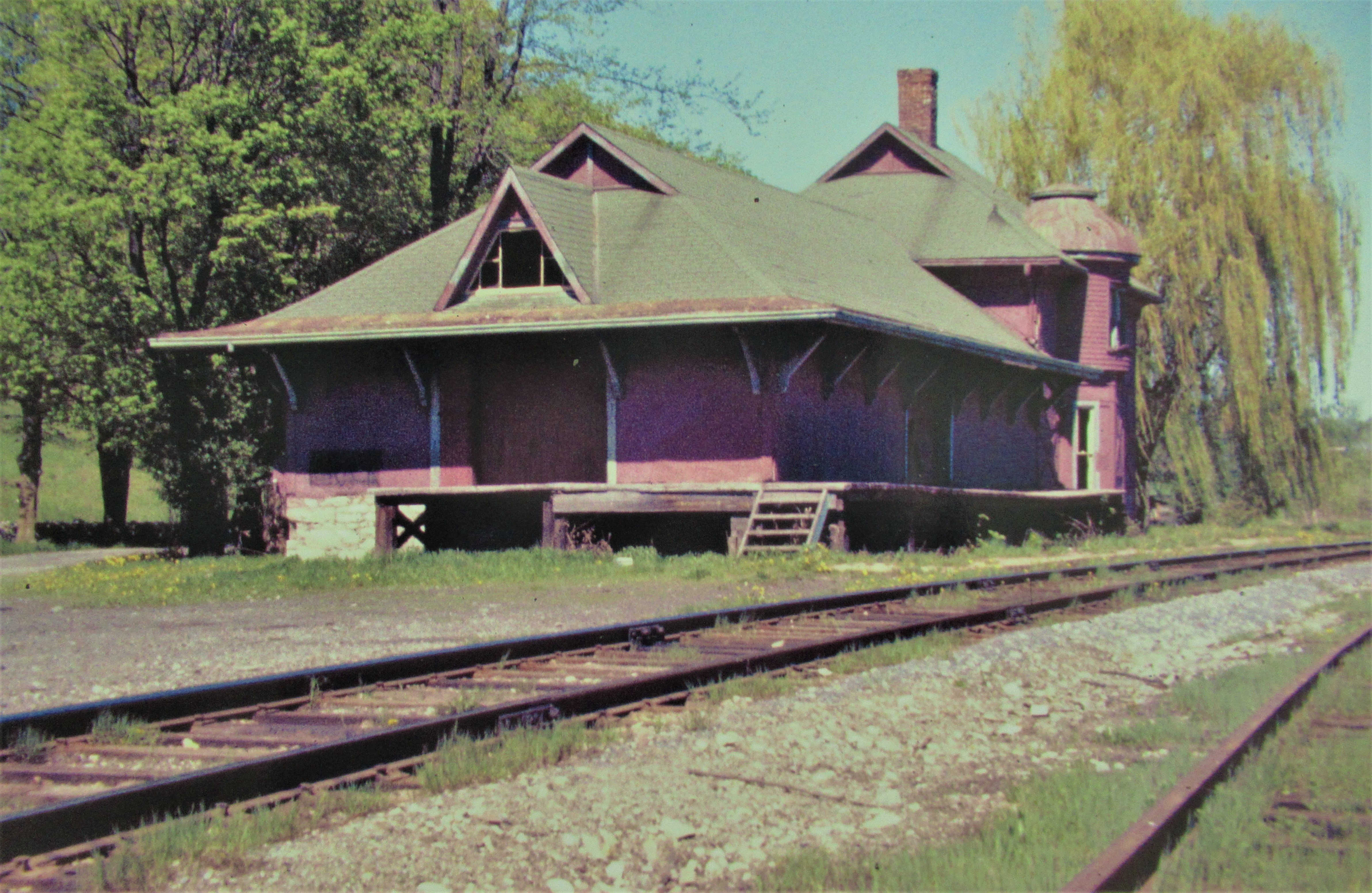
A 1971 CN track schematic showed track SA50, a 2500-foot passing track at Mi. 80 Smiths Falls Sub, visible in the foreground of the early-1970's Bill Reid photo (below). The Sydenham station's best years are definitely behind it. Most local residents now identify this as the location of The Beer Store. Just to the east was a turntable and one-stall enginehouse built at the shore of Sydenham Lake, dating from the days when Sydenham was the 'end of the line' before its extension east to Smiths Falls and Ottawa.
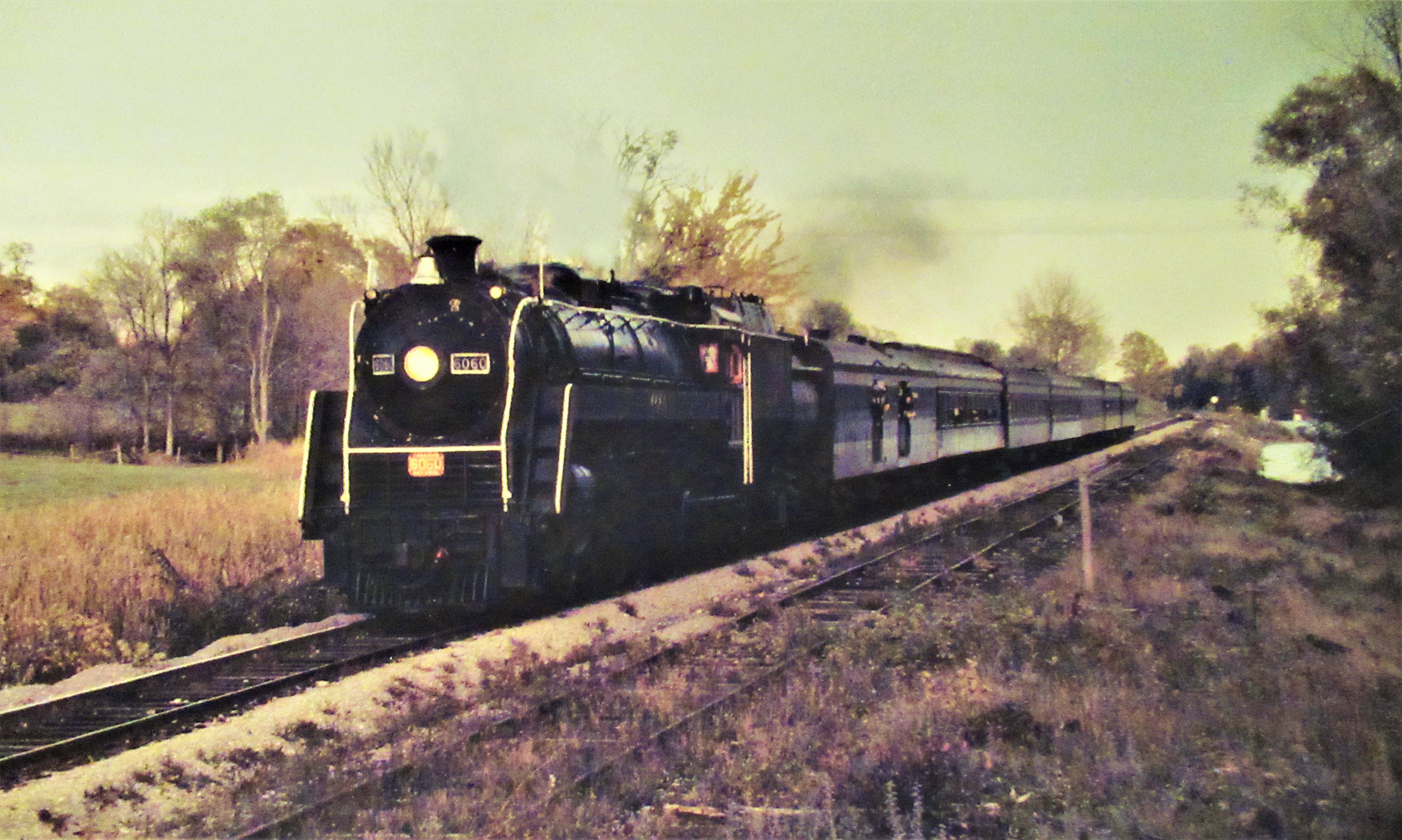
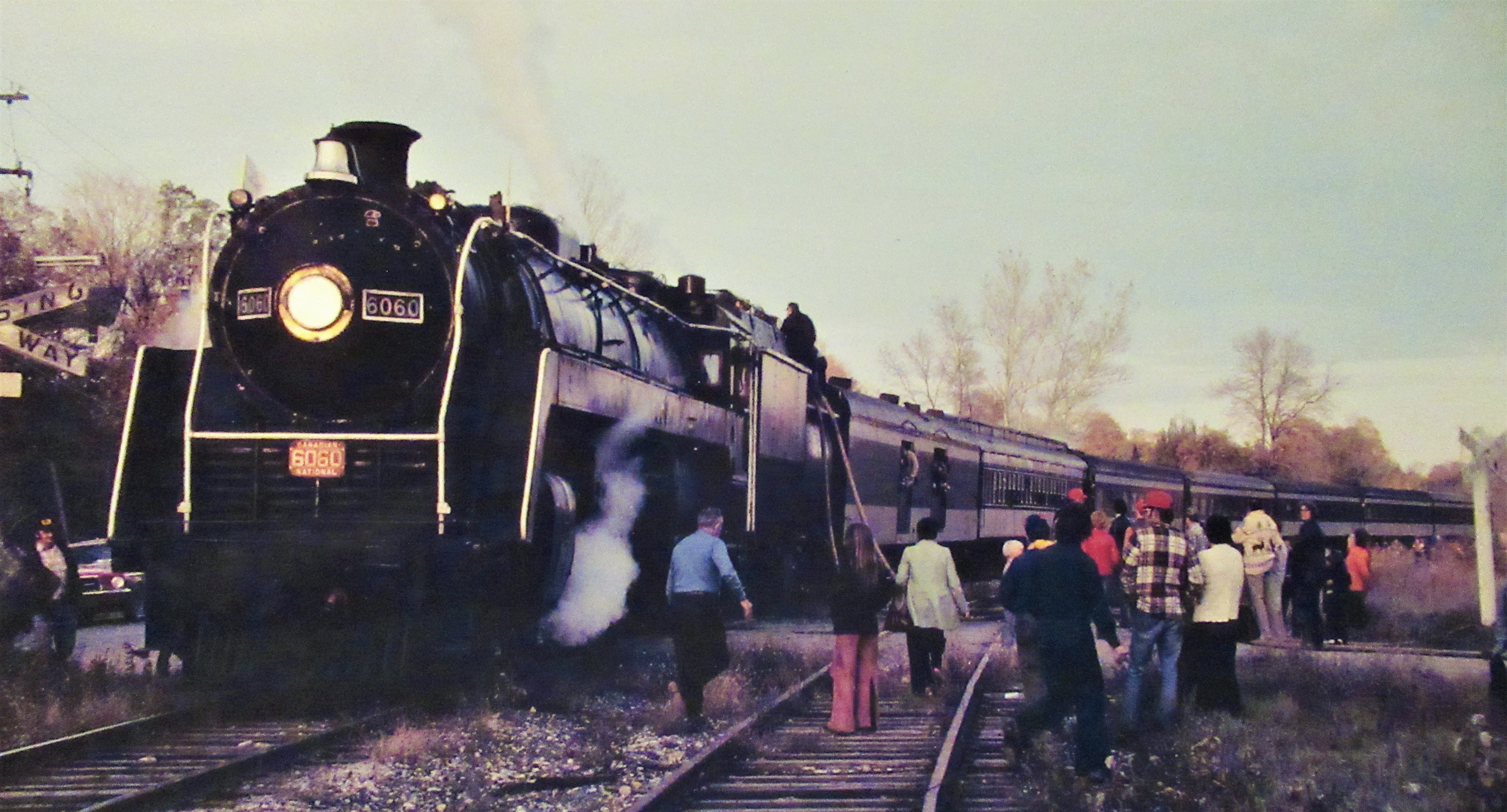
Ottawa-Toronto fantrips behind CN 6060 would grace the line before its eventual removal. Watch for an upcoming Trackside Treasure post on the peregrinations of this perennial crowd-pleaser! This Montreal-Ottawa-Toronto fantrip, on October 17, 1977 stopped for watering by the volunteer fire department at the level crossing in the village. The special train passes the east end of the siding and Sydenham Lake at right, with daisy-pickers hanging out the open doors of the baggage car. They would be cinder-free thanks to the oil fire:
Taking on 11,000 gallons of water from Sydenham Lake just after sunset. Operating two hours late, this detrimentally affected photography. Lots of local residents came out to see what all the noise was about! We were also there.
Pounding up the grade out of Sydenham. With sunset at 1830, the light was fading, but not our anticipation. Nor the the impending smoke and sound! (Three photos, Bob Hunter via Liz Reid, author collection.) Church Street crossing, near the cemetery. Perhaps it's overstating it, but the sound could wake the dead!
Though the line would see infrequent continued use into the early-1980's, including short-lived visions of a dinner-train, the end of CN's Smiths Falls Subdivision was not far off. We'll visit Harrowsmith during the CN's final days in the fifth post in this series.

Running extra...

I'm pleased that downtown Kingston's best book store, Novel Idea, now carries my latest book Smoke on the Waterfront - The Trains, Ships and Industries of Kingston Harbour. Good news - proprietor Oscar told me that customers had already been requesting the book! Not-so-good news - Oscar had no idea where to find it! Fixed.

This post is spawning an upcoming post on the peregrinations of 6060 in the 1970's, following its refurbishing for fantrip service. Based in Toronto, she sure got around! Most impressive were solo deadhead moves along the Kingston Sub with no railfan telegraph for warning - only the sound of a steam whistle!

March Forth is just past. One of the few days of the year that gives us a suggestion of something to do. Well, besides March 14! That latter day tells us what to have for dessert!