Saturday, February 13, 2021

Harrowsmith, ON Part 1 - The Early Years

Harrowsmith station, 1910
Harrowsmith, Ontario is a village north of Kingston. The sign off Highway 401 directs drivers 16 kilometres up Highway 38. At the hub of roads linking Verona to the north, Sydenham to the east, Wilton and Yarker to the west and Kingston to the south, the village was a crossroads community. The top photo shows a westbound train passing the town's station in 1910. It's probably fair to say that trains photographed in Harrowsmith, 19 rail miles north of Kingston, were only there because they were on their way to someplace else. But Harrowsmith's unique location led to the village hosting a unique railway connection. One that I'm struggling to contain in anything less than a five-post series, the links to which will reside here as they're posted:
B of Q - NT&Q - K&NW then CN

The Rathbuns' Bay of Quinte (B of Q) Railway & Navigation Company was granted a charter in 1879 to build a line to connect Deseronto with the Grand Trunk Railway (GTR) at Napanee. The line entered service in 1881. 

The Napanee, Tamworth & Quebec Railway (NT&Q) was chartered the same year, coming under Rathbun control in 1883. It commenced operations from Napanee to Tamworth in 1884. Only the Grand Trunk connected the two lines at Napanee. Here are schedules of the B of Q and NT&Q from a 1887 Official Travelers Guide:
Notice all the Rathbun family members in B of Q and NT&Q management!
The NT&Q became the Kingston, Napanee & Western Railway (KN&W) and leased to the B of Q on September 24, 1891. With running rights over the GTR, through service from Deseronto, plus NT&Q extensions from Tamworth to Tweed, and Yarker to Harrowsmith completed in 1889, these lines were connected to Kingston by running rights over the Kingston & Pembroke (K&P), also in 1889, until 1913. So, there were 60 aggregate miles under Rathbun control, plus an additional 24 miles of running rights. 

The KN&W was merged with the B of Q, forming the Bay of Quinte Railway Company on January 1, 1897. An original 1893 plan for Harrowsmith proposed a KN&W extension that would cross the K&P at Harrowsmith via a diamond. But a curving line into the village meant a more optimal through-connection sharing a short section of the K&P line, not a diamond. This junction was controlled by a manned interlocking installed by the KN&W. The said crossing to be protected by derails and two distant semaphores, on the Kingston, Napanee & Western Ry. one in either direction, placed in such position, in addition to distant signals on the Kingston & Pembroke Ry. The said derails to be kept locked open during the night - the key (there must not be more than one) locking and unlocking the said derails, to be held in the custody of the Stationmaster at the Harrowsmith Station who will be responsible that they are so kept locked open at night.  All at the cost of the Kingston, Napanee & Western Ry. A 1902 proposed plan for signals at a diamond crossing of K&P/B of Q:
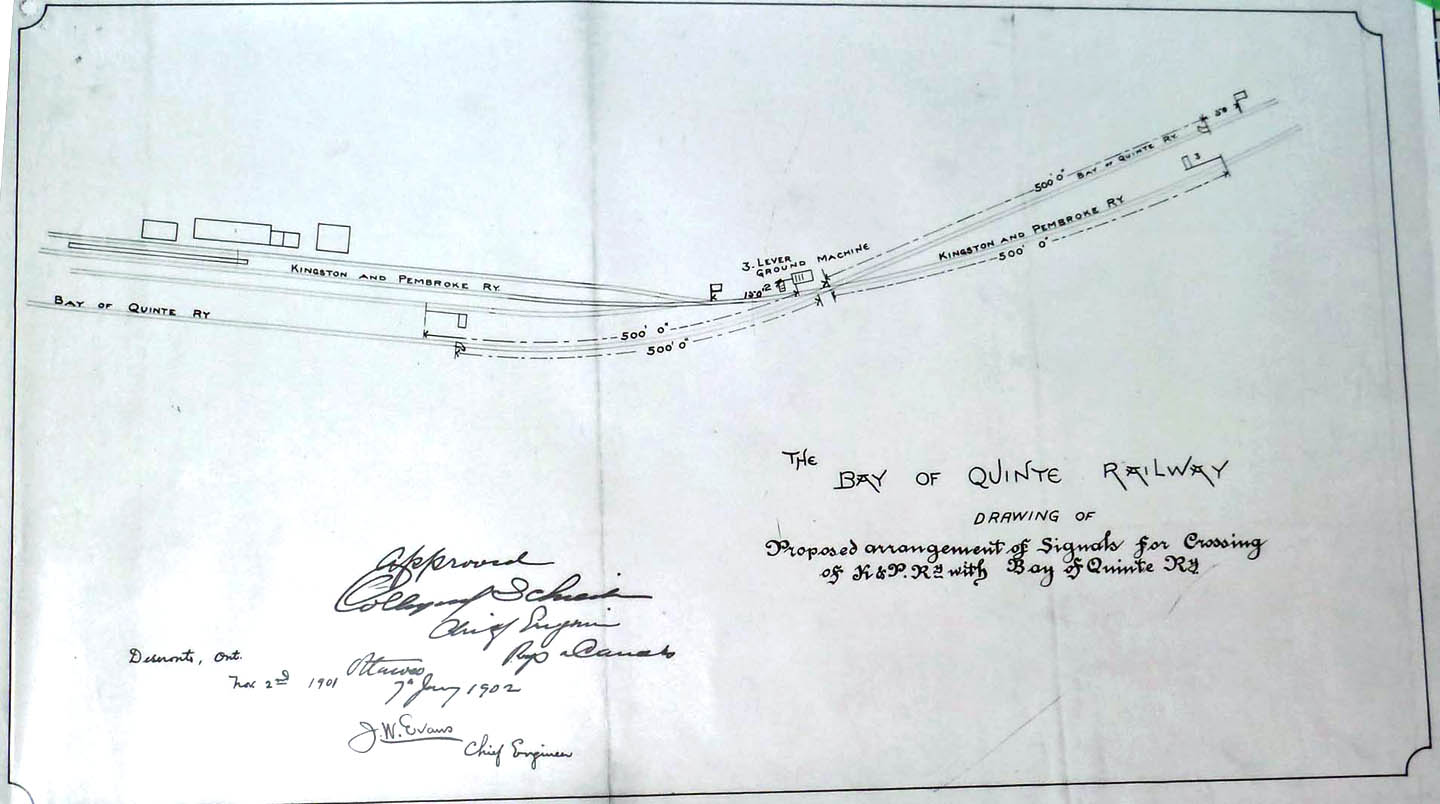
The B of Q passed into the hands of Mackenzie and Mann in 1909, then under full control of the Canadian Northern Railway (CNoR) in 1914. The CNoR built a through-connection at Yarker, west of Harrowsmith, in 1912-13. This more effectively linked the two segments of the B of Q on the CNoR's way from Toronto-Ottawa (opened in 1912), thence Montreal in 1914, without previous cumbersome switching moves. The rebuilt connection included a new, longer bridge at Yarker in a now-uninterrupted east-west flow of traffic. CNoR was taken over by Canadian Government Railways in 1917, thence CN. The CNoR remained a paper railway, its corporate existence coming to an end in 1954. The K&P dark-lined map below, before what would become the CN line extended east of Sydenham and Harrowsmith, shows Harrowsmith during the running rights era. Once the connection between Ottawa and Napanee was completed, CN and CP trackage  mapped at Harrowsmith would show that 'X' marked the spot.

KINGSTON & PEMBROKE then CP

Survey crews under Thomas Nash mapped out a route for the Kingston & Pembroke, from Kingston to Sharbot Lake. The construction contract was let to G.B. Phelps & Company of Watertown, N.Y., coincidentally one of nine Watertown investors. The official sod-turning for the K&P took place at Kingston on June 17, 1872 near the site of the Davis Tannery. Rail was 50 pounds per yard as far as Sharbot Lake, thereafter 56 or 60 pound rail further north. Of the line’s 103 miles of main line, the track was only level for 38 of them, and only tangent for 65 miles. Curves accounted for more than 35 miles. Harrowsmith and trackage as far as Godfrey was completed on June 17, 1875; Sharbot Lake on October 25, 1875 and opened for use on May 8, 1876. An excerpt from Engineering, Vol. 39 on the completion of the K&P, Jan-June 1885:
Here is the K&P schedule, also taken from the 1887 Official Travelers Guide, showing trains heading from Kingston to Sharbot Lake and Renfrew. From Harrowsmith with connections to...Vancouver!
The K & P line was in receivership in 1894. But it reorganized four years later and in 1903 passed to the CP. The Bay of Quinte Railway enjoyed trackage rights over the Kingston line until 1913. Before the First World War the Kingston service consisted of a daily passenger and mixed train each way with an extra mixed service as far as Sharbot Lake. The Canadian Locomotive Co. built the Kingston company's 11 locomotives. Records show the line's inventory when the CP took over included seven passenger cars, 50 flat cars and 20 box cars.  CP gained full operational control of the K&P in 1913, though it would remain a paper railway. 

In 1909, K&P train times at "Harrowsmith Junction" (shown as 24-hour clock here) with times at Kingston 45-60 minutes different, Northbounds/Southbounds:
  • 1242 No 1 Kingston-Sharbot Lake Psgr Daily Ex.Sun/No 2 1512
  • 1755 No 3 Kingston-Sharbot Lake Mixed Daily Ex.Sun./No 4 0710
  • 0835 No 5 Mixed thrice weekly/No 6 1242
In 1909, B of Q train times at Harrowsmith Junction:
  • 1655 No 11 Third Class Mixed Daily Ex.Sun./0910 No 12
K&P Harrowsmith Yard Limits in 1909 extended from South Semaphore to North Semaphore. Harrowsmith was a register and bulletin point, with day telegraph office symbol 'SD'.

In 1915, daily CP train times at "Harrowsmith Junction" Northbounds/Southbounds:
  • 1158 No 619 Kingston-Renfrew/ 1445 No 620
  • 1805 No 623 Kingston-Sharbot Lake/ 0655 No 624
  • 2045 No 621 Kingston-Renfrew/ 1325 No 622
In 1914, daily Canadian Northern train times at Harrowsmith, with times at Kingston 50 minutes different:

  • 1720 No 75 from Kingston to Tweed via Yarker daily ex.Sun. northbound
  • 0920 No 76 from Tweed to Kingston daily ex.Sun. southbound
Above - Various Kingston British Daily Whig newspaper advertisements for BofQ (1912 small), K&P (1911) and GTR (1911 and 1917) and all three (1911). Click for a larger version.

Below - A 1938 CP plan showing arrangement for interchange tracks and a (CN or predecessor) wye south of the trackage in Harrowsmith, west of the current Highway 38. The interlocking tower is shown as 22 feet square at the joint section. Also, a reference to a collision which occurred on September 29, 1917 appears therein. 
Sightlines noted at Wilton Road crossing just west of station. (Plans via Colin Churcher/Ottawa Railway History Circle)
Some station vintage views:
1908 looking west

1912 looking east

1915 looking west

Maps illustrate Harrowsmith's transportation importance to us as rail enthusiasts. It would not be until 1985 that I would get to know Harrowsmith in another more personal way. My future wife, and her family lived in the area! In fact, right beside the Canadian Northern line between Harrowsmith and Sydenham.

In the next post in this five-part series, we'll look at Harrowsmith operations in the steam era and eventually farther east to Sydenham!

Running extra...

Harrowsmith Fun Fact: The same-named magazine, first conceived in 1976, was initially published in Camden East, not Harrowsmith! For homesteaders earth-mothers, and those who wanted to live on their own.

What social isolation? Over the past week, I enjoyed opportunities to:

  • watch inimitable Fallowfield Effect live-action HO Galt Sub. switching
  • hear Bob Fallowfield discuss how to blend 'That Car' into a realistic fleet
  • join the Toronto Railway Supper Club for two hours of Hanley Spur discussion
  • enjoy an Associated Railroaders of Kingston Zoom presentation by Bill Linley
  • keep up on the blogs in my sidebar - varied prototype and model subjects
  • enjoy the True North (all-Canada, above) February 2020 issue of Railfan & Railroad, leading to a discussion  with editor Steve Barry about Quebec place-naming conventions!
  • 'see' CN freights with IC Heritage and BCOL cowl units, the latter repeatedly showing up Toronto-Belleville trains 516/517

Saturday, February 6, 2021

Pop-up Post: 1 Hour, 6 Freights, February 2021

More photos! Less Verbiage! Time for another pop-up post, the genesis of which was CN military tribute unit 3015 (top photo) that was heading east to Kingston on CN No 376 on February 4.
0946 W CN No 271 5668-2568 all auto racks


1008 E CN No 106 3227-DPU 3044 488 axles, 51 mph
Multi-door container

1013 W CN No 369 5652-5720 378 axles, 49 mph. FAXX 285 PD car

Aging bulkhead flat car for pulpwood WC (BC Rail!) 237723

20 new CN covered hoppers on tail-end 

1028 W CN No 149 5632-2591-2500 NA map scheme 526 axles, 28 mph

(This was a long intermodal train. The tail-end still hadn't passed Mi 178 while the head-end was at Mi 180. Based on 178 platforms, with many being five-paks for 53-foot containers around 305 feet in length, many single-well cars for 53-foot containers at 76 feet, and several five-paks for 40-foot containers at 265 feet, plus the power, my back-of-napkin calculation puts the train at 10,570 feet = 2 miles. It passed Mi 170 doing 47 mph but was clawing its up way up the hill to my location.)
1036 E CN No 376 3015-3220 508 axles, 34 mph

Early-morning sun caught the camo - yellow ribbon on engineer's side

Hostler's choice! CN 100th anniversary unit + military unit!

Next morning on CN No 105 (image courtesy of Railstream, LLC) -  poppy on conductor's side

MTBX 010-012 'scrap-tubs'


New UNPX 320-series sodium chlorate cars - previous aluminum cars obsolete

Clean Montana Rail Link boxcar 21086

FAXX 280 PD car

FAXX 298 PD car

Cylindrical dimensional load on TTPX 804276

1043 W CN No 305 2243-2512 NA map scheme

CN 197114 with three BLE hoppers in tie service.


Wednesday, February 3, 2021

New Trains - CN Nos 516/517

 WHO'S NEW ON THE KINGSTON SUB?

On CN's Kingston Subdivision, train Nos 516/517 was an irregular Toronto-Belleville train over the past few years. Normally taking cars from local industries east and west of Belleville to Toronto's MacMillan Yard, Belleville yard power pulled the train, heading to the locomotive shop there for scheduled maintenance. Recently, CN has changed the frequency of 516/517 to daily, normally weekdays but sometimes also on weekends. Besides the increased frequency, and perhaps coincident with the move of CN dispatching from Toronto to Edmonton, 516/517 are now powered by two road locomotives. (Top photo - BCOL 4601-CN 2567 head No 517 west with 75+ cars from Belleville at 1245 on January 19/21 - image courtesy Railstream, LLC) Toronto to Belleville and return - these big ponies are no longer the small Geep yard power I found ready to take 517 west in April, 2015 (below). Also, their run has been extended east to Brockville. Some January locomotive consists: 2166-2403, BCOL 4601-2567-5675-5630-2538-5685, BCOL 4605-2417, 2548-5605, 2634, 2101-26xx, 5639-2610, 2559-2446 (NA map scheme).

This post examines new 516/517 in all "five W's"!

WHY THE CHANGE?

In decades past, the maid-of-all-work trains on the Kingston Sub were Nos 317/318. These two took a day (or two) to work Kingston Sub online yards between Toronto and Montreal. Once they stopped running, or operating as a weekend-only dimensional load/fill tonnage train, road freights have made lifts and setouts at Belleville and Brockville. Perhaps the service design wizards at CN now prefer to have only one train handling all the online work, not delaying multiple trains at multiple yards along the busy subdivision.

WHERE DOES IT GO?

Eastbound 516 brings cars to Belleville for roadswitcher No 519 to Trenton/Cobourg/Port Hope and No 518 to Millhaven/Kingston, as well as Brockville cars. Westbound, 517 takes cars from those same places - empties that have beeen loaded and loads that have been emptied - back to Toronto for furtherance on the CN system. At times, the locomotives run as light engines between Brockville and Belleville.  

WHEN DOES IT RUN?

It's a train that operates normally at night through Kingston, and it's been a long time since I've observed any train that runs in the middle of the night! Observations show that 516 arrives at Belleville after suppertime, changes its designation to CN No 526 through Kingston by midnight thence Brockville. Returning through Kingston at zero-dark-thirty, possibly lifting here, still as 526, 517 leaves Belleville before lunchtime, thence working Oshawa before arriving in Toronto. (Interestingly, 516 has also headed east to Montreal, or conributed east traffic to 586 at Brockville/Maitland!)

WHAT'S ON IT?

I've been able to observe several iterations of 516/517 at Belleville, in a socially-distanced way, from Kingston. Train length can be anywhere from 20 to 70 cars. It's an interesting and unpredictable consist. Unpredictable because Bellevillle-Trenton-Port Hope 519 (night job which sometimes also heads east from Belleville) operates on the opposite weekdays from day job 518 Belleville-Kingston, the latter usually running Monday-Wednesday-Friday. Cars brought in to Belleville be 518 and 519 are taken west on the next 517, so for instance, Kingston Invista cars can be seen on 517 on a Tuesday, Thursday or Saturday.

  • Cars from Belleville: Soltex tank cars; plastic pellet covered hoppers, and roofing granule covered hoppers.
  • Cars from Kingston: Invista covered hoppers/tank cars; KIMCO I-beam steel loads on bulkhead flat cars or Railgon gons, and scrap loads out in IC gondolas or CMBX gons and bathtub gondolas.
  • Cars from Millhaven: stored covered hoppers, Procor sodium chlorate covered hoppers and tank cars in and out, Coco Paving asphalt tank car loads in and Gibson Gas propane loads in.
  • Cars from Port Hope: single eye-catching SFLX white/brown tank cars with hydrogen fluoride.
  • Cars from Cobourg: plastic pellet covered hoppers, 2-6 bulkhead flats with slat wood for pallet plant.
I haven't yet dived into the abyss - divining which of 516/517's 30-50 tank cars go where. I've noted one or two black/white DPRX tanks consistently, and 5-20 Corn Products short corn syrup tanks and EVOX hydrogen peroxide white tanks, the latter two types likely from Brockville/Maitland/Prescott. There are also shorter SHQX/UTLX/TILX leased to Dyno/Nobel tanks placarded for UN 2426 hot ammonium nitrate/cesium UN1407. At Johnstown, there is a 320-car Canadian Rail Equipment Works & Services (CREWS) transload/storage facility. Cardinal's Ingredion facility stores cars there, as well at Dyno/Nobel at Maitland. Same for the 1-18 plastic pellet covered hoppers. However, 516 does bring traffic for Brockville: for CP, and for CN roadswitcher No 532.

Kingston Invista receives 4-7 KLRX, MGRX and INVX covered hoppers and 4-6 TILX black tank cars each time it's switched. 

The 5-12 Belleville granule cars are an eclectic mix of shorter covered hoppers - old cylindricals, NAHX and MWCX newer cars and clapped-out former Boston & Maine AEQX's like 3001, 3007, 3008, 3012, 3028, 3030.

Unpredictable consist cars include:
  • KRL or QTTX flatcars carrying Alstom (Bombardier) Flexity Freedom LRT cars from Millhaven, heading to Winnipeg, Eglinton or Kitchener, with idler flats fore and aft. Bryan Martyniuk adds that the vehicle pictured is on its way to Alstom Bombardier in Thunder Bay for finishing before delivery to Toronto's Metrolinx TTC (Below and top photo - image courtesy of Railstream, LLC):
    Bryan kindly sent a photo of the same Flexity on CP in Thunder Bay:

  • On occasion, up to 50 empty 'bare-table' well cars heading west, representing the current imbalance of containers mostly heading east on the Kingston Sub.
  • Stray LRS/ATW/WC boxcars, ingot loads and lumber loads (further research required as to destinations, - in Belleville, Brockville or maybe Prescott.
  • Up to 20 auto racks
  • CN(WX) grain cars or auto racks, 1-2 of each with two auto racks going through to Brockville!
  • Lost cars, misswitched or bad-ordered online. Misdirectomies.
RESULTS OF MY CONSIST STUDIES

Based on 66 consists that I've viewed, here are some statistics on typical 516/517 consists at Belleville:
  • Average number of cars: 40
  • Average arrival time for No 516: 2030
  • Average departure time for No 517: 1200 before Feb. 8; 1600 after Feb. 8
  • Two units assigned if over 50 cars
  • Average numbers of cars on appropriate days: 18 tank cars, 12 granule covered hoppers, 8 covered hoppers, 5 KIMCO cars, 5 Invista tank cars, 5 Invista covered hoppers, 3 Cobourg bulkhead flats, 5 ingot flats.
So, if you see a certain cornucopic consist canoodling along the CN Kingston Sub, day or night anywhere west of Brockville, you could be seeing 516/517! Enjoy! Thanks to Chris de Vries, Malcolm Peakman, Paul Hunter and Logan Cadue for additional information in this post.

Running extra...
I switched from Jimmy Fallon to Stephen Colbert for the latter's acerbic, wry and wordy commentary including his extended intros to his Quarantinewhile... segment. With your indulgence, I'm going to practice an intro that's pertinent to this tail-end part of each Trackside Treasure post. Hmmm. Goes like this:

"Every so often, when I'm concocting the word salad and cheesy casserole of observations and wallowed-in nostalgia and photographic pastiche known as my main blog post, I also measure out, mix and food-process some tasty, non-sequiturial accoutrements swept from the bottom shelf of my refrigerator into a gastronomic dustpan dessert, known for its sweet and syrupy, word-wise and world-wise view of all things not necessarily train-related that I then couple together and slowly but surely drag out of the departure tracks of this blog onto the mainline for all the trackside folks to wave at, salute and enjoy, in the flat-wheel-laden segment I call....Running Extra..."

Stephen used to enjoy pronouncing the name of disgraced and fact-fearing White House Press Secretary Kayleigh McEnany (which he feistily pronounced KayleighMACKENANNY!!" but will now have little trouble with her replacement, Obama-era Jenn Psaki. And I don't know why, because the funniest letter in the alphabet is 'K'.

Fun fact: Every 'c' in 'Pacific Ocean' is pronounced differently. Cee what I did there?

Thursday, January 28, 2021

Model Railroading During a Pandemic II

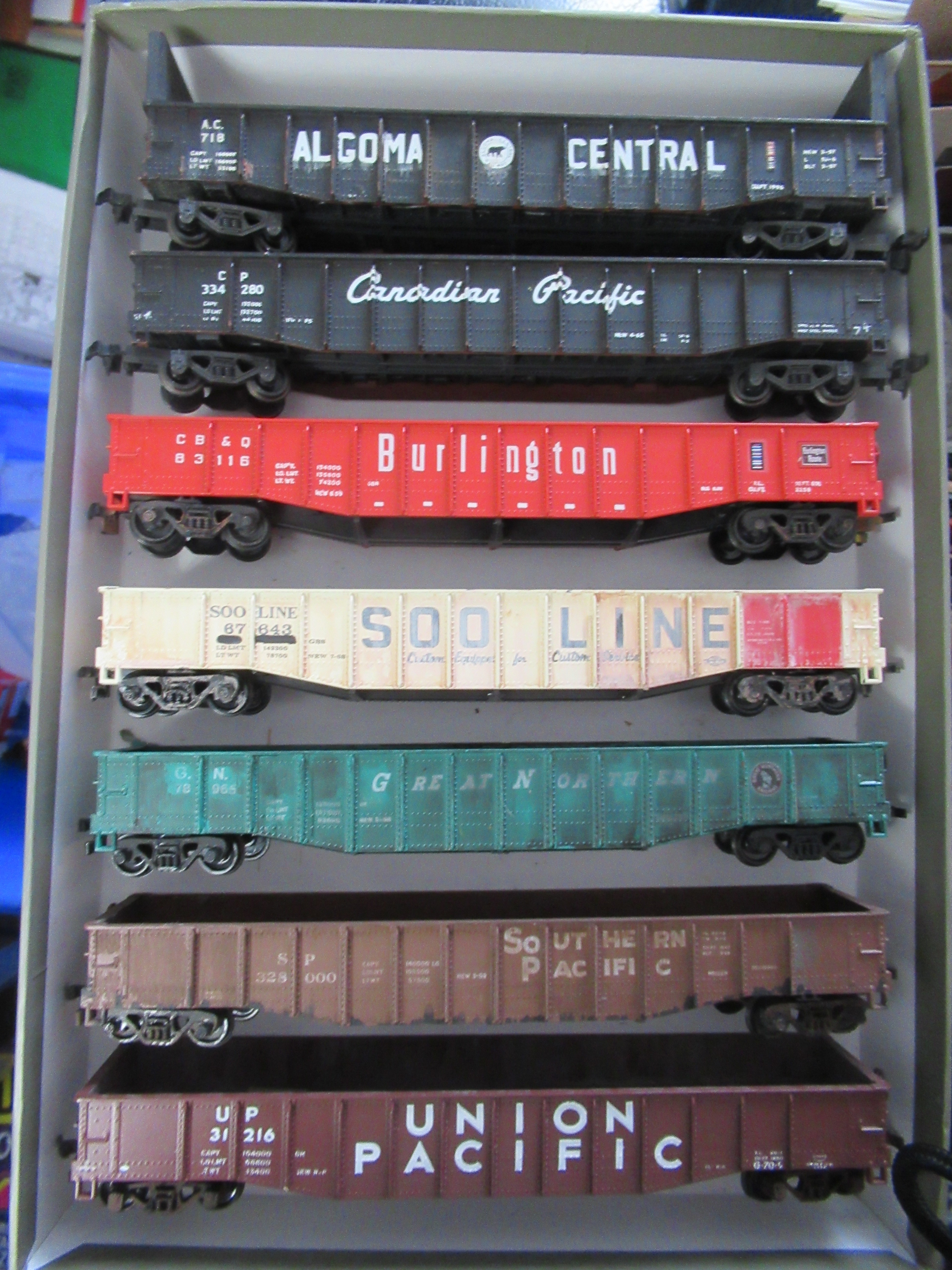
It's coming up on a year since my first Model Railroading During a Pandemic post back at the start of the lockdown in March. And I will be glad when this pandemic is someday gon. Athearn's  gon is one of my most reliable, favourite cars to operate on my Kingston's Hanley Spur HO layout. Fortunately, I have at least four industries that receive them, and a couple that ship commodities these cars can handle. So I keep accumulating them! My 1970 modelled era saw the advent of several bright railroads' paint scheme, while the steam-era holdover boxcar red schemes predominated.  I have a hard time deciding whether I prefer them weathered or unweathered, though I'm trending toward the latter. Since most of my layout is visible from the 'inside', I have kept one side pristine (below) and the other weathered (above) on many cars. 
These cars are in steel and scrap service so they're not kept pristine. It seems realistic to me to keep some of the cars' lettering almost illegible to match the prototype! I've made a point of painting the interiors. They don't stay bright red and bright green in service! You'll notice I added some bits and pieces to a couple of the cars' interiors. I wanted to do more...
Watching a real train from above, many details become visible that we don't traditionally see trackside. Spilled grain on covered hopper roofs, boxcar roof weathering, and gondola interiors. For some reason, I'd kept a whole plastic parts drawer full of wood bits (below). They were about to come in handy. Also, when I 'Dremel' a structure kitbash, I've filled a scrap metal truck with the little melted plastic bits that adhere to the cooled styrene and have to be broken off. Also in this photo, to paraphrase Monty Python, "Sir Not Appearing In This Film", that is a Frisco MDC (non-Athearn) gon that has also received the weathering and interior treatments:
Here are my pre-positioned raw materials for the cars I was doing: Dremeled styrene bits, scrap wood, and black magnet trimmings to represent metal banding. 
After gluing and painting (below). If they're hard to discern, that's OK. I want the effect to be subtle. No man should be left behind, and no gon should be left completely emptied!
One important reminder: I have some sheet steel loads made of styrene, as well as several RBT's, and if the debris is too 'tall' then your loads will not sit level. That's why I kept these low-profile!

More pandemic modelling I've been doing over the last month or so, that you may not have seen:
That illustrated list makes it seem that I have been busy. Or that I have a panoply of pandemic modelling projects to do! Watch for an upcoming post on operating the layout - CN 4530 and an end-cupola van switch a lone PC boxcar (back when it stood for Penn Central, not Politically Correct!).

Graphics guru and fellow modeller Randy O'Brien vastly bettered my meme of 'Eric/Bernie' riding the 4530...
...and enjoying the nice weather on the Bajus Brewery loading dock! Thanks, Randy!

Running extra...

I'm looking forward to presenting a program to the Toronto Railway Supper Club this coming week. It's entitled Kingston's Hanley Spur - An Industrial Approach. A topic near and dear to my heart and more fully profiled in my new, seventh book. The combination of an interesting talk and Supper just can't be beat!

Let's keep on fighting that war,
You know the WAR that I mean,
I read it on a tank car, 
Its ON 'BUG COVID-19'!
If you woke up this morning and jumped out of your rack saying, "I don't think I'll see a A.V. Roe metal plate today diagramatically depicting the oil system of the Avro Anson", well, you were wrong: