Tuesday, October 1, 2013

Sceneramics, Tiny Lettering

Now that we've covered some history, operations, in-service photos and disposition of these superb Sceneramics, there's one issue that remains unsettled. I hinted at it in Sceneramics, Part 2. It's the question of that tiny lettering high up on each side of the cars while in CN and VIA service. I've consulted VIAphiles, uberVIAphiles and they've consulted me, but no-one had the 'Sceneramic smoking gun' or  'Sceneramic steel spike' to definitely drive through the heart of this enigmatic beast. Until now.

EQUIPMENT TRUSTS
Rolling stock can be 'repossessed' and resold if necessary, so money is readily available to help pay for cars and locomotives. An equipment trust is a mortgage on specific rolling stock. In the most common arrangement, called the 'Philadelphia Plan', equipment trust notes covering about 80 percent of the cost of specific equipment are issued by a financial institution, with the railway making a down payment of 20 percent. The notes are paid off in instalments by the railway, with the bank retaining title to the rolling stock until the last notes are retired, usually in 15 years. Insurance is carried by railways to cover any losses to equipment while held under a trust note. Serial maturities mature over a period of years, and control of the rolling stock reverts to the railway as those maturities occur. The lender holds an interest in specific equipment and can seize it to repay the loan. When cars under an equipment trust certificate are paid for, the certificate is cancelled, and the trust plates or stencilling removed. At that point the railway fully owns the cars. Wall Street believed that financing tied to a specific asset was more credit-worthy than financing tied to a railway's financial health. The ultimate purpose of an equipment trust certificate is to lower interest costs. Manufacturers Hanover and the Equitable Insurance Company were well-known companies in the field.

EQUIPMENT TRUSTS AND THE MILWAUKEE ROAD
Interestingly, the Milwaukee Road was known for its use of equipment trust certificates to finance the rebuilding and reselling of its freight car fleet. Eventually, spending on rebuilt cars outstripped spending on new cars and the Milwaukee was forced to rebuild and sell cars to pay the charges on its existing fleet. This practice was likely the Road's biggest single downfall, as there was neither available money nor an adequate, modern car fleet. CMSTP&P annual reports often recorded equipment trusts and a series of expiration dates. The 1955 Annual Report includes a list of equipment trust certificates in series Y, Z, AA-HH, JJ-TT, and in the 1962 Annual Report series HH and JJ-ZZ.

EQUIPMENT TRUST PLATES ON PASSENGER CARS
Passenger cars often bore equipment trust plates in the form of cast metal plates, showing the name of the owner and the railroad leasing the equipment, as in this NYNH&H plate. Plates were favoured over stencilling as they were not as easy to remove if the car was repainted, nor lost if a car was wreck-damaged. Stencilling could be missed or forgotten over time due to repairs or repainting. The location of such plates on passenger cars varied: sometimes high up on the car side, on a vestibule wall, or near the builder's plate. Plates could also be riveted to the centre sill under the car, usually near a brake system information plate. Remember that equipment trust certificate periods could be as long as 25-30 years.

SUPER-DOME EQUIPMENT TRUST DOCUMENT
A 1973 US Surface Transportation Board recordation 6649-B lists in its appendix Four (4) Dome Passenger Cars, Chicago, Milwaukee, St. Paul and Pacific Railroad Company's identifying road numbers, respectively: "55, 57, 58 and 59, together with said present stock of spare parts for said cars".  The notarized recordation, dated May 4, 1973 is between officials of the Milwaukee Road and the Continental Illinois National Bank and Trust Company of Chicago, Trustee. Is it possible that the six other Super Domes, acquired by CN were governed by a similar trust? (I stumbled across this STB Recordation site while searching for lease information for the 1980 Manitoba Covered Hoppers post. It's a treasure trove of rolling stock information, buried deep in legalese) 

EQUIPMENT RESTRICTIONS AT WINNIPEG
Any city that has a station trainshed must be concerned about clearances, just as trucks must be concerned about low highway overpasses. Nobody wants a Sceneramic, Skyline or Park car dome scraped off, with associated passenger and crew fatalities and injuries. So the operation of any high or wide equipment would have to be checked by company officials before the equipment operated in the vicinity of a station trainshed. Well-known examples include the Canadian's F-unit icicle-breakers, Superliner equipment tested by VIA, double-stack container well cars, wedge plows, and in this case, Sceneramic cars. At Winnipeg, where VIA/CN 6510 (above - CSTM Collection CN000551) poked its nose westward in 1977, half-ties were used on specific tracks to increase rail-to-trainshed clearances. Here's a Chris Doering photo showing the lettering applied to many Prairie Region plows:
There are photos of Park cars, including Algonquin Park, drumhead-less in 1980 and Sceneramics being operated through the trainshed. Remember that Sceneramics, 15'6" in height, were four inches below the 15'10" height of Park cars, not the other way around! Here are Gary Hadfield's fine photos of CN No 1 at Winnipeg in October, 1975:
Follow the characteristic Winnipeg Union lightposts into the trainshed and out the other side, and it appears that when that when the Super Continental heads west, the train's Sceneramic, bearing that tiny black-on-white lettering, is going right through the shed! Club lounge Gaiete was removed and Sceneramic Athabasca added during Gary's layover at Winnipeg.
Gary later photographed Athabasca steaming during a chilly Jasper station stop:
SCENERAMIC EQUIPMENT TRUST DOCUMENTS
It's possible that when CN acquired the Milwaukee Super Domes, there was an active equipment trust that accompanied the cars. In fact, a VIA roster published in 1979 specifically but cryptically states that the Sceneramics are "Ex-Milwaukee Road 'Super Domes', rebuilt for CN service. Cars leased from Wall St. Trust Co. [sic]". Ex-Milwaukee sleeping cars are listed differently, as "Purchased from the Chicago, Milwaukee, St. Paul & Pacific RR..." This Wall St. Trust Co. notation got me wondering. Googling 'Wall St. Trust Co.' reveals nothing relevant. Perhaps that was just someone's unofficial notation on the VIA roster...

SO JUST WHAT IS THAT TINY LETTERING?
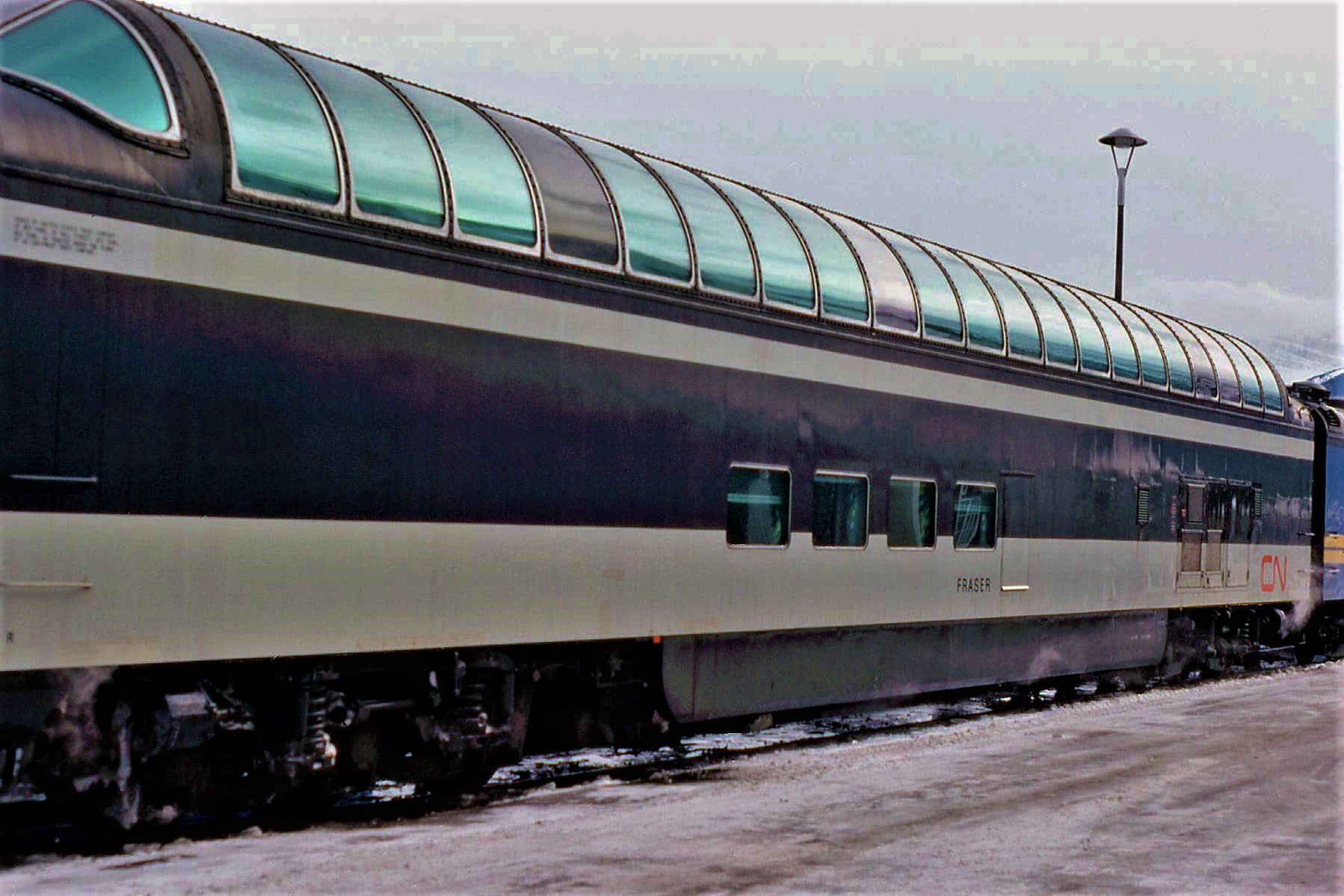
The positioning, size and visibility of the lettering is certainly consistent with other equipment trust stencilling (see photo second from top). The fact that the same lettering is visible in photos from the CN era up to the VIA era in 1981 shows that it was important enough to be re-applied after repainting from black-on-white to white-on-blue. Curiously and conversely, CN's double-deck auto transporters used in Car-Go-Rail and Auto-With-You services had large, probably 6" or larger, bilingual warning lettering (below) and a yellow line at both ends and both car sides - that's six different locations per car!
Yellow line is clearance limit for standard cars. Max. height for this car 16' 6"
This lettering was visible from all sides and ends. Compare that with the Sceneramics' tiny lettering, only at the top left of each car side - only two, rather inconspicuous locations per car! (Notice how it was easy for the painters to properly locate the tiny lettering on the narrow white CN passenger scheme band, but a little more location leeway for the stencil was employed on the solid VIA blue)
Columbia, online auction site photo:

STB RECORDATIONS
Here are links to pertinent STB recordations regarding Sceneramics:
6648-B MILW 55/57/58/59 (there's also 6649-B) signed in 1973 due in 1984)
7430  CN 2700-2705 6 Cafe-Bar-Dome-Lounge cars (there's also 7430-A and -B), 1974
14616 MILW 53/VIA 2701 sold in 1985 to Chicago & North Western (there's also 14616-A and -B)

I steeled myself to plow through all 83 pages of the CN recordation which was signed by CN Vice-President J.M. Duncan in 1974, confident I would find a connection here somewhere. Each recordation contains pages of various legal conditions that must be satisfied, assigned to the parties. There are conditions for trust markings on the equipment, and a Schedule or Appendix that includes the reporting marks and type of equipment. At page 18, I struck gold! I found the following clause proving this is equipment trust stencilling, required as a condition of the bank's ownership of the equipment in trust, and setting out the exact language to be applied to each piece of equipment:

Article 4.06 --- Marking of Trust Equipment
The Company agrees that it will cause each unit of the Trust Equipment to be kept numbered with the identifying number set forth in Schedule I hereto, and will keep and maintain plainly, distinctly, permanently and conspicuously marked on each side of such unit in letters not less than one inch in height, the following words:
"OWNED BY UNITED STATES TRUST COMPANY 
OF NEW YORK, 45 WALL STREET, NEW YORK
NEW YORK, AS TRUSTEE UNDER THE TERMS
OF AN EQUIPMENT TRUST AGREEMENT"
I've typed the equipment trust lettering on four lines as it appears on the sides of the Sceneramics. If you compare it with the photos above, you'll see it matches exactly! We've come full circle from the 1979 VIA roster notation - it wasn't THE Wall Street Trust Co, but it was a Trust Co. on Wall Street!

I believe the text of this troublesome, VIAphile-confounding, VIAnigma can now be reliably ascertained. Like Indiana Jones, the mystery has been uncovered by applying just the right combination of searching, teamwork and luck. Thanks to Bruce Chapman, Gary Hadfield, Mark Kaluza, Ian Lisakowski, Brian Schuff and Tim Vitelli for their inspiration, generous assistance and photos, in the production of this series of posts. Wouldn't it be wild if the following conversation took place aboard Athabasca back in 1980?
JUNE 2021 UPDATE: Boy, if I'd seen this photo from the UConn JW Swanberg Papers eight years ago, this mystery would have been A LOT easier to solve. 
Enlarged from this nice, hi-resolution photo of Columbia at the Winnipeg Depot in June, 1977:
And it was still fun to discover that Tiny Lettering, regardless!

Running extra...

I shouldn't have mentioned challenge. Here are some suggestions that have poured in since:
-why didn't CN just buy Super-Domes instead of continuing the MILW equipment trust?
-where can I find tiny lease lettering decals?
-did the borrowed Amtrak Superliners fit under Winnipeg's trainshed in 1984-85?
-what about those four elusive stainless steel cars scrapped by VIA?
-any photos of Jasper in VIA paint?

This interesting quote from a letter to the editor in today's National Post, regarding what we know (and how we all have to rely on others to help us know it):
"When at Library School in England many years ago, we students were taken to the British Museum Library in Bloomsbury and allowed to walk along one mile of the library's 80 miles of bookshelves. We were told that if we lived a long life, we might just have time to read the titles of the books on the shelves, not their contents, and we must be aware that a further 200,000 titles would be added each year while we were doing so. We were taught to accept the vastness of our ignorance so that we would properly deal with those who came into our libraries seeking knowledge. It was stressed that we remember that the possession or not of a particular fact or idea is not an indication of a person's worth. Nothing is known until it is known."

Thursday, September 26, 2013

Sceneramics, Part 2

VIA SERVICE
Sceneramics, Part 1 covered CN's acquisition and use of the ex-Milwaukee Super Domes as Sceneramics. CN even gave cardboard punch-outs of matching A-B F-units, coach and Sceneramic to kids onboard. Speaking of punchouts, looks like there is a fracas in rows 7-8 of the dome, with a different kind of punchout going on. No more red wine for her! More here in this Sceneramic Scequel post!
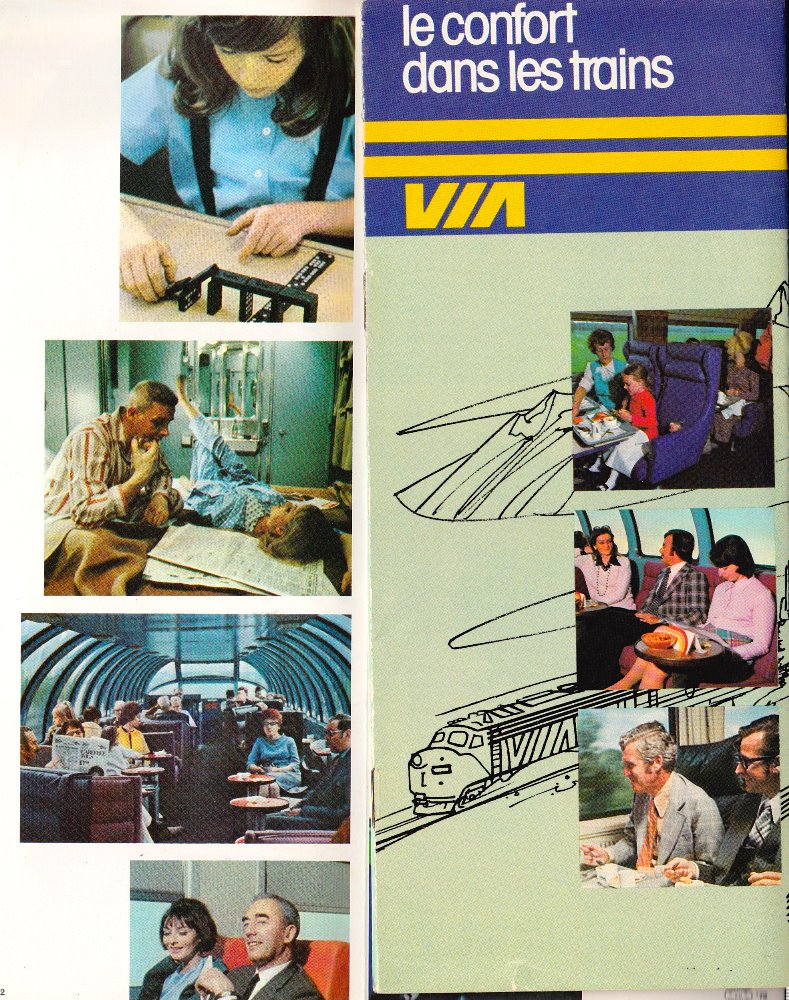
VIA converted the punch-out artwork for Jasper to their blue & yellow paint scheme from CN's black & white. VIA continued to feature the Sceneramics in their accommodations brochures, albeit with updated passenger fashions. Groovy, baby!
Passengers in Sceneramic dome:
As the cars aged, VIA found the electrical and A/C systems increasingly unreliable and the cars were frequently removed from service. Fraser and Qu'Appelle remained in CN colours until retirement. Athabasca and Columbia were painted in VIA colours (notice the JB initials on the end of the car in the latter photo, denoting sale to J Baldwin - see below) during 1977. At one point, Athabasca even had a crossed-A VIA logo! Jasper and Yellowhead received VIA paint as well.

OBSERVATIONS
I reviewed published reports and consists I included in Trackside with VIA: Cross-Canada Compendium Consist Companion. Here is a snapshot of the six Sceneramics' travels during their service careers with CN and VIA in the 1970's, as well as VIA in the 1980's by car, year, location and train number:
Athabasca:
1975 Wpg; 1976 Edm No 2; 1977 Jasper No 1; 1980 Vanc No 104; 1980 Jasper No 3;1981 Vanc No 3.
Columbia:
1976 Edm No 2; 1978 Jasper No 1.
Fraser:
1976 Edm No 2; 1976 Wpg No 2; 1978 Edm No 3; 1978 Jasper No 2.
Jasper:
1976 Edm No 1 & 2; 1979 Vanc No 2.
Qu'Appelle:
1970 Edm No 1; 1976 Edm No 2.
Yellowhead:
1972 Jasper No 2; 1976 Edm No 2; 1978 Edm No 2.

TRACKSIDE PHOTOS
I was fortunate to see two Sceneramics in use at Portage la Prairie, MB. A late-running Super (normally due at 0655) happened by eastward at West Tower at 0923 June 17, 1980 with Athabasca bringing up the markers:
On August 25, 1981, a westbound 17-car Super passed through Portage with Columbia trailed by Cabot Manor. This was a fairly common occurrence in 1980: Sceneramic trailing ex-CP sleeper on the Super, likely for safety reasons - providing a vestibule on the trailing car, something the Sceneramics lacked.
This photo from VIA's rainbow era of 1979-1980 shows a CN-painted Sceneramic ahead of a CP-painted Chateau at Edmonton (Brian Schuff collection):
I observed rusting Fraser, in need of repair in CN colours at Winnipeg's East Yard in October, 1980, and again in June 1982 along with Athabasca.
Notice the by-then sorry state of the dome glass: murky, cloudy with various shades of tint. Depending on which seat a passenger sat in, the view would certainly have been 'through a glass darkly'. Lubricants, exhaust and accumulated road grime appeared around the equipment access doors. Here's Fraser (at left) in East Yard in 1982 coupled to Athabasca (at right). (Next four photos by Brian Schuff)
Fraser is rusting away, coupled to an equally rusty ex-CP baggage car 2720, one of another set of coach yard queens - CP smoothside baggage cars that minimal if any service with VIA. Note the tiny lettering at the top left corner of Athabasca's side has been painted out:
Here's another view from the other end of the deadline. Fraser is spending a little time apart from 2720 whose Canadian Pacific-painted number still visible on the end door. Both cars are hemmed in by a cut of covered hoppers - not going anywhere soon!
CN-painted Qu'Appelle also spent some time at East Yard:
In September 1981, just one month before the withdrawal of Sceneramics, Aubrey Mattingly photographed well-weathered (with tiny lettering painted out) Athabasca at Winnipeg (CSTM collection MAT001146) on the station-level tracks:
and CN-painted Qu'Appelle (CSTM collection MAT001143) in East Yard:
Other sidelined Sceneramics included Columbia and a sister, Jasper, in Vancouver in June, 1983.

DISPOSITION
The cars were removed from service on October 25, 1981 just before the cancellation of the Super on November 15, 1981. The massive November 1981 VIA cuts resulted in the removal of several smaller car series including the Sceneramics, and they were all retired by mid-1982. Athabaska, Qu'Appelle, Columbia and Fraser were sold to Great Western Tours of San Francisco in November, 1983. Jasper and Yellowhead were sold to Tour Alaska in 1984. Dome Lurker's Dome.main for further disposition of the Sceneramics. Interestingly, Jasper, Columbia and Fraser could be found on Amtrak's Auto-Train to and from Florida from 1990 to 1995! Amtrak added dome glass tinting, a dumbwaiter and ventilation to the kitchen, shifted the dining room upstairs while retaining Princess Tours-installed rooftop air-conditioners (this location for A/C was also not problem free).
These two photos show "JB2704" formerly Qu'Appelle, on an excursion in Minnesota in 1984, at Duluth (above-one of the few photos I've seen of a Sceneramic from directly overhead) and Two Harbors (below) (both Tim Vitelli photos). JB apparently refers to J Baldwin, through whom the Sceneramic was conveyed to Great Western Tours.
Interestingly, one car not acquired by CN (ex-MILW 57) returned to Canada for use on BCR's Pacific Starlight Dinner train and Ontario Northland, even having stainless steel side panels added. Check out

RUMOURS 
I hate to include rumours and unanswered questions, but these cars have spawned more than their share...
  • Did VIA plan to keep the cars in service on CP's scenic mountain route?
  • If so, if the I-series roomettes had indeed caused trouble with tunnel clearance due to their truck centres/grab irons, the Sceneramics would have required tunnel work to increase clearances.Tunnel clearances became an issue with the advent of double-stack containers 15 years later.
  • Was the fifth lounge side window a victin of CN re-design, due to the reconfigured lounge and need for a side loading door?
  • Were the Sceneramics too high for various the Winnipeg Union Station trainshed? At 15'6" maximum height, the cars were four inches shorter than the ex-CP Budd Skylines and Park cars! 
  • Was height an issue when the cars operated in Toronto Union with its trainshed?
  • Did the dome glass become multicoloured shades of grey, green and black due the failure of interior sunproofing film or due to ongoing window pane replacement?
  • What did that tiny, stencilled lettering at the top-left side of each car side actually say??
ABOUT THAT TINY LETTERING...A SUBSEQUENT POST****
This tiny lettering has been the source of much discussion among VIAphiles and uberVIAphiles, none of whom have conclusive, definitive proof of what it said. I've just crossed the line from curiosity to obsession, and will be publishing a future post on my theories and some supporting evidence of what it could say.  ****0100 UPDATE: After some late-night sleuthing, I am incredibly ecstatic - I have cracked The Da Sceni Code and all will be revealed in a Postscript later this week. Stay tuned.****
Interior views of VIA Columbia in 1978, reformatted online auction site photos:
 In the upper level (above) and stairs (below)
CONCLUSION
The Sceneramics added some spice to the consists of CN and VIA. The cars' unique design was a holdover from the last great streamliner era, allowing passengers to see western Canada's trackside scenery from a unique vantage point. (CSTM collection photos CN000549 above, CN002407 below)
It would seem that a combination of design, age, complexity, unique requirements, unconventionality and ultimately a lack of sustainability in an atmosphere of budget cuts led the cars' eventual demise.

Running extra...

It's music time. All this dome car research reminded me of the Hank Snow, Johnny Cash classic I've Been Everywhere. Get the tune in your head then come along with me on this lyrical, glass-covered musical medley across the decades and the continent:

I've been everywhere man, I've been everywhere man,
crossed the coach yard bare man, I've breathed that diesel air man,
Dome travel I've had my share man, I've been everywhere.

I've been a Super Dome, Vista Dome, Ultra Dome, Pleasure Dome,
Skyline, Domeliner, dome diner, Superliner
Three-Quarter Dome, Turbo Dome, Princess Dome, Astra Dome,
Great Dome, Big Dome, what the hell's a microtome?
Yoho, Tremblant, Kokanee, Kootenay
Bring your guitar, we're gonna have a hootenanny,

I've been everywhere man, I've been everywhere man,
Groovy 70's hair man, purple and bright red chair man,
Why not climb the stairs man, I've been everywhere.

I've been on UP, CP, CN, GN,
eastbound, westbound, northbound, southbound,
Jasper, Casper, Cisco, San Francisco,
Evansburg, Hinton, Alberta sunlight all a-glintin'
Shasta, Hiawatha, Super Con, El Capitan,
On the City of Everywhere, puttin' Brylcreem in my hair

I've served up cocktails, mocktails, pink Pepto-Bismol,
Labatt Blue, Fifty, Canadian Club kinda nifty,
Getting cloudy, VIA needs some glass replacing!
Forward-facing, rear-facing, traffic-pacing, mountain-facing,
Hogtown, Cowtown, Winnipeg windy downtown,
Athabasca, I-tasca, say boy wha'd I ask ya?

Yes, I've been ev-ery-where...strum!

Thursday, September 19, 2013

Sceneramics, Part 1

ORIGIN
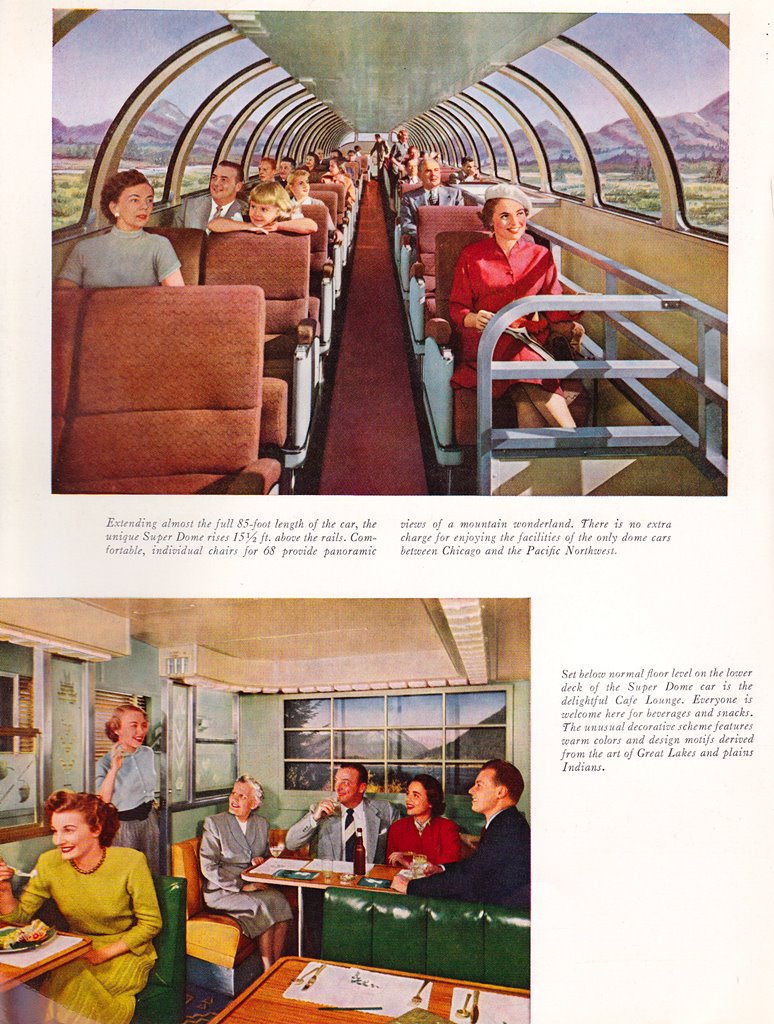
Ten 'Sceneramics' were built by Pullman Standard for Milwaukee Road, numbered 50 to 59 and were delivered in 1952 at a cost of $325,000 each. Originally christened Super-Domes*, the cars were painted in Milwaukee's attractive harvest orange, royal maroon and black passenger scheme. The Sceneramics are often confused with other specialty dome cars, so let's get some definitions out of the way:
  • Sceneramic - a full-length dome, built as Super-Domes for Milwaukee Road in 1952, retired by VIA in 1982,  used mainly between Winnipeg-Edmonton-Vancouver (*I'll use the term Sceneramic throughout this series for clarity)
  • Skytop (Skyview in CN service) - an 8 double-bedroom, round-end bar lounge car, built for Milwaukee Road in 1949, refurbished by CN at Pointe St Charles in 1965, retired by CN in 1977, used mainly in Eastern Canada, the Corridor and Jasper-Prince Rupert
  • Skyline - a mid-train dome, built for CP in 1955, still in service with VIA, used in Eastern and Western Canada
DESIGN
The Sceneramic design was unique for its time, involving three-level construction:

51" from railhead car-end entrance level (no vestibules) with one washroom at each end, two Waukesha DC enginators (generators) and electrical equipment at one end, A/C unit, compressor and water tanks at other end. Placement of this heavy equipment was necessitated by the drop-floor design of the car, and essentially made the car mechanically independent from the rest of the train. The entrances led to side passageways that were open to dome level, leading down three stairs to:
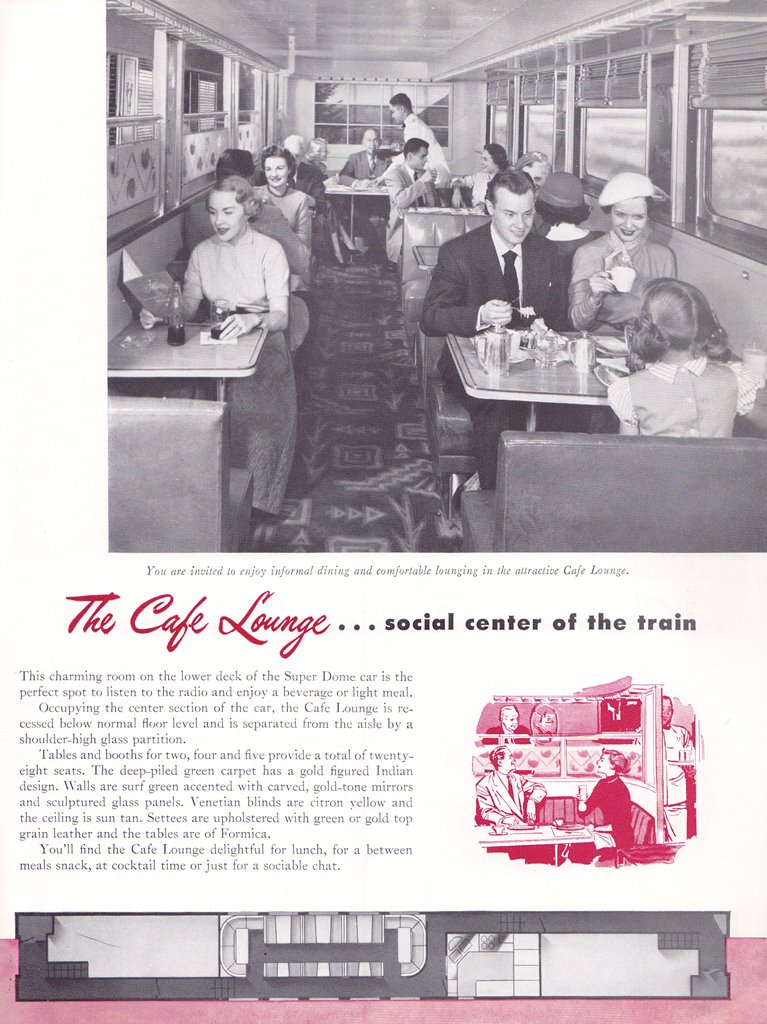
23" from railhead 28-seat lounge and stainless steel kitchen/bar in centre of car below:
104" from railhead 68-seat full length dome reached by six stairs up.
There was no centre sill, instead two 24-foot girder-type General Steel castings at each car end met with side sills that were load-bearing in the centre of the car. General also produced the 6-wheel, 11-foot wheelbase Timken roller bearing trucks with 36 1/2" wheels and large outboard springs, each weighing 33,275 pounds, to maintain the 15'6" external height cars' stability. The Trane A/C plant had a 20-ton capacity to keep the car and its 625 sq.ft. glass dome comfortably cool, the refrigeration equipment capable of producing 20 tons of ice per day. The 21 rubber-mounted double-glazed dome glass panels measured 3x5 feet and were lightly tinted. Manufactured by Adams & Westlake, the outer layer was 1/4-inch Pittsburgh Plate Glass Solex heat-resistant plate glass, with a 3/8-inch laminated Solex safety plate glass inside, separated by a 28-inch steel roof panel. Two Waukesha Motor Co. 25 kW diesel generators rated at 40 volts DC rested on pull-out tracks for servicing, also accessible from inside. The 85-foot car, with supplies and passenger load at 224,080 lbs. total weight.

In Milwaukee Road service, the cars were called Super Domes, initially used on the Chicago-Tacoma Olympian Hiawatha and Chicago-Minneapolis Morning and Afternoon Hiawathas.
CN SERVICE
After 1957, the Sceneramics were deemed surplus to the needs of the Milwaukee Road. Acquired by CN in 1964-65 intended for use by sleeping car passengers, the cars were named after western Canadian rivers upon shopping:
  • 2700 Jasper, ex-MILW 50, acquired by CN in 1964
  • 2701 Athabasca, ex-MILW 53, acquired 1964
  • 2702 Yellowhead, ex-MILW 54, acquired 1964
  • 2703 Fraser, ex-MILW 56, acquired 1964
  • 2704 Qu'Appelle, ex-MILW 51, acquired 1965
  • 2705 Columbia, ex-MILW 52, acquired 1965 
Initially numbered in the 2400-series, the cars were renumbered into the 2700-series in 1974. Names were visible on car sides, with numbers on ends. Existing CN parlour car car 573-Athabaska was renamed Great Slave Lake to prevent a conflict. (Columbia at Jasper, above. Jasper at Vancouver, below. Both photos - Brian Schuff collection)
The first four cars entered service by July 1964 after shopping at Transcona. CN replaced 39 centre-dome seats with lounge seating in twos and threes plus revolving single club car seats in 1971. In 1973, the entire upper level was modified with all lounge furniture in red/purple/blue/green with a total capacity of 54 seats.
Modifications were also made to the kitchen, lounge, passageway and a dome serving area was added. The attendant is getting ready to 'highball' in more ways than one. Numerous ashtrays on tables make one wonder about a smoke-filled dome. Notice the clear plastic bound covers on the magazines at right for passengers who have given up on getting a decent view out the dome windows and are tired of looking at their own reflection - 1974 interior photo (Brian Schuff collection):
Some early limitations of the cars' design was the mildly comfortable seating and the minimal forward view from the dome. CN passenger angling for a shot of mountains:
CN passengers made the most of the Sceneramics. A British family travelled across Canada in July 1964, at the dawn of CN's Sceneramic fleet. Their candid photos reveal views of a family exploring our great nation aboard CN's newest passenger cars: dome view of Hell's Gate, dome interior, lower level lounge, single dome seats and passageway and the difficulties of Sceneramic phorward photography, even on a curve! Single CN SW shepherds Sceneramic shadowed by spruce and surprisingly sheer, snow-capped sierra:
For a spine-tingling Sceneramic saga at Jasper, check out Bruce Harvey's Runaway Super-Dome. Thanks to Elijah Hall for the link! Yellowhead in service, 1974 (this and bottom photo, Brian Schuff collection):
CN featured the cars in several brochures from the mid-60's to the early-70's:
John Hardy spent some time in a Sceneramic aboard the Super, heading west from Winnipeg in 1973, from his book Canadian Rail Travel
     "On this trip, the train had a full length Sceneramic dome car in which I rode for much of the afternoon. This car had been purchased used from an American railway as part of CN's passenger marketing strategy. The upper, glassed level of the monstrous car was laid out as an observation lounge with a bar in the middle portion. The lower section contained a lounge, kitchen and generators. Only three passengers and the bar attendant occupied the observation lounge. By moving to the front of the car, I was able to photograph a couple of stations as the train passed through rural Manitoba. Riding up in the warmth of the dome car, I felt insulated from the harsh winter which gripped the Canadian Prairie outside."
ROUTES
Initially, in 1964 the cars were to be serviced in Jasper, but maintenance facilities there proved inadequate, resulting in movement to Edmonton on the Super Continental. Until 1968, the Sceneramics were used on the Super Continental and Panorama. In 1969 they operated year-round on the Super only, though in 1970 they interestingly operated out of Toronto. 1972 CN onboard brochure:
Though I should have known this while writing this post, I did have an opportunity to ride in a Sceneramic on CN's Super Continental. Okay, I was four. L.C. Gagnon photos (three, below) of our family in the dome. We appear larger than life in the reflections!
Two Sceneramics at Jasper. Perhaps one was the Sceneramic added to our train at Jasper.
Our train is stopped at an outlook to view majestic Mount Robson. Check the CN logo on the car ahead, the stepbox and the natty porter's uniform.
From 1970-78 the cars operated Winnipeg-Vancouver from September-June, and Saskatoon-Jasper-Edmonton-Vancouver in summer, except 1976 used Winnipeg-Vancouver year-round. From 1978, the cars operated Edmonton-Vancouver only, except from October 1979-January 1980 operation was Vancouver to Winnipeg. Here's Qu'Appelle at Edmonton:
This 1974 end view at Edmonton shows the cars' lack of vestibules and black end doors with silver push bar complete with car name. This photo brings us to the 'end' of Part 1. Read more about the cars in VIA service in Part 2.
Derek Henderson kindly shared this photo of Fraser taken at Jasper eastbound in February, 1977, still in CN paint:

Running extra...

Though I consider this post on VIA's Canadian in 1984 my favourite Trackside Treasure post due it's F-unit-laden photo subject matter, I feel like I have given birth to this Sceneramic series. I've been able to cobble together more information and photos (many through the generous co-operation of Winnipeg's Brian Schuff) than I've found in any other single location. Loaded with links, click away to discover more Sceneramics! It seems  that once passengers got off the train in a place like Jasper, they proceeded to take photos of the biggest thing around, be it the mountains, a totem pole, Jasper the Bear or a CN Sceneramic!

Speaking of the biggest thing around, check out Ben Alain's Youtube video of the Alberta Free-Mo event. The shooting took three hours, and the editing really lets you enjoy the various Free-Mo modules, meets, rolling stock and even off-layout happenings. Very enjoyable to watch - better than those hokey fish tank screensavers. Imagine yourself riding the pilot of the unit on this train! A model railway in a hockey arena - very Canadian!