Saturday, April 1, 2017

BCOL Covered Hoppers

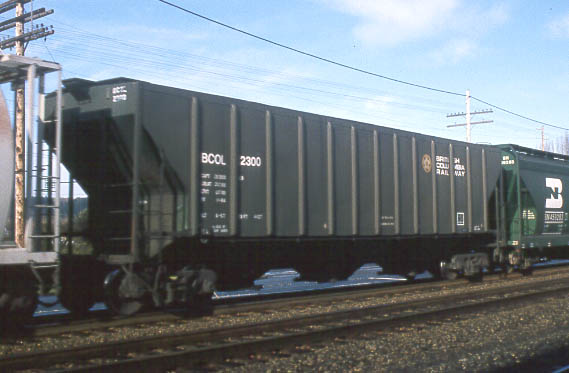
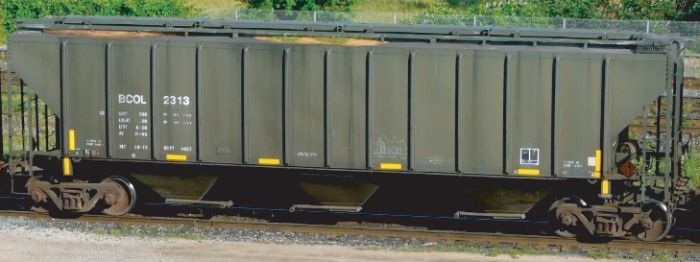
Over the years, some interesting British Columbia Railway covered hoppers have been on CN freight trains through Kingston. BCOL 2300-2320 were 4427 cu.ft. PS-2 covered hopper cars built in 1972 by NACC, likely for the Denver & Rio Grande Western. Acquired by British Columbia Railway, renumbered and repainted in an overall dark green paint scheme, the cars were placed in service in 1985-87. At the time, British Columbia Railway was transitioning to BC Rail. BCOL 2300 had arrived first in October, 1984 and was the only car repainted with the dogwood logo and 'British Columbia Railway' lettering applied. BCOL 2304, 2314 and 2320 have been scrapped. BCOL 2304-2301 were at Kingston in this undated Tim Reid photo (top), placarded UN 1759.

BC Rail acquired grain cars when the grain subsidy was applied to BC Rail, after an amendment to the Western Grain Transportation Act. Though granted access to CNWX grain cars, at least in theory, it still behooved BC Rail to secure its own grain car supply. By summer 1995, additional Trinity-built cars were leased, namely BCOL 2350-2399. It was BC Rail policy to have all leased car numbers begin with '80' and this became especially urgent after costs that should have been assigned to the lessor were being absorbed by BC Rail. Hence the addition of the slightly off-centre therefore notable '80' to these cars, which took place throughout 1999.

Grain loading took place at Dawson Creek and Fort St. John. In early 1999, BCOL 2374, 2375, 2378, 2382 and 2398 were engaged in soda ash service between Perry, BC (10 mi. west of Chetwynd on CN's Dawson Creek Sub) and a mining operation in New Brunswick.
Rusted BCOL 829104-829105 westbound at Kingston on Oct 1, 2005 on CN train No 309 (above). BCOL 829111 in 2005 stopped on a CN freight in emergency near Collins Bay, ON (below):
BCOL 829000-829099 were leased next - 5150 cu.ft. covered hoppers Thrall-built in 1996-1997. Off-lease cars with capacities of 4750 cu.ft. and 5250 cu.ft. BCOL 829100-829131 were leased in 1997. 
BCOL 829124 (above) and 829128 (below) were placarded UN 1759 at Belleville in a CN freight in these Tim Reid photos.
BCOL 829127 made it to Innisfree, AB in 2003 (online auction site photo):
BCOL 802372 is one of four with BC Rail lettering, seen here westbound at Belleville on March 2, 2021 (image courtesy Railstream, LLC):
The varied types, condition and colouration of these cars caught my eye. My observations with date, car number, type ('ACF' refers to Thrall and 'P-S' refers to the flat-sided cars, and CN train on, with notes:

Jun 8/92 BCOL 2319 Ctr St Team Track Blt 9/71 (?photo)
Feb 20/99 BCOL 829014, 829125, 829018 ACF HO on No 309 destined Perry BC 
Mar 20/99 BCOL 2374 P-S, 829115 ACF on No 306 destined Bathurst NB Loaded
Apr 3/99 BCOL 829125 (no type listed), 2398 P-S, 829099 ACF, 829116 ACF on No 303, placarded UN 1759 (corrosive solids, n.o.s.) 
Jul 18/99 BCOL 829026, 829062 ACF on No 317
Aug 2/99 BCOL 829098, 829099, 829084 (all ACF) and (80)2393 P-S on No 306 destined Bathurst NB
Aug 19/99 BCOL 829114, 829110 rusty ?blue PS repaint on No 303
Aug 20/99 BCOL 829026, 829028 ACF and 829118 P-S on No 303
Oct 7/00 BCOL 829024 on No 306, to Chemin de Fer Baie Chaleur
Mar 17/01 BCOL 829118 rusty blue repaint P-S on No 309
Apr 29/01 BCOL 829115 rusty P-S on No 306
Jun 6/04 BCOL 829104 P-S on No 309
Mar 28/05 BCOL 829111 blue repaint P-S on No 309, placarded UN 1759 
Oct 1/05 BCOL 829104, 829105 P-S (above) on No 309
Feb 12/06 BCOL 829101 P-S on No 305
Mar 24/06 BCOL 2303, 2301 dark green P-S and BCOL 829104 grey P-S
Jul 7/06 BCOL 2307 green P-S and 829108 P-S on No 309
Nov 27/06 BCOL '80'2387 grey P-S on No 305
Jan 21/07 BCOL 829016 ACF on No 376
Jun 11/07 BCOL 829099 grey ACF on No 308
Sep 22/07 BCOL 829059 grey ACF on No 309 (?photo)
Jan 11/08 BCOL 829131 grey P-S 
Aug 3/08 BCOL 829002 grey ACF on No 305
Apr 17/10 BCOL 802353 grey P-S 
Feb 1/15 BCOL 829011 grey ACF on grain train
Mar 28/18 BCOL 829001 grey ACF:


Lots o' links:
Running extra...

Mimico meanderings...a recent trip around Mimico included Lantic Sugar and those CGMX/LATX covered hoppers, VIA's Toronto Maintenance Centre and some unexpected surprises. My trip did not include a Fitbit or pedometer. Watch for an upcoming two-part series:
Arrival was aboard VIA No 651 Eng 916 bearing the CANADA 150 wrap. Photography is sooooo much better under Toronto Union's daylighted trainshed! Passenger expressions...'Wut?'
Upon arrival home, a flurry of emails and a river of revisions travelled back and forth electronically between me and my graphic designer. My fourth book on VIA Rail is taking shape nicely, if not taking flight yet. To conclude for now, just when you thought, "It's all good, baby"...


Wednesday, March 29, 2017

Then Everything Ground to a Halt

For years, model railroaders have been applying scenic materials. First it was dyed sawdust. Then ground foam. Then blended turf. Now it's static grass. But until now, no-one has bothered to ask why the changes. Well, until now. It's because of the worldwide ground foam shortage. Trackside Treasure is here to answer the question no-one is asking. Sorry, that should read the question no-one else is asking [edit this before publishing this post - E]

Turns out that model railroaders have no-one to blame but themselves. Especially those modelling Appalachia and the Deep South. Spreading the stuff for years with abandon on veritable oceans of dilute white glue have led directly to the current crisis. Sustainability? Sidelined. Future generations? Forgotten. Nobody cared. As long as there was enough ground foam to cover this hillside or that open patch of plaster, it was let's-make-scenery-while-the-sun-shines.
Now, Woodlund Scenics is scrambling to find new sources of ground foam production farther afield. Countries that might be willing to allow their ground foam crops to be harvested, processed and exported are few in number, though. Outstanding in his field, this farmer did not want his identity shared. Look at this bountiful ground foam crop that he stands to profit handsomely from:
But there is not a total absence of hope in this story. The scenic flavour-of-of-the-month is static grass and that will certainly exert downward pressure on the pace of production. Recovery is possible. It remains to be seen if this will have any impact on the scenic spectrum available to model railroaders.
As you read this, the dwindling stocks are being closely-guarded and production is extremely limited. Having just painted the last patch of virgin plywood on my layout, I have to admit I'm part of the problem. My next step was to be to apply some Woodlund Scenics ground foam. But I'm reconsidering that. Is it ethical? Is it responsible? I'm considering making my own, using everyday supplies readily available in most Canadian households or at your local dollar store - sponges, green dye, kitchen blender, paper towels, sifter, chopsticks, a small trowel, elbow macaroni, rubber bands found on broccoli, wooden matchsticks with the heads removed, two or three water balloons, one and a third cups of aviation gas or JP4 jet fuel, a chocolate chip cookie, Montreal steak spice, 24 inches of dental floss, two bottles of beer (do NOT add to the ground foam, these are just for drinking while you think about how the hell this is ever going to work) and a quarter-cup of McDonald's special sauce.
LATE UPDATE - turns out those lines of cars being 'stored' on out of-the-way and little-used spurs include some cars that are actually carrying a precious lading - you guessed it - ground foam. They are stored on lightweight-rail branchlines - this stuff is foam after all. If you're trackside and see a covered hopper rocking and perhaps trailing a small stream of green particles trickling out, you may have found one of these cars of green gold heading to the Woodlund Scenics production facility!

AS IF THIS WEREN'T ENOUGH - Nobody listens anymore. I said...Light, RAPID and Comfortable. Pay attention, people.

Friday, March 24, 2017

Lionel HO T-20105's Long Life

Model railroaders are spoiled. Never had it so good. Especially modellers of Canadian prototypes. Back in the late 70's, other than occasional 'foobie' Athearn plastic car kits, there were no lines of Canadian prototype rolling stock available. Then Lionel HO happened. The Parker Brothers product line catalogue (top photo) shows the stock numbers. Which were also the car numbers. That's right, there was none of the prototype fidelity we have been treated to today (including road number-specific details from Rapido Trains). So every car number started with a T prefix!! Whaaaaat?
Where am I going with this? Well, I'm going to Prince Edward Island, that's where. And that's where Chris Mears takes up the story on his Prince Street Terminal blog. Proposing some layout design mockups, Chris used an historic piece in his photos. It was Lionel HO CP Rail 40-foot boxcar T-20105 (oh, there are those awful T-series car numbers again!) Oh, the 'breeding pair' in their natural state above? I found the photo on Ebay, going for $89.99 or best offer. I am not making this up. Box-end view:
My 1978 car roster from the Cataraqui Northern Lines, the early name that my Dad chose for his model layout and I continued to use until the advent of the MWR - Manitoba Western Railway - shows two Lionel HO products. Check out the fourth and fifth boxcars. Even then, at fourteen years old, I knew the T-prefix was folly and so did not list it!
But then, on August 9, 1980, another Lionel HO product joined the roster (last line in photo below). You guessed it, CP T-20105. I listed it here for documentary purposes:
For $2.25! Notice my attempts to add Canadian prototype cars to the roster. Also, notice the prices! Jeesh. By the end of the month, I'd added a 1, making it CP 120105:
In October 1980 and March 1981, CP 120105 was now in grain service
The same month, the Department of Motive Power and Car Equipment recorded some tuning-up with truck-swapping upgrade. Of course, no coupler-swapping:
To reflect the application of wheat sheaf logos to boxcars that CN and CP refurbished with financial support from the federal government, it was time to apply the wheat-sheaf logo in November, 1982:
But within a year, things changed. With better-quality Athearn and Roundhouse grain cars entering service, I downgraded Lionel HO's product to woodchip service, driven by my prototype observations of converted CP roofless woodchip boxcars and grain cars during travels west aboard VIA Rail. The car's roof was removed and a renumbering to CP 30490 and touch-up painting was done, along with a new set of hinged doors to replace the troublesome Lionel HO sliding door's weak door guides. After reading Chris' post, I went looking for CP 30490.
And I found it. No underframe. No wheels. When Winnipeg was my modelled prototype, I needed some scrapped freight cars to complete the scene at Mandak Metals. Not needing woodchips in Winnipeg, CP 30490 was repurposed yet again. And it still makes its way in a gondola car, now to Vancouver's Coast Steel Fabricators:
Perhaps an ignominious end, but still serving. Thanks for your service, humble T-20105
Ready to be repurposed yet again? Thanks to Chris for sending me on this interesting and rewarding journey back to my model railway roots of over 30 years ago! And, thanks to Lionel HO for being perhaps the first manufacturer to peddle Canadian prototypes!

Running extra...

While my upcoming book Trackside with VIA: Research and Recollections is with the graphic designer, there is still VIA-watching to be done. Namely, CANADA 150 wraps that have been applied to 16 cars and seven locomotives and counting. The first wrapped locomotive, VIA 6454 is currently heading for Vancouver leading VIA No 1. Steve Boyko caught the train in Winnipeg. Also, watch for Vimy 1917-2017 logos on VIA Business Class cars. Who says VIA is boring these days? 

Steve also got busy for my recent birthday, re-wrapping Mark Sampson's photo at the Toronto Maintenance Centre (spot the GO bilevel!) of VIA 6454 with a unique scheme:
I was also pleased to receive artist and NS Heritage Unit program idea-shipper Andrew Fletcher's birthday greeting depicting Trains of Canada. Andrew has a striped FPA4 that looks a lot better than Lionel's "FA-1" did in the top photo of this post!

Saturday, March 18, 2017

March Miscellany


Spring is just around the corner. I've been splitting my time between shovelling drifts, pushing drafts of my upcoming book on VIA Rail back and forth to my graphic designer, and creating some VIA-related memes. So I give you this pop-up post of spring miscellany. Tim Hayman snapped a photo of the first CANADA 150-wrapped VIA F40PH-2D 6454. I used the expansive nose to do a bit of publicity including Tim's role as a valued contributor (top photo). Have you ever wanted to be in the 1%? Here's an onion diagram that reveals how you can be:
VIA has wrapped Business Class car 3476 in the attractive 'leaves' variation of the CANADA 150 scheme similar to that applied to lounge car Glenfraser. Shaun Hennessy snagged the kaleidoscopically kolourful kar at Fallowfield station:
 My initial enthusiasm for the CANADA 150 scheme has not waned:
However it has come to my attention that trackside photographers are taking WAAAAY too many photos of the CANADA 150-wrapped locomotives and not nearly enough of the coaches:
We'll see how that works. Meanwhile, last Sunday's VIA Nos 648/650 featured 650's consist led by VIA 905 trailing the 50/50 consist tailed by VIA 916. Remember that 916 was initially released with white cab numbers which were soon replaced with the far more visible black numbers:
Logan Cadue kindly shared his notable nose-to-nose view at Kingston, and the same night Mary and Malcolm Peakman captured the nocturnal niceties at Napanee:
Some would say the wraps are being applied to cover up less-than-stellar paint jobs on non-refurbished non-Renaissance-scheme cars and there are more than enough photos of the gnarled noses of the P42's that warrant a little covering up:
Hyperbole at the White House:
Hyperbole at Halifax:
Meanwhile at Napanee, ON not much has changed over 150 years:
Last weekend's Kingston Rail-O-Rama netted some fine finds. Vice-Regal, preserved 6917, Brockville, Sudbury, Montreal and back-to-back 6400's added to my photo collection:
And afterwards, a trip to the Kingston station to see an unusual consist on VIA No 63 - LRC's replace the normal HEP consist:
'Orange you glad'? Citrushelf down and consider the navel-gazing I did at our very own city wrap that's appealing and not yet a-peeling:
And a Kingston Transit NOVA bus 1689 pausing proximal to the platform:
Getting a 'D' for E-series Edmunston or EdmunDston:
No longer available - we will no longer have a monopoly on what game pieces we use. The thimble, boot and wheelbarrow have been replaced by updated rubber ducky, penguin and dinosaur. Updated dinosaur??
And a view no longer available. Bright morning sun and dome haze cannot obscure the fact that this photo, taken from the eastbound Corridor Canadian Park car by my Dad in 1983 shows a shimmering stainless steel consist spread ahead as the train crosses County Road 6 near Amherst View, Ontario.
It's photos such as these that I was proud to include in my upcoming Trackside with VIA: Research and Recollections. My Dad's trip accounts, early-80's Corridor Canadian consists and photos get a well-deserved airing. Sharing this material is a fine legacy for data that I hadn't even known existed. I'm really looking forward to making it available to a new generation of VIAphiles, and leading off my book with this fitting tribute: