Saturday, March 1, 2014

CN's Kingston Sub in the 1950's, Part 2

Continuing our trip from Part 1 along CN's Kingston Sub, via the photos of the John W Barriger III National Railroad Library, we are departing Belleville station as passengers parade on the platform. In Part 2, I'll again refer to the photo numbers in brackets such as [242] above. I'll present the photos as if we're still heading west to Toronto. A re-formatted version of the photo shows an F-unit in the yard, centre of photo. CN received its F-units as early as 1951 - another photo in the CN collection shows CN 9060 in northern Ontario, so it's safe to say these photos date from the early 1950's.
Looking west, we're leaving Belleville, approaching the Moira River bridge.[450] Hey kid! Not a good place to practice your skipping or sprinting!
Looking back at the other side of the bridge from the Moira Street crossing [243]. Today an osprey roosts here and makes trips to the 'fish buffet' in the river.
Approaching the Trent River bridge. The Trent-Severn Waterway is beneath us.[244]
CN's Trenton Junction station [245]. Notice the concrete mile marker indicating Mi 233 Kingston Sub.
Not sure where this photo is taken; any ideas? It includes a nice mix of pastoral and industrial. Notice the old brick building at left, yard switchers, plant water tower and overpass in distance. I believe it may be just east of Toronto. Hmmm.[455]
A sweeping curve, showing the usual fine ballast and subroadbed of the Kingston Sub, likely at Oshawa. [459]
Strong backs and labour was cheap [445]. An extra gang of more than 20 section men work in some new ballast near two classic wooden bridges. Can't picture this location today? That's because it's now within the property of the Darlington nuclear plant. Today all this work could likely be done by a two or three tamper track machines.
Here's the culprit, giving those gandy-dancers all that work. A work train behind MLW-built S-1-f 3501 with a mix of ballast cars [446], and some attentive section men near the caboose. Notice how the ballast behind the train is light-coloured, clean and new as in the photo above.
At Bowmanville, there is more trackwork in progress [447]. The section gang is working on the south track, and our train (actually eastbound) is changing tracks with the gang in the clear. Notice an underpass with white-painted guardrails and a spur with wheel stops at right. In the distance, another set of concrete mileposts could give us the exact location.
Now we're at Port Hope (two photos). The photo following the one above [448] shows the CN and CP bridges on a cloudy, humid or rainy day:
Sun's up, uh-huh, looks OK [462], another view of the Port hope bridges, with the station in left background, then an approaching CN wayfreight and CP's bridge over the Ganaraska River at right.
Here is Port Hope freight shed and station [461]. The wayfreight is behind CN 1123, and the Smith Street level crossing is in foreground.
Cobourg. Note CP's wooden water tower and station at left. CN's water tower is in mid-photo [466]. Distortion, such as the telegraph pole, and some blurring is evident in some of these classic photos taken at speed from a moving train.
The CP main line crosses back to the north on the west side of Cobourg [465] and a CP freight happens to be up on the bridge as we pass by.
Gooderham & Worts Distillers Since 1832 is on the right, and CN's Don Yard on the left as we arrive in Toronto [442].
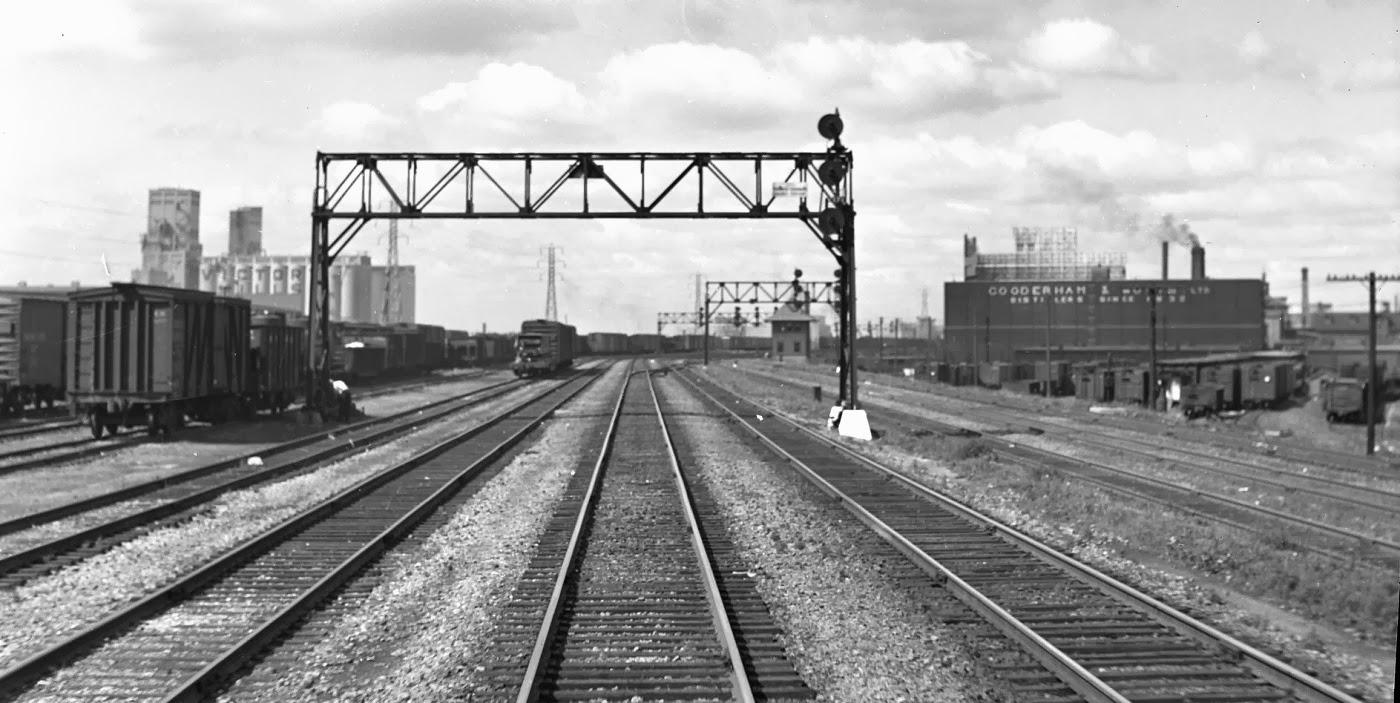
Yet another signal bridge looms as does the Royal York Hotel [441] at far right.
The Barriger Library is a unique, nearly fathomless resource that is meant for sharing. Curator Nick Fry was kind enough to comment, expressing his approval for the sharing and enjoyment of these images for Trackside Treasure readers. These scans of copy negatives were made in the 1990's from the original nitrates. Good news - there are more to come, according to Nick! 

Fortunately for us, the library has placed 119 sets of photos on the photo-sharing site Flickr. Here are some Barriger Library Flickr photo collection links for your viewing and sharing pleasure:
-The CN Collection: 362 photos
-All 119 sets: from Boston & Maine's one photo to Ontario Northland's 111 photos to Union Pacific's 912 photos

Thanks to Keith Hansen and Tom Box for confirming some of the locations shown in these fine photographs.

Running Extra...

In the August 2013 edition of Esquire magazine, author Mark Warren wove a thoughtful tale entitled The Father You Choose. This paragraph resonated with me, and pertains to any good parent:
"A man doesn't go and announce, I am going to be an example for you, I will show you how to live. He just carries himself through the world. And the most important lessons aren't declared or obvious, but more likely come along in the commonplace."

But one reason I like that passage is because the author is not afraid to start a sentence with a co-ordinating conjunction. And that's one thing I like about it. But not the only thing. For some reason, it's become popular to start sentence after sentence with another co-ordinating conjunction these days: "So, today we're going to build a bookshelf." "So first, we're going to select our lumber".

Hockey trivia...who was the only Team Canada player repeatedly referred to solely by his first name in the call of the Sochi Winter Olympics mens' gold medal hockey game?
Cole Harbour's own "Sid"....Crazzbeeeee

Wednesday, February 19, 2014

CN's Kingston Sub in the 1950's, Part 1

The John W Barriger III National Railroad Library is a unique collection that I became aware of only recently, part of the University of Missouri - St Louis Mercantile Library. Barriger (1899-1976) was an MIT graduate, responsible for loans to railways during the Great Depression. After World War Two, he became President of the Monon Railroad, moving on to leadership roles at P&LE, M-K-T, B&M, NYNH&H and Rock Island. A collector and historian, Barriger amassed a huge collection of books, photographs and documents exceeding 26 tons in all! Many of the photographs in the collection, taken all over North America, focus on railroad engineering and trackage. Over 350 Canadian National photographs are available online - scans of copy negatives made from the original nitrates in the 1990's. Though these are uncaptioned as to location, I was able to find several from the CN Kingston Subdivision, taken in the 1940s and 1950s.
The photos available online are lightbox views (top photo) that include a white ink notation on the photo border listed in photo caption in [brackets], and that's all. Many such photos are taken from onboard a train, and as such include lots of trackside treasure - buildings, yards, signs, signals, and railway facilities. Some are purely scenic. In locating Kingston Sub images, I looked for recognizable, double-track scenes that I could identify. With the image formatted, it's easier to focus on the railway elements of the scene. The Turcot Yard [308] steam engine facility ready track (above) includes 1910-built H-6-d 1325, suburban tank engine, electric, caboose hop and elephant ear-equipped road power. Even though these photos were likely taken from the tail-end while heading east, let's imagine we're on the head-end of a westbound heading from Montreal to Toronto.
At Ste Anne de Bellevue, [305] we are leaving the westernmost point on the island of Montreal (above), about to cross onto Ile Perrot. CN's station and still-standing municipal water tower are south of the double-track main line, while CP's line west from Montreal is visible at right. In Cornwall [303] we are on the outskirts of town, though the line has been relocated and this area is now built up. Tenth Street is on the right, CP's Cornwall Sub then McConnell Avenue crosses the two-track main line (now the end of CN's Cornwall Spur), and the Cornwall Electric Railway electrified line runs from the CN exchange yard to the Courtaulds plant in Cornwall's east end at left.
Paved paradise and put up a parking lot [303] (below). Closer to Cornwall station, the Cornwall Electric Railway is at left, currently the site of a Canadian Tire store parking lot. A water tower in the distance and a water plug at the end of the platform are visible:
West of Brockville station, just west of the Perth Street level crossing [301] the 216 foot-long Grand Trunk-built 600-ton coaling tower was in place from 1904-55. Its accompanying inclined trestle looms in the distance, marking the east end of Manitoba Yard (named for the adjacent Manitoba Street), as an ABS signal mast sign north of the main lines indicates Mi 125.7 miles west from Montreal.
We hop off the train at Kingston [299] to look over some remarkably (not uncommonly) cindered, empty yard tracks across from the Outer Station on Montreal Street. Stock cars are spotted at the stock pens at left, and the station train-order signal and steel water tower are visible at right.
On the north side of the yard at Kingston [300] are four flat car loads that certainly caught the photographer's eye. These are not North American locomotives. Rather, they're metre-gauge export locomotives built by the Canadian Locomotive Co. on Kingston's waterfront. Chained aboard CN flat cars, these locomotives are part of a large order of locomotives destined for India. Based on their shipping date of May, 1950, we can date these photos at Kingston.
Best of the bunch. Napanee [237] looking east on a summer evening shows a fantastic maze of trackage, with CN's Smiths Falls sub diverging to left, freight house lead at right. Watch for an upcoming post on Napanee's rail-served industries, and yes, the Nabisco factory behind the Quonset hut is still standing today!
There are very few locations on the Kingston Sub where one railway crosses another. I believe this one [237] shows the west side of the Shannonville bridge that carries CP's Belleville Sub over the CN. Belleville yard is next.
We'll end this first part of our Kingston Sub journey at the division point of Belleville. At Belleville East [454], site of the current yard office, a concrete behemoth coaling tower stands guard; nearby are a water tower and sand house. Note the unloading track for coal hopper cars (including one PRR car) and water tower at right.
Pointe St Charles-built P-5-h 8393 is working a long cut of cars [453], including wood reefers and boxcars:
A modern-day view of the yard looking west shows that it's common to see a double-stack intermodal train taking the length of the yard. Though the yard tracks to the south of the main line are largely gone [452], additional through trackage has been added to expedite CN and VIA trains through Belleville, still a crew-change point.
Looking east, a last shot back at the coaling tower [240]
The west end of Belleville yard [241] is a busy place on this evening, with two yard goats working, a road engine in line with the water tower, MoW boxcars at right and a B&O wagon-top boxcar in line with the smokestack.
Approaching Belleville station [242] where baggage carts line the station platform and the train-order signal is up; a combine with six-wheel trucks reposes at right. The Moira River bridge, just visible in the distance and Part 2 will take us westward to Toronto.

Thanks to Chris Granger and Don McQueen for assistance in the production of this post.

Running extra...

A nice blog tribute to Canadian Super-G skier Jan Hudec by CBC's Scott Russell.
Ted Nolan trick play results in a breakaway goal. A Latvian scintillating spinnerama!

Pin this! Trackside Treasure's fledgling Pinterest page. Giving a home to photos I want to save, though I frankly don't know what to do with. Except pin them for future reference. Can Facebook be next?

Thursday, February 13, 2014

Sceneramic Scequel

This is the fourth, perhaps final post in what has become a sceries on Sceneramics, a special scenic scenario of splendour specifically schemed. Links to all four posts can be sceen at top of scidebar.

SUPER DOME ON PGE?
Did Milwaukee Road Super-Domes ever operate in Canada? Yes! The Pacific Great Eastern did not have enough of its own passenger equipment to mark the opening of its northern BC lines in 1956, so it borrowed some from western US roads (above). Bert Mills photo via Trevor Mills, Bob Loat and Bruce Chapman.

SCENERAMIC STYLIN' 1980-STYLE
David Thomson sent six excellent early-era VIA Sceneramic photos. No 4 at Matsqui BC June 1980, approaching...
with Jasper ahead of two Action Red-striped ex-CP sleepers:
David also rode Qu'Appelle on a trip to Vancouver in June, 1980. Looking grubby at Jasper:
and a rare interior forward-looking photo of Qu'Appelle, approaching slide sheds:
Athabasca and Columbia west of Viking, AB in March/April 1980: Columbia passing through snow flurries:
and Athabasca bringing up the markers, trailing a CP-painted sleeper:
Having seen the Sceneramics quite a bit, David commented that Jasper was likely never painted in VIA colours. 

Here's an online auction site photo of CN track inspection car Sandford Fleming, interestingly coupled to a Sceneramic in CN colours at McBride, BC in 1979:

GEORGE H. DRURY SCENERAMIC REVIEW

In his travelogue article in the March, 1982 TRAINS magazine, Kalmbach librarian George H. Drury reviews the cars thusly: "The Sceneramic dome has windows of several degrees of transparency - clear, tinted, and reflective - and the curvature of the glass is just right to give you a twice-life-size reflection of yourself. The lower level of the car is a snack bar, and the upper level has a service bar across the middle, cutting the lounge in half. The lounge decor is an improbable but agreeable mix of turquoise walls, olive carpet, and couches upholstered in turquoise-and-olive and red-and-purple. The car rides well, but at the leisurely pace called for by the four-night transcontinental schedule anything would. The diesel generator at one end of the lower level of the car makes enough noise to penetrate the passenger spaces."

1976 DERAILMENT

Somewhere just west of Winnipeg, sometime in 1976, this CN train derailed, with Yellowhead and auxiliary CN 50108 featuring prominently in these online auction site photos:


ONR OWN NOW
Grant Bailey kindly sent a photo of Ontario Northland Super-Dome 900, lettered Otter Rapids, on ONR's Dream Catcher Express train in October, 2005. Formerly Milwaukee Road 57, the car spent some time with BC Rail among other owners.
Having received the stainless steel 'temple treatment' earlier in its dinner train career,
GOT ANSWERS?
Some answers to some of the challenges that the original Sceneramic series generated:

-Superliners borrowed by VIA in 1984-85 were NOT run through the Winnipeg trainshed (Relative car heights: Superliners were 16'2", Sceneramics 15'6", ex-CP Budd domes 15'10".) When ready to depart, the train with Amtrak cars was backed out the north end of the depot, then ran west on the parallel CN Rivers Sub through tracks, outside the trainshed.

-Restrictions in Winnipeg Union Station Trainshed, taken from General Footnotes 2.8 and 2.9 of CN's Time Table No 23, November 15, 1981:
Winnipeg Union Station Train Shed - Clearances are restricted on all tracks leading to and into this train shed. Overhead clearance is 16 feet 2 1/2 inches from top of rail. Cars of greater height than 15 feet 10 1/2 inches must not be moved through the trainshed on these tracks. Conductors and yard foremen must know that all cars being handled have proper clearance before entering the trainshed. Engines equipped with standard ice-cutters must not enter the trainshed. ALL MOVEMENTS RESTRICTED TO 10 MILES PER HOUR THROUGH THE TRAINSHED. Movements handling snow plows must not use north track passing Winnipeg Union Station trainshed. Snowplows will not clear platform adjacent to north track.  (Mark Perry photo):
SCENERAMIC, HO!
VIAphile Tim Hayman has modelled Jasper well-weathered, in VIA colours. Notice Tim's treatment of the dome glass and 'tiny lettering'. Working with the Walthers model, Tim repainted the seating and may return it to its VIA floorplan. Tim used Microscale decals and Bragdon weathering powders.
My thanks to the above contributors for adding some additional material on the scintillating Sceneramics!

Running extra...
What do you think of this list?
1. Be agreeable
2. Know your goods
3. Don't argue
4. Make things plain
5. Tell the truth
6. Be dependable
7. Remember names and faces
8. Think of success
How to be a successful blogger? Well, maybe, but originally posted 90 years ago in a Hudson's Bay Newsletter, in February 1924: The eight commandments of salesmanship! Pelting you with dam interesting stuff just fur the fun of it, the ever-eager-beaver blogger of Trackside Treasure lodge.

Go Canada! The Dufour-Lapointe sisters, Justine and Chloe take gold and silver in Sochi in the women's moguls. Bravo!