This is the third
in a five-post series on the Kingston & Pembroke Railway. This post deals with the buildings and facilities that the K&P, and later CP, inhabited in Kingston. Its terminus was across Ontario Street from Kingston City Hall (top photo - Queen's University Archives, George Lilley Aerial Photographs, V25.6-10-7).
DOWNTOWN TRACKAGE ON ONTARIO STREET
Its initial request to build on Fort Frontenac lands was refused, so the K&P instead settled on Place d’Armes in 1873. Its principal address in Kingston was listed as Place d’Armes in 1885, and the original station of the K&P in Kingston was built there (three-storey building, centre of 1920 photo below, with engine house visible at bottom right). The site had previously been used by the military in Kingston as a 'fuel yard'. The station became the office building for the Frontenac Lumber & Coal Company. A spur was later laid crossing Ontario Street to serve the Montreal Transportation Company grain elevator. A small two-stall engine house was built nearby, in use between 1877 and 1883, and the track continued to North Street.
In 1929, CP’s Kingston ticket, express freight and steamship office was at 180 Wellington Street. Its freight offices were at the foot of Clarence Street and passenger station was listed as being opposite City Hall. The track closest to the station was considered the mainline, with the adjacent track serving as an engine run-around track. The next tracks received perishable shipments such as refrigerator cars for Toye’s Wholesale or newsprint for the Whig-Standard. The next two tracks held cars spotted for the freight shed, with CN’s track to the locomotive plant and shipyards at waterside. The plan below includes the Market Battery, then only a memory.
Although the K&P had negotiated running rights with the GTR from River Street to near Brock and Ontario Streets in 1886, it requested and was approved construction of its own track between Brock Street and the K&P passenger station across from City Hall. A February, 1957 lake view shows freight cars on the CN and CP trackage at water's edge, and the CP freight station and sheds (below - Queen's University Archives, George Lilley Fonds, V25.5-51-37-307-1). A switchman’s wooden shanty north of Barrack Street and west of Ontario Street housed a CN flagman to cover CP movements across CN even into the early 1960’s (circled in yellow in photo above). 
The Ontario Street station, showing its awning between the baggage shed and the station. The Richardson No 1 elevator is visible at far left. Undated, pre-1941 with streetcar tracks apparently still in Ontario Street (Trackside Treasure collection):
Here's a different angle, from the Wolfe Island ferry dock in July, 1963 (Queen's University Archives, Kingston Whig-Standard Fonds, V142.1-24) with CLC in the distance at left:
ONTARIO STREET PASSENGER STATION AND FREIGHT STATION
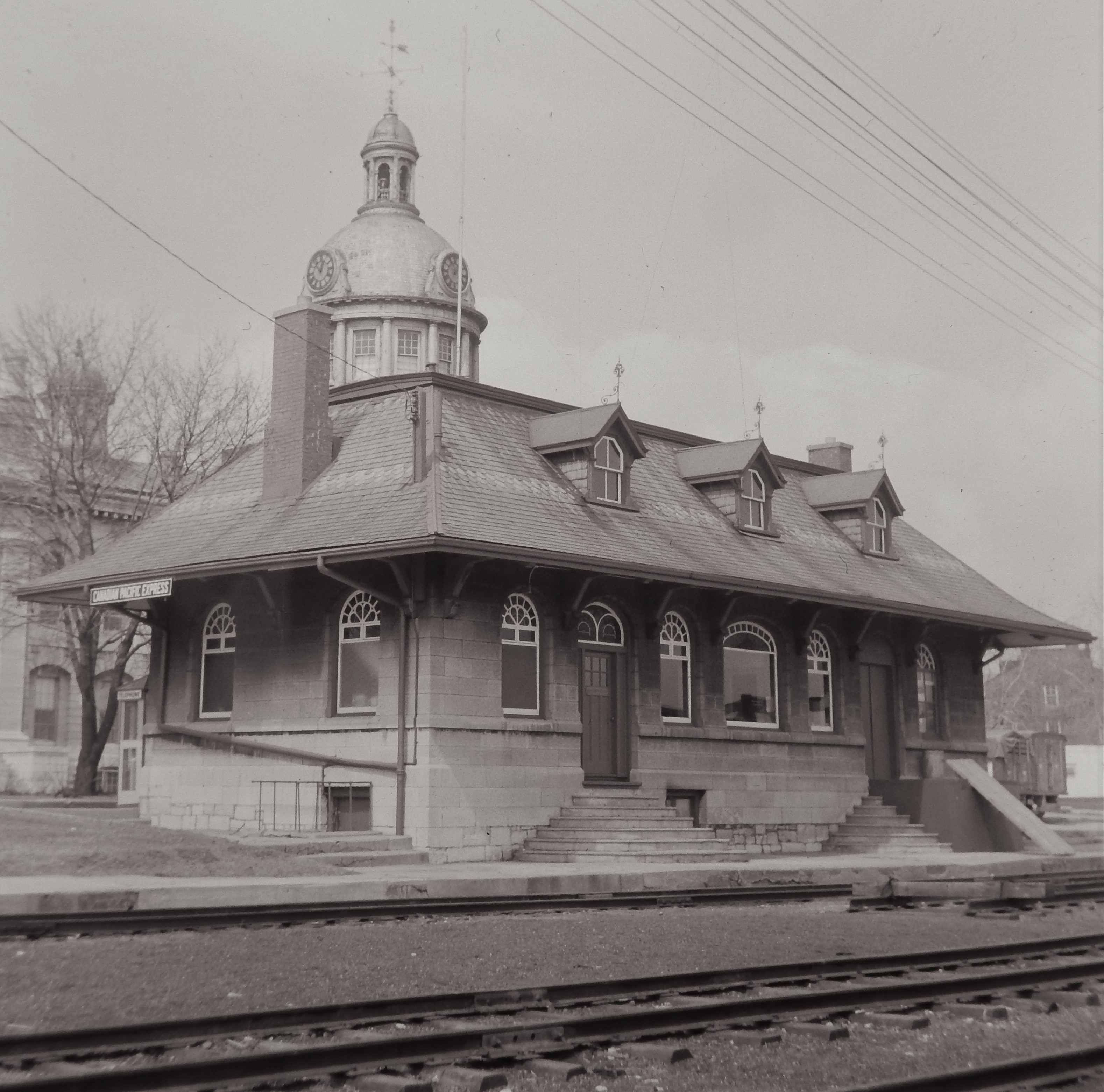
Built in 1885 at a cost of $12,000 and measuring 65 x 24 feet, the stone station included stone from the demolished Market Battery nearby. Designed by William Newlands, main floor wider central curved windows as well as other curved windows were crowned with coloured art glass fanlights. The bellcast roof featured six gabled dormers and a patterned slate covering topped by iron fringework. The interior was finished in natural woods. A 125-foot covered passageway led to the station baggage room. Drawings and descriptions published in a December 10, 1886 edition of the Whig (below) and both buildings were finished and occupied by the following July.
After the end of passenger service, the baggage room is being demolished on February 29, 1960 (below - Queen's University Archives, George Lilley Fonds, V25.5-26-99)
In the 1920’s, large floral CPR lettering was part of the decorative station gardens. The station is still in use as Kingston’s Visitor Information Centre.
From 1917 to 1923, perennial plans for the construction of CP freight sheds on Place d'Armes near the then-CN, ex-GTR freight sheds built in 1912, were a constant source of discussion in the city. The desire was to eliminate several street crossings by CP trains serving the freight sheds: Brock, Princess and Queen. CP's freight station/shed remained closer to the lake, thought its offices were consumed by fire on December 29, 1939 as shown in this Whig clipping:
The freight sheds were demolished in 1966,
making way for Confederation Park in time for Canada's Centennial. Demolition is underway on July 21, 1966 (two photos below - Queen's University Archives, Kingston Whig-Standard Fonds V142.3-196). The freight sheds were vacated on July 8 of that year, and the last CP yard tracks removed. The freight shed was occupied by some local teen coffee-house denizens after their Brock Street location was no longer available in the interim for a few days.
Almost gone, CN boxcars nearby.
PLACE D'ARMES FREIGHT YARD
A 1964 aerial view (below - CP lead in green) after crossing Ontario Street on the 0.1-mile (J)oint section with CN, CP's trackage skirted the coal yards at Place d'Armes, where CP had a team track and (I)intermodal piggyback ramp. Passing through Anglin's lumber yard, Canadian Dredge & Dock, and (N)orth Street before heading farther north, parallel to CN. (Queen's University Archives, Kingston Whig-Standard Fonds, V142.1-60)
A road-level view of the intermodal tracks, taken on April 7, 1967
during work on the Lasalle Causeway (Queen's University Archives, Kingston Whig-Standard Fonds, V142.4-128)

FOOT OF NORTH STREET ROUNDHOUSE AND FREIGHT YARD
Eleven acres of what was deemed swamp were filled in to provide land for the K&P yard, roundhouse and turntable along the Inner Harbour, usually referred to as being at the 'foot of North Street'. The track then crossed the Grand Trunk Railway (GTR) at a diamond crossing protected by semaphore signals at River Street.
The mixed train’s passenger cars were taken to the roundhouse upon arrival, where the baggage car was turned on the turntable and recoupled to the coach for the next day’s trip north. The steam locomotive was left at the ash pit for maintenance by the North Street roundhouse crew.

In its hey-day, the five-stall roundhouse made running repairs to up to four steam locomotives, five coaches and up to 20 freight cars with the labour of only a few men. In 1948 for instance, locomotive foreman H.R. Davis did greasing, oiling, watering and emergency coaling. Regular coaling was done at Tichborne. Car inspector A.A. Potter supplied ice and water for coaches, filling Pintsch gas lamp tanks and tending car stoves. Joseph Harten was labourer and Thomas Roberts, employed at the Kingston roundhouse for 32 years, covered the night shift. A steam boiler kept coaches warm in the yard. CPR 459 emerges from a roundhouse stall onto the turntable on February 13, 1948 (above - Queen's University Archives, George Lilley Fonds, V25.5-1-392).
The question of when the roundhouse and turntable were installed is perplexing. It's shown on an 1892-1904 fire insurance map. A May 1, 1896 drawing showing Ordnance Land and location of the K&P roundhouse (Library and Archives Canada):
 Mel Easton's book reports the date '1917' scratched into some concrete at the site. There are several incidents from 1909 to 1913 (though none before reported in the newspapers) at the K&P roundhouse: a worker injury, weed-clearing, small fires, rabble-rousers, fishermen and more. Another report mentions the roundhouse being built and the 70-foot turntable being installed in 1912. The roundhouse and turntable are clearly shown on the May 1911 revision to the July 1908 fire insurance map, with the nearby tracks denoted as Kingston & Pembroke main line, prior to the CP lease of the line:
It's also mentioned in this April, 1910 news item, mentioning its proximity to the wharf to be used for iron ore vessel loading:
Even the Duke of Connaught once frequented the roundhouse, while in Kingston to attend a ceremony at Royal Military College. His walking route on May 31, 1912, mentioning the roundhouse, was profiled in this Weekly British Whig article published on June 3 of that year:
CP's North Street yard comprised several tracks along the Cataraqui River. The tracks are empty, with passenger cars no longer in use, in this October 26, 1964 view looking toward downtown with the roundhouse and Canadian Dredge & Dock cranes and dredges in background, with a switcher's cab just visible in front of the Shell Oil tank, and CP boxcars at right. (Below - Queen's University Archives, Kingston Whig-Standard Fonds, V142.2-18)

CP’s roundhouse was demolished in 1978. The 70-foot turntable was relocated to
Wakefield, QC in July, 1974. Shipped sideways in a CP 65-foot mill gondola car, a flat car was used as an idler for the overhang (below - photo from Canadian Rail, May 1976). The turntable was installed to turn CP 4-6-2 1201 (and later the 1907-built Swedish steam engine 909) on its excursions from Ottawa.
Two Snapshot Kingston views of the CP roundhouse, turntable and yards at the foot of North Street: 1955 (one bulk tank) and 1966 (two bulk tanks):
The roundhouse was demolished in 1978. The Swamp Ward & Inner Harbour History Project has
geo-located it retrospectively. Heading north from North Street, the mainline closely-paralleled the CN trackage.
CAR SHOP ALONG MONTREAL STREET
The K&P car shop, built along Montreal Street in 1878 and shown in an 1892 fire insurance map, (above) would burn on September 12, 1905 after some years of disuse. Still standing nearby is the Depot School, designed by John Power and opened in 1873.

The CP diverged here and crossed over the CN mainline on a bridge, superseding the 'diamond' K&P crossing of the GTR that followed the current Hagerman Lane alignment, and was deemed too dangerous. The bridge was removed at the time of CN's realignment in the early 1970s. More about this in
this post on my Kingston's Hanley Spur [other] blog! From here, the K&P/CP left Kingston and headed north to serve the communities on the way to Renfrew. In the
fourth and final post in this series, the stations in the southernmost communities are the focus.
KNICK-KNACKS & PARAPHERNALIA
Just as it does today, CPR 1095 is in place near CP's former passenger station on September 14, 1966 having been rolled into place and dedicated on July 1, 1966. (Below - Queen's University Archives, Kingston Whig-Standard Fonds, V142-3-244). The site was still under development - there was no show in September, despite the city sign!My brother kindly shared this page from A Canadian History of RPOs 1853-1967 by L.F. Gillam, F.C.P.S, 1967:

A K&P advertised tender for coal in the Kingston Daily News on May 4, 1885: 
Running extra...
But what about CN? Didn't it matter, too? You'd normally find this K&P series on my Kingston's Hanley Spur blog, but I decided to host the series here since its railway content slightly outweighed its Kingston historical content. While we're on the topic, I had the pleasure of making a presentation on both lines to the Kingston Historical Society last week. Here's
the full presentation video of my PowerPoint and question period at the
March 20 KHS meeting. They were great hosts!
Happy Easter to all Trackside Treasure readers! Faithful Trackside Treasure reader Terry Muirhead ventured from the Left Coast to Montreal and Niagara Falls this past week. It's nice to see someone actually riding trains, not just talking about riding trains, and in first class to boot! My photo of Terry's VIA No 60(and 50) arriving in Kingston:
and Terry's, taken while boarding VIA No 97/Amtrak No 64 at Toronto Union: