Monday, February 28, 2022

Kingston to Prince Rupert aboard VIA - September 1985, Part 2

VANCOUVER - JASPER - EDMONTON - JASPER- PRINCE RUPERT

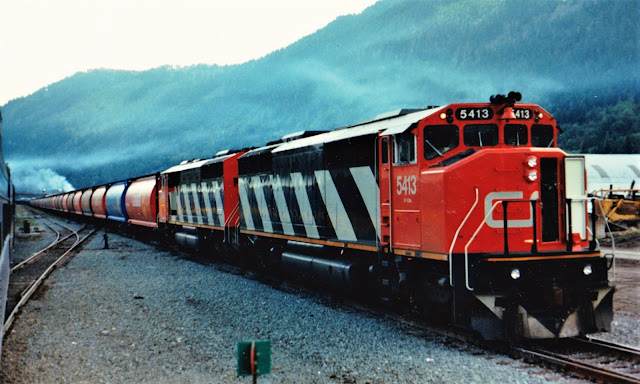
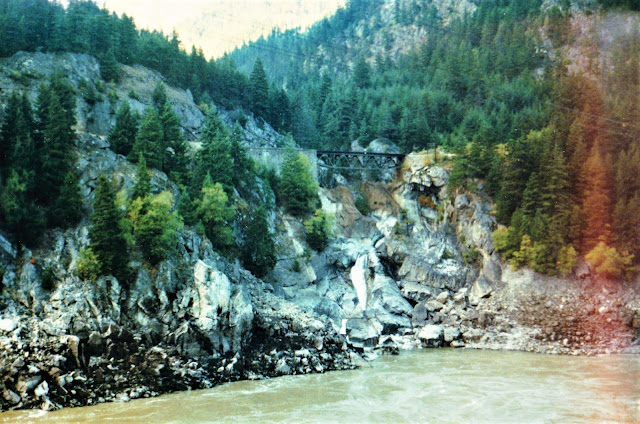
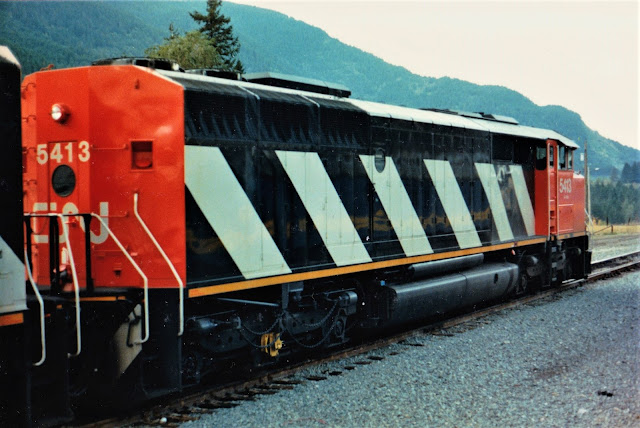
In Part 1 I travelled to Vancouver. After a quick turnaround on September 22, it was on to the next leg of my trip, on VIA No 4 over CN to Jasper-Edmonton-Jasper-Prince Rupert. At Boston Bar, new SD50F's 5413-5414 were in the yard with cylindrical grain empties (top photo and below). The CP Scuzzy Creek bridge was visible across the Fraser River around Mi 5 of CN's Yale Subdivision (below) just west of Boston Bar. Not too far away was an abandoned CP boxcar at water level!

Just east of Boston Bar, at 1745, CN 5402-5404 were leading grain and coal:
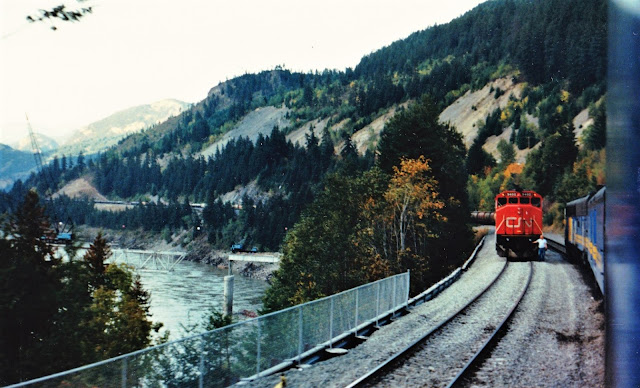
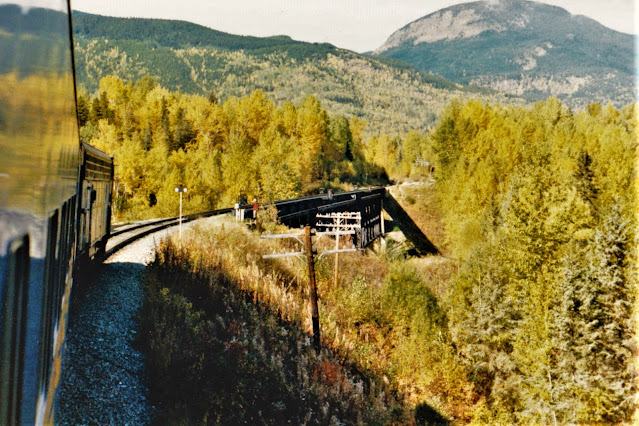
We got to Boston Bar about suppertime. Another nice evening vestibule ride from there for quite a while along Fraser and Thompson Rivers. Saw 3 or four CP trains across the river. Very good scenery; lots of tunnels and bridges but topography eventually goes from rocky to very sandy with few trees. This tunnel was at Martinson, around Mi 122 CN Ashcroft Sub:
The next morning's awakening on September 23 was near Hinton, AB. I was also awakened at Kamloops and Jasper. Travelling in coach does not provide the same somnolence setting as sleeper space!                                
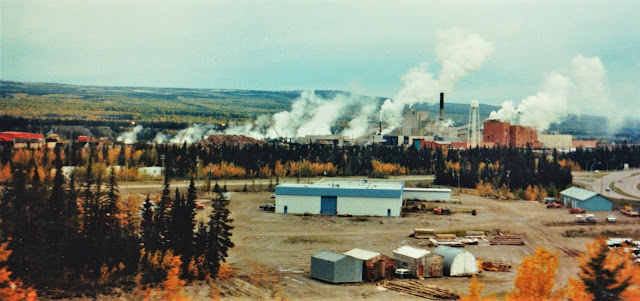
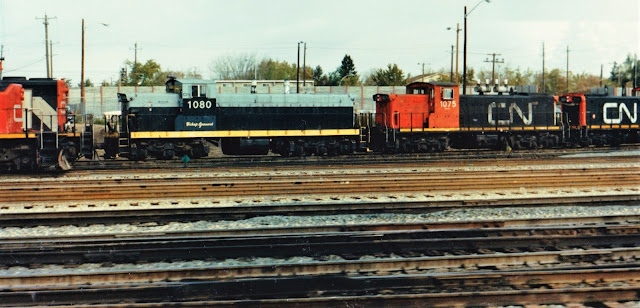
Hinton paper mill, at the time the only one in the province. Into Edmonton on time, mainly sunny. At CN's Calder Yard shop, GMD-1's 1080 (ex-NAR), 1075 and 1081 were reposing:
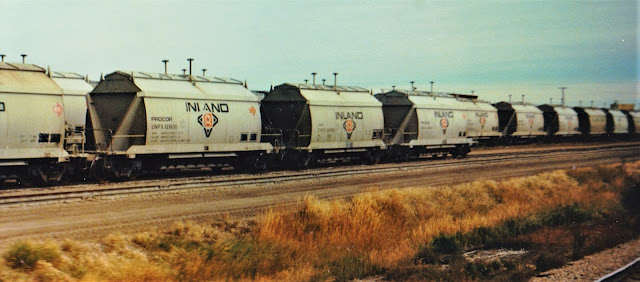
Inland cement hoppers at the large Inland facility in West Edmonton like UNPX 121659 and 121956:
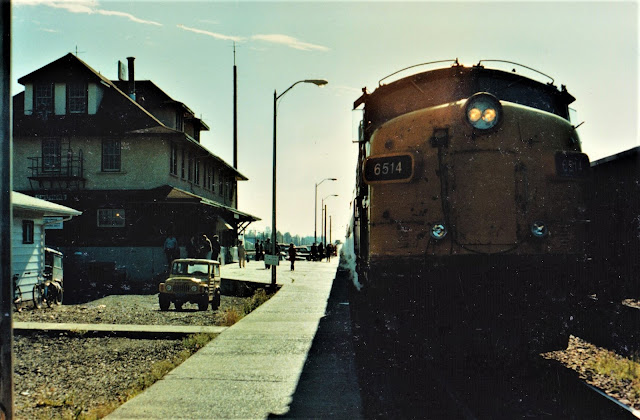
I needed a shower. Chateau Lacombe (CP) and Westin wanted around 50 bucks for a half-day rate, so I went to the YMCA for $2.50 instead, then bought souvenirs at the station. I didn’t want to get back late, so had lunch there in the station coffee shop - clubhouse sandwich, I think. I had a two-and-a-half hour layover before boarding the  4- or 5-car train to Prince Rupert around 1500. No 5’s consist at Edmonton: 6514-9487-5512-752-and two E-series sleepers. My train and No 3 to Vancouver both use the same line between Edmonton and Jasper, so they just tack our train onto the back of No 3 until Jasper. 

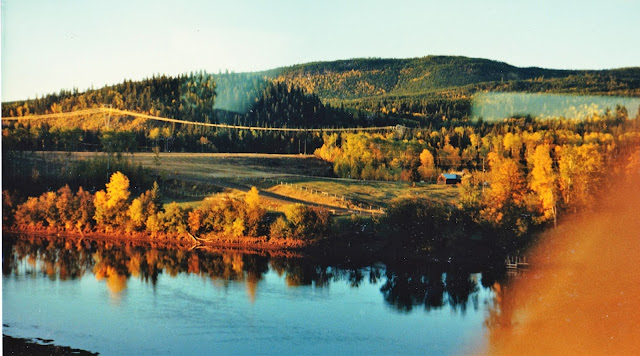
We got to Jasper around 2100. I hopped off to get some souvenirs, then it was back on the train to sleep. I woke up around Vanderhoof, BC on Tuesday morning, September 24. Great timber country! At Fort Fraser at 0830, a few miles west of Vanderhoof, I'm making good use of my polarizing filter:
nice and relaxed train, and the Conductor got off at one point to pick some berries for some American passengers. Other American tourists attempting to pronounce local place names: Endako (Endak-ka), Smithers (Smitten) and Athabasca (aska..athca..ascabaskis) A girl was doing her mother’s hair in the coach. We got into the main mountains at Smithers, BC around 1100:
I headed to the vestibule for lots of very high trestle pictures along the Bulkley River. There were many mountains around Hazelton, BC also lots of logging areas, and we crossed the Skeena River, making lots of flag stops in the late afternoon west of Terrace. Between Mi 27-32 CN Bulkley Sub:

The 839-foot Boulder Creek trestle:

Between Mi 50-62 Bulkley Sub:

Skeena Crossing, Mi 62:
Looking back at the Rocher Deboule range and Hudson Bay mountains:
We got into Prince Rupert around 1830. The big, new grain elevator terminal had been constructed there about 2-3 miles out of town. Rupert is a very nice little town, and I wish I had more time there. Lots of fishing boats on a foggy evening. Even though most stores were closed, I found one open and was able to buy some postcards. Very good supper of KFC, orange Crush, and Old Dutch salt & vinegar chips. 
A fishing dock at Prince Rupert (above) at 1820 with the 1979-built vessel Anangel Fidelity. The Ridley grain terminal, established in 1983:
In Part 3, I head back east from Prince Rupert.

Running extra...
Well-known Ukrainian-Canadians include Royal Canadian Air Farce's Luba Goy, Supreme Court Justice John Sopinka, Ottawa Senators' Eugene Melnyk, Big Sky's Katheryn Winnick, Deputy Prime Minister Chrystia Freeland and Jeopardy host Alex Trebek. We are home to the largest population of Ukrainian descendants outside of Ukraine. 
Slava Ukrayini!


Tuesday, February 22, 2022

VIA Siemens Venture's First Visit to Kingston

VIA's first Siemens Charger trainset made a nocturnal visit to Kingston at 2:22 on February 22. That's 0222 22.2.22! Operating as VIA train No 627, the 'test train' departed Montreal around 2230 on February 21. Later than expected, one goal of this trip was to take the Charger consist for its first trip west along CN's Kingston Sub as far as Cobourg, making all stops. Testing up to this point had been Montreal-Morrisburg and Montreal-Ottawa, some runs captured on video by a fellow intrepid enthusiast. That same intrepid videographer recorded No 627 here. I had previously caught the consist's move east from California to Montreal on September 29, 2021.

Passing freights during the wait, none with DPU:

2255 EB CN No 148 Engs 2995-3096

2330 WB CN No 321 Engs 2614-2341

0005 WB CN No 377 Engs 3905-2512

0035 WB CN No 369 Engs 3278-3098

0200 EB CN No 306 Engs 5667-5654

VIA is attaching a certain amount of secrecy to these test trips, hence the zero-dark-thirty times. Also, test trips need to be co-ordinated with CN. Like night work blocks, these late hours keep the wayfreights and numerous VIA trains to a minimum. Goodness knows CN wouldn't want another tiny movement clogging up their double- and triple-tracked mainline and keeping all those 35 mph key train (almost-underpowered freight monsters) from making it to their destination just-in-time! On continue/but I digress! Speed east of Kingston was 71 mph, so I'm sure 100 mph was reached farther east.

Video of the arrival. Apologies for wind noise. It was a very windy night with rain expected the next day and wind out of the east. Temperature -4C but felt colder with the wind. Departing eastward.

After meeting 306 in Queens south service track, 627's headlight and ditchlights could be seen as the tail-end of the freight cleared, and the 'test train' crossed over to the north track for its station stop. Perhaps the first traveller to ever detrain from a Charger at Kingston:

Tail-end of the westbound 'test train':

There were tests of the door mechanisms and measurements taken at platform level. 


Business Class car with plastic still covering the unsat-in seats:

Those karacteristic Kingston hockey-stick lights have seen RDC's, conventional, LRC, Turbo, Renaissance, and now Chargers beneath their ghostly glow. Coach view:

You can see inside! As bright as a disco (above) and cab (below):
The engineers preparing to switch ends to the cab car:

The next move was back into Queens, for a trip around the wye and return east to Ottawa (ETA approx. 0530) as VIA No 628, making stops at Smiths Falls and Fallowfield, again with the locomotive first after wyeing. An intrepid videographer's video of the departure here VIA staff and running trades employees on board numbered about a dozen. Tail-end upon arrival, before leading east for the movement to wye at Queens: 

Right now, this exists as a bit of a pop-up post because it's 0400 and now to bed!

Friday, February 18, 2022

Kingston to Prince Rupert aboard VIA - September 1985, Part I

AN OVERVIEW OF THIS THREE-POST SERIES

Heading west less than a year before my visit to Vancouver’s Expo 86 aboard VIA, I was travelling on a Canrailpass in coach, with a system Canrailpass trip (costing $230) in September-October 1985 began with a very early morning departure aboard the Cavalier from Kingston to Montreal, then the Canadian through Ottawa and Sudbury to Portage. Following a stopover, the Canadian took me from Portage to Vancouver. At Vancouver, I hopped right aboard train No 4 to Edmonton, thence heading northwest to Prince Rupert on No 5. The next morning, slightly delayed out of Rupert by a derailment, I continued on No 6 to Edmonton, No 4 to Winnipeg, then west again to Regina. I arrived there in the wee hours of the morning, picked up my rental car at daybreak, and spent a few days photographing grain elevators before heading east on No 2 to Thunder Bay. A derailment near Ignace caused passengers travelling eastward to board a turned No 1 at Thunder Bay, as it headed east as No 2. Then it was train No 10 from Sudbury to Toronto, thence No 48 home from Toronto to Kingston.

A year before, the Prince Rupert train was known as the Panorama. At the time of my trip, the Skeena was an overnight, full-service train; today it’s a day train with an overnight stop at its midway, Prince George. Trains were open during stopovers in Winnipeg and Calgary. Most detraining passengers waited to reboard in the station. If one knew where to access the platform outside, it was possible to detrain for supplies, then check out trains under the trainshed before departure! It would appear my not-so-healthy diet choices mentioned herein were a major part of my trip – travelling on a budget! Recommended dining from the take-out window: VIA’s $2.30 double cheeseburger correctly microwaved. Yum!

VIA had not yet installed showers in its ex-CP sleepers. There are still no showers in coaches. Standing in the vestibule, without tomfoolery but with camera in hand, was tolerated by most porters and train crew, who generally turned a blind eye while walking between cars. My total proposed mileage totalled 9,264 miles. Nineteen days’ travel for $230 seemed like a pretty good bargain! This three-part series covers my trip out-and-back.
KINGSTON - MONTREAL - OTTAWA- PORTAGE LA PRAIRIE - VANCOUVER

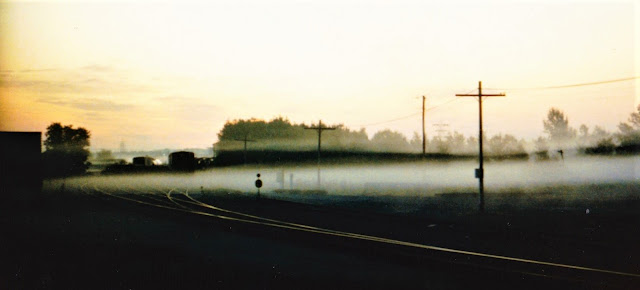
I left Kingston on Monday morning, September 16 at 0300.  The trip aboard the Cavalier to Montreal was uneventful; lots of commuters get on at Cornwall. Fog shrouds CN's yard at Coteau (above) at 0630. During my two-hour Montreal layover, I walked around outside Windsor Station, buying a snack, a to-be-personally-delivered Montreal Gazette for my aunt and uncle I’d be visiting. There are no luggage lockers in Central Station, removed after a bomb went off in one before my trip. Instead, there is a special baggage area. I boarded VIA No 1, as did a carload of seniors from Wolfville NS going to North Bay for a convention. They were extremely noisy and rambunctious. I was in the dome car when they passed out songsheets, so I sang all the oldtimer songs with them. “Edna, Edna, who’s he put your mind to...the McIntosh boy?” I got in some vestibule time between Montreal and North BayNice country up through Chalk River, Petawawa. I had a seatmate between Petawawa and North Bay. Into Sudbury that night, I walked off the train, got a newspaper and mailed postcards. 

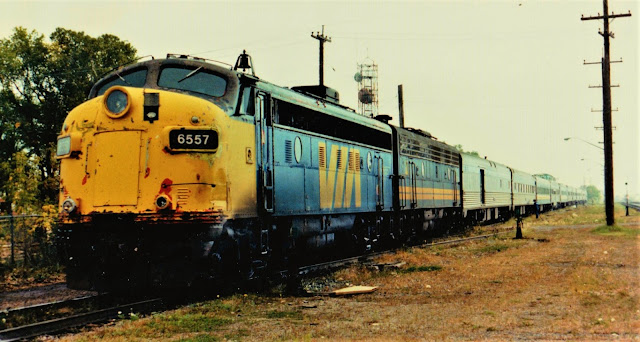
No 1’s consist at Sudbury: 6557-6631-616-126-3246 (my car)-500-5752-Cameron Manor-Hunter Manor-Bayfield Manor-Chateau Rouville-Louise-Eldorado-Algonquin Park. 

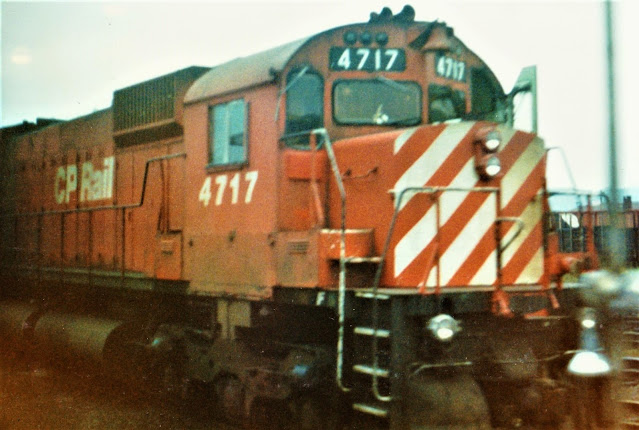
CP 4717 at Schreiber:
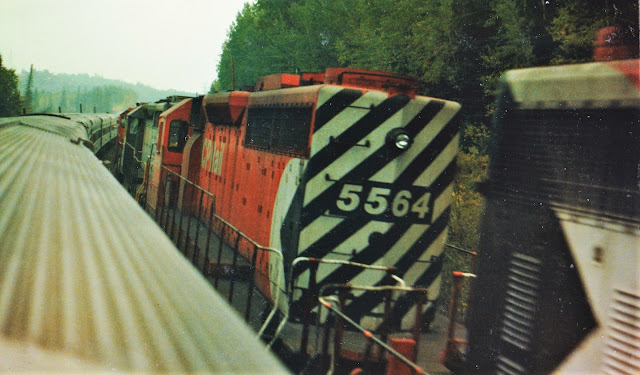
I headed up to the dome car the next day around Schreiber - very cloudy. An eastbound with CP 5943-QNS&L 206-5564-5594:
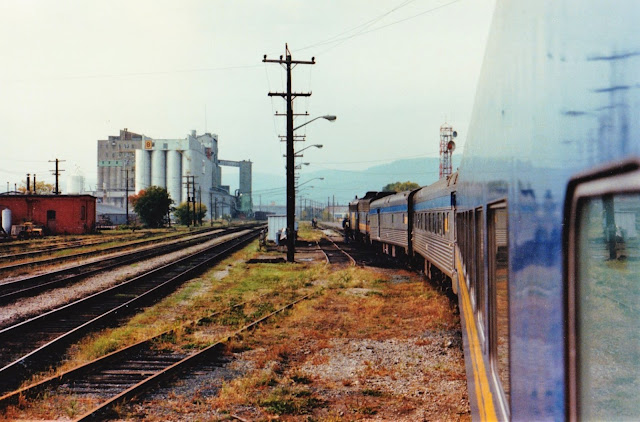
I always enjoyed coming into Thunder Bay. Not only were there CP switchers and trains, but also adjacent CN movements. Terminal elevators and cylindricals:
The sun was out. Approaching CN's Port Arthur station:
CN slug set 425-455 with a freshly-painted tank hopper on the pin:
CP 5979 approaches under CN's ore dock:
Plodding passage – through CP trackage in Thunder Bay, as No 1 is about to halt for fuelling then station stop (above).
During the station stop, I walked up to get a photo of the head-end:
Very nice and sunny west of there through Ignace, Kenora, extremely fantastic ride over Manitoba border near Whitemouth (in vestibule). You could smell all the poplar trees. Lots of farmers combining. In Winnipeg, I mailed more postcards and got eaten alive by mosquitoes, the provincial bird, while trying to get photos of engines on trains. Great ride in the dark west of Winnipeg. In dome car and could see stubble fires and grain elevators looming up ahead in the headlight beam.

By this time, I had amassed great numbers of train orders just by asking Conductor for them. I would continue to do so, and came home with about three-and-a-half inches of them. I arrived in Portage la Prairie a little late, and there happened to be an RCMP cruiser in the parking lot. I spent until Friday night with my aunt and uncle. They let me have their car. I saw many trains, out to Poplar Point and High Bluff to photograph elevators, also the new continuous-pour elevator east of Portage at Tucker. The train west was about two-and-a-half hours late, so I talked to the CN operator while we waited for the train to arrive from Winnipeg. September 21 - good morning, Saskatchewan:

Webb (above) and Gull Lake (below).

And Piapot, which I also photographed in similar weather a year later.
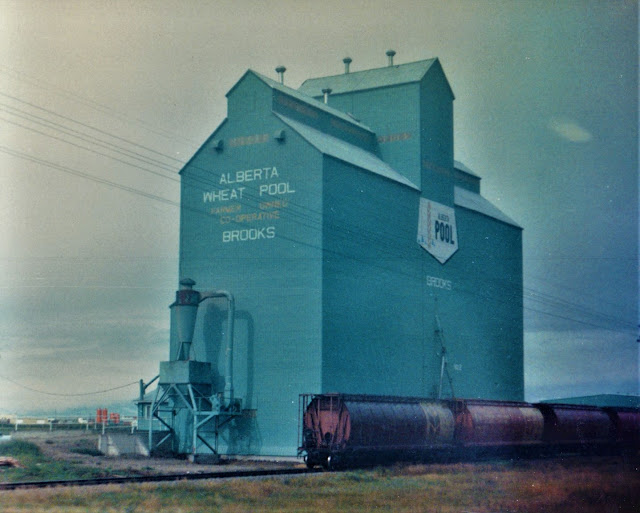
Cloudy, but saw several antelope and lots of hawks. Very open country, went under a huge cloud bank. through the window, Brooks' Alberta Wheat Pool elevator: 
I got into Calgary around 1300, went into station to get souvenirs, then out by ‘secret’ passageway to train early, securing a seat in the dome car. An hour or so late out of Calgary, there were very good views through mountains, cloudy then snowed, but sunny through the Spiral Tunnels. I talked to Aussies and other folks in the dome car. A view back from the Skyline west of Banff: 
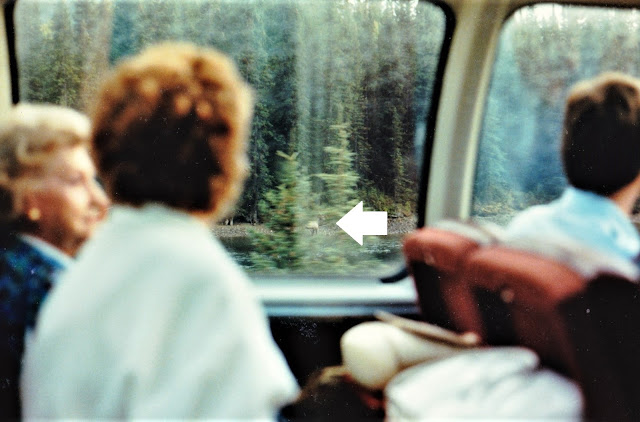
An elk (trust me) at Mi 88 CP Laggan Sub. Just to the left of the arrow!
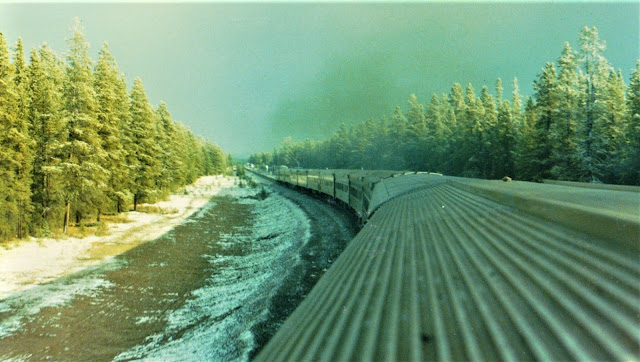
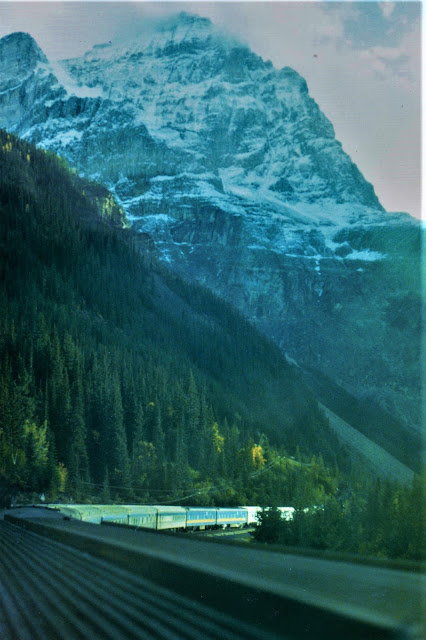
There are lots of Aussies, Kiwis and Brits on the train. Approaching the Upper Spiral Tunnel (below) and three miles west of the Spiral Tunnels (top photo).
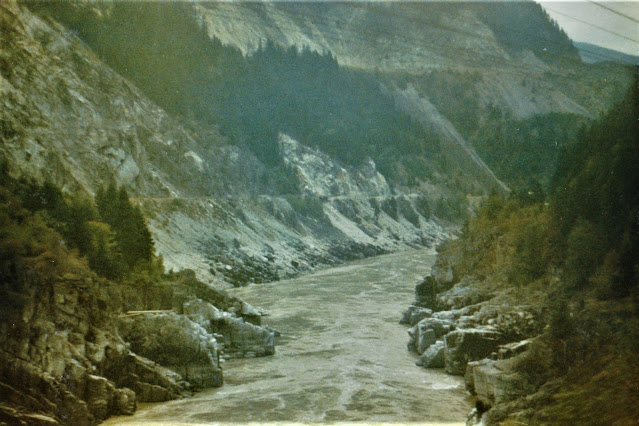
Waking up on Sunday morning, September 22 going through the Fraser River valley. In the vestibule, photographing and paralleling a CN freight on their line across the river. Near China Bar, BC:
I talked to a young Trainman who used to work on CP as an operator around Smiths Falls, etc. Arriving in Vancouver one and three-quarter-hours late, with a fairly tight (for a transcontinental run) turnaround time in Vancouver of just over 3 hours, I was prepared to detrain at Coquitlam at 0835 if No 1 was running very late, catching No 4 there at 1340. I had a short time to walk to waterfront, looking forward to Expo 86, I got a McDonald’s meal to take on the train. 
In Part 2, I travel from Vancouver to Edmonton thence Prince Rupert, and in Part 3 east from Prince Rupert and all my notes, eastward and westward, are transcribed in this postscript

Running extra...

Divine intervention meant a snowstorm blanketed the Wellington Street protesters late Thursday night. Like heavenly snowflakey manna, or perhaps destined to confuse the cops. Nope, all is getting shovelled out, the Ottawa Police Service remembered how to arrest people, and the city of Ottawa returned to its inhabitants today. Let's hope for more divine intervention against any hidden AR-15's or more dangerous, less lethal wonky rhetoric. Freedom! indeed.
I did, however, enjoy seeing the everyman work ethic on display. Can't get porta-potties brought in? We'll build our own. Need supplies or firewood? We'll set up a depot near the baseball field. Need diesel fuel? Well, here's my Radio Flyer and I can help you with that. I trust that when there are no protests, these industrious, beaver-like tendencies can be used for good causes. Now get the hell off our Parliament, because only politicians live there and you'll never be one of them, Kurt (and Dave, and Dan, and Gene)!
Freedom isn't free, and democracy is sometimes not all that democratic-looking. I'm thinking of turning this into a political blog. You know, juicy tidbits from the halls of power and scads of salacious scandals. Possible blog titles: Justin Time, Candice Bergen Meets Murphy Brown FYI, Jagmeet Me For Coffee, Centre Bloc Toc, Green With Envy the Environmentalist, Back-biting and Back-benchers? Salaciousness knows no right-wing or left-wing! We're staying in defence of centre as our goal(ie)!

Friday, February 11, 2022

VIA Historical Association


INTRODUCTION TO THE VHA

The new VIA Historical Association (VHA) was the topic of our February Associated Railroaders of Kingston meeting, ably presented by ARK member and VHA Treasurer Andrew Jeanes. Andrew presented not only VIA's history, but also the genesis of modern VIA preservation by the Toronto Railway Museum and Exporail, and the extension of the Rapido Trains Inc.'s efforts by the VHA with its now-charity status.

WHY VHA? 

The VHA has its own website and Facebook presence. Here are some excerpts from their online mission statement:

The VIA Historical Association was founded in 2020 by a group of dedicated VIA Rail Canada enthusiasts and historians. Building upon the collection assembled by model railroad manufacturer Rapido Trains Inc., the VHA aims to assemble a representative collection of VIA train cars and locomotives to interpret the history of Canada’s national passenger railway.

Since its incorporation in 1978, very few artifacts of VIA equipment have been preserved for future generations of Canadian historians and railway enthusiasts to appreciate. 

In the next few years, the majority of VIA’s fleet will be retired and replaced. If we don’t act now, most of this heritage equipment will be either scrapped or dispersed across North America like VIA’s conventional fleet was in the 1990s. The VHA collection will allow VIA’s history to be preserved, and our aim is to maintain the equipment in operational condition according to Transport Canada regulations. We hope that the VHA collection will be used to celebrate VIA’s history during milestone events, such as VIA’s 50th anniversary. We also hope that VIA will use our collection to operate railfan excursions, charity events, VIP charters, etc. The collection will serve as a travelling museum and educate the public about VIA’s history.

The VIA Historical Association also looks forward to sharing VIA’s history through online exhibitions, printed publications, and in person at railway-related events across the country. 

WHY PRESERVATION?

Why do rail enthusiasts seem to have a core belief that many, many pieces of equipment should be preserved? Preferably one of each, (or more, like GG-1's!) of their favourite piece, favourite manufacturer, favourite railway. I don't hear this from ship or airplane enthusiasts, fans of apartment buildings, parking garages, baseball stadiums or other large, bulky objects. Most enthusiasts don't usually realize that preservation = labour. That's volunteer labour, usually at a museum, with bylaws, rules, cliques, an unclear collections policy, infighting and often failure, followed by scrappers coming in, and the demise of preservation efforts. Preserved trains require either indoor storage or ongoing, expensive maintenance if outside in the great Canadian outdoors. Both are expensive.

My mother-in-law told us the other day that she has 21 teacups. She doesn't use them, she just displays them. She treasures them all, but who knows if anyone else does? She hopes they will find good homes and continued treasuring! Such was the misapprehension of civic, industrial and museum bodies that assumed future generations would always maintain and treasure the hulking locomotives and other rolling stock they preserved at the end of steam.

                                              WHY VHA PRESERVATION?

Except for a few static displays, such as a Park car and F-unit in VIA colours at Exporail, and other ex-VIA equipment no longer in blue & yellow, the VHA intends to have the largest extant preserved fleet of VIA preserved equipment. There is a core group of current employees, rail enthusiasts, former employees and modellers that are willing to help. There is also centralization of preserved equipment and resources in the Greater Toronto Area.

In the course of creating my four books on VIA Rail, it became apparent to me that VIA is a very manageable railway history to document, and therefore a finite fleet to preserve. Unlike, say, the Pennsylvania Railroad! Preserving 'one of everything' on the Standard Railroad of the World would require greater museum space than already devoted to preserved pieces of the PRR fleet!

VIA is also recent enough for many still alive to remember (unlike the PRR!) and let's face it, VIA did most of the preservation itself as their aging equipment was rebuilt and refurbished in-house. Some have described VIA's fleet as a rolling museum.

WHY DONATE TO VHA?

I don't usually promote 'causes' on Trackside Treasure. The first questions in readers' minds would be, 'well thanks for telling us to contribute to the cause, but did you?' I guess that's what social media influencers do. So, why this post? The day after Andrew's presentation, I came across an historic photo montage (top photo) from five years ago that I was preparing to use on the cover of my fourth book on VIA Rail.

It seemed to be a message to post a VIA good news story - one that matches my 2022 Year of Optimism masthead widget! And I do hope to forge ongoing meaningful connections with the VHA. Not in that scraping-off-old-paint way, but possibly through cross-marketing, submitting material, and blog posts like the one you're reading now! Speaking of  'five years ago', that's when I caught the freshly-wrapped Glenfraser CANADA 150 gliding through Belleville on VIA No 53 on February 11, 2017. It's a sign!

INAUGURAL ISSUE OF VHA'S MAGAZINE

Panorama issue 2021:1 of  the VHA's full-colour, bilingual, glossy paper magazine includes stories on the untimely demise of VIA's Turbos, origins of the VHA's present equipment collection, a restoration report on E-series sleeper Edmundston, and more on Mission 2028 - the VHA's planned expansion of its fleet to include a touring exhibition train for VIA's 50th anniversary. Panorama is distributed free of charge to donors, supporters and friends of the VHA. 
Thanks to VHA President Jason Shron, a copy of the inaugural issue came my way prior to the publication of this post. Here's VIA's boilerplate from its masthead: The VHA's unique mission includes preserving and restoring examples of VIA Rail Canada rolling stock and locomotives for public exhibition and operation; educating the public about VIA's vital role in Canada's transportation network; and documenting VIA's history through archival materials, exhibits and publications.

To this humble blogger, that sounds like a worthwhile, realistic and VIAble mission.

Running extra...

Your humble blogger has had the pleasure of meeting Jason on a few occasions. The first quite by chance - on June 19, 2008 as we headed east to Montreal in VIA1 on VIA train No 52/40. Hearing a conversation down the car aisle, a passenger with book in hand was chatting amicably with on-board staff. I put two plus Turbo together and realized it was none other than a certain model train manufacturer doing the kibbitzing. On his way back to his seat up the aisle, it was, "Excuse me, are you Jason Shron?" Surprise!

Thanks to my son-in-law for snapping this photo of the ideal Retired Railfan Reflection and Respite location along Coronation Boulevard, just east of Mi 182 Kingston Sub. A resin chair, trackside, waving to traffic between trains!

This week's should-watch includes a trans-Atlantic collaboration between James Hilton and my blog partner Chris Mears. - Bear Creek. The equipment lettering and presentation of the overall scene are masterful!

Friday, February 4, 2022

CN Derailment at Kingston, March 2005 - Part 2

Part 1 was the genesis of CN No 306's derailment at Mi 178 Kingston Sub on March 17, 2005. In this Part 2, we'll clean up the incident by covering the clean-up. There were eight derailed cars, atop the Gardiners Road underpass. I visited the site in the morning of March 18, though taking these photos into the morning sun at 1100 did not provide the best lighting! The worst was over and the derailed cars were already rerailed by heavy equipment. It's easy to see how a trespasser could cross the tracks here, as there are gaps in the right-of-way fences at the ends of the overpass and a subdivision south of the south track, east of Gardiners Road. Such a trespasser was the cause of emergency brake application that led to the derailment.

Before my arrival, that morning's trains past the site included No 105 at 0500, No 120 at 0515, VIA No 51 at station 0520, No 104 at 0630, and No 362 at 0715. 

At 0525, Work Extra 6023 arrived from the west (symbol W30031117), and was given a Form 564 at 0600 to proceed from Queens West to the derailment site on the south track.

At 0745, CN No 310 set out ten cars of slag ballast ordered from Toronto MacMillan Yard into track 1 at Queens.

At 0800, VIA No 41 was making its station stop, asking for a signal for the south track! Foreman Dave Reynolds responded there was no way, due to the cars on the ground in a big hole up here!

Foreman Reynolds was clearing all approaching trains with the following foremen also operating inside his Rule 42 limits: foreman Tammy Taylor stationed at the Centennial Drive overpass project, foreman Joe Whalen, foreman Dave Scott, foreman Dave Casano, equipment supervisor Mark Ethier from Toronto and Mike Taylor.

At 0820, foreman Mike Labelle is given a Track Occupancy Permit to take two spikers and a hi-rail truck west from Queens on the north track to Ernestown, then crossing to the south track and returning to work the west end of the derailment site.

At 0830, the crew bus is loaded up for Denny's. Some are not able to make it as they are still rolling the rail near Country Style, west of the site.

At 0845, foreman Randy Snarr replaces Dave Reynolds, though still running the Rule 42 under Reynolds' name, confusing to all including those who are good at recognizing voices! Reynolds is louder with folksy delivery; Snarr quieter and terser.

At 0900, No 305 is holding for spikers as well as VIA No 52 at Queens. The work train is lifting the ballast cars at Queens set out by No 310. Dan Ash was supervising the slinging panels over the north track, and truck driver Don Bainen was hi-railing to Collins Bay Road, working east from there unloading bags of anchors from his truck east of Mi 178.7.

VIA No 52 was held west of Collins Bay for 30+ minutes waiting for the hi-rail truck. The Rail Traffic Controller (RTC) was soon calling 'Dave Reynolds' to ask why!

At 1015, 'Dave Reynolds' reported a hanging bracket on one of CN No 305's boxcars, to be inspected upon arrival at Belleville. 

More passing trains: CN No 103 at 1030 and VIA No 53 at 1035.
Driving to the derailment site at 1100, I passed two spikers and the Trax hi-rail truck were operating across from Frontenac Secondary School. Later, a tamper and ballast regulator were operating around Mi 179 with a hi-rail pickup. Upon reaching the site, two Don Hart excavators from Napanee were operating on the south track on the Gardiners Road underpass. One was digging up ties, the other was lifting panel track into place from a float truck which had been backed up to the south track. Welded rail at this location had been cut and removed. Removing rails, lifting panel track (above and below):
The NOKL hopper had been removed. The NAHX and CN hoppers had been rerailed by Hulcher. The next CCBX tank car was off the rails, having been pushed east by a large Hulcher bulldozer, about to be rerailed. Two other Hulcher side-boom bulldozers were alongside. The other three tank cars and the RFMX hopper had all been rerailed. Side-boom bulldozer at left, another bulldozer pushes the last rerailed car (below and top photo):
North side view, looking west, with panel track and hi-rail truck on north track (below). The track formerly in the foreground was CN's Industrial Spur to the Northern Telecom plant.
CN flatbed transport truck with MK IV tamper, backed into an access road between Union Gas and commercial buildings on the east side of Gardiners Road south of the underpass (below). Numerous CN trucks, as well as a float truck carrying panel track, two CN Police cars and three Hulcher float trucks were in the field in the southwest corner of Gardiners Road.
Local railfan Tim Reid took this photo (purchased from Liz Reid) earlier in the day, with two side-booms lifting that CASCO tank car and panel track on the transport truck:
At 1100, Work Extra 6023 was leaving the east end of Queens onto the south track. It went west pulling ten ballast cars and coupled onto the three easternmost rerailed cars. 

Trains past the site: VIA No 57 at 1230, CN No 149 at 1240. The road repair truck was returning to Belleville.

Between 1400 and 1530, the following trains passed the site: VIA Nos 60, 61, 44, 45, and CN No 308. At 1515, CN No 363 expressed concern to the RTC about stopping its 167 cars, including 30 welded rail cars on the head end. Not wanting to put on the brakes on one that big because it might not get started again.

Foreman Randy Snarr (aka Dave Reynolds) was clearing all approaching trains with the following foremen: Tammy Taylor, Norm Primeau, Brian Mylks and Dan Ash. Foreman Brian Cooper and trainmaster Don Anderson were also on scene.

At 1530, track machines were left at the north end of the Cataraqui Spur for lifting by crane onto float trucks later. 

At 1600, a bus trip to Denny's was being organized, thence to the Comfort Inn.

The work train, directed by foreman John Shakel, was unloading ballast on the newly-laid panel track while also pushing the rerailed cars. The engineer wanted to get rid of the cars with blocks and chains on them. The answer was no. Would Shakel take responsibility for them, then? The answer was yes.

The spikers moved west of Frontenac Secondary School pedestrian crossing to Mi 179 to make headroom for the work train.

At 1600, No 309 was held at Queens with 13,000 tons and the lead engine dead due to no fuel, not passing the site until 1650.

Work Extra 6023 went into emergency heading back to Queens at 1715. CN No 377 was held in Queens 1 for VIA Nos 64 and 65, passing the site at 1830.

At 1730, CN No 306 was held in Queens on the north track for VIA trains.

Foreman Dave Reynolds is *really* back on Rule 42 Duty at 1800. As No 377 heads west, they express amazement that the derailment has been cleaned up already. Reynolds replies he feels sorry for the crew who had struck a child in Brockville just last month. He also noted that luckily, all the derailed ars had remained coupled and upright.

The RTC calls Reynolds to ask whether he can run trains on the south track. Reynolds is waiting to hear from Signals & Communiations. Two maintainers are onsite now, and when they confirm that track circuits are operating, they will call the RTC. There will be a 25 mph slow order on the south track at Mi 178. There was discussion between Reynolds and the maintainers regarding the implications of a 25 mph slow order on the timing of nearby crossing circuits.

At 1845, VIA No 47 passes on the north track at 5 mph. Reynolds reminds them that the maximum is *50* mph.

Trains past the site: VIA No 67 at 1930 and CN No 321 at 1940.

At 1950, the first train over the new track was CN No 376 with 15,000 tons and 10,000 feet. They passed by at 10 mph, increasing to 25 mph.

At 2010, VIA No 48 passed over the south track at 25 mph, slow order flags not yet placed. 

More trains on the south track: CN No 368 at 2020, 106 at 2200, 148 at 2300. CN No 519 is in the area at 2330, not able to enter the Cataraqui Spur due to switch.

At 2100, Reynolds contacts the RTC for confirmation of Rule 43 at the site:

Due to track conditions
Form B
specifying speed restriction of 25 mph
has been issued on south track 
Mi 178 to 178.1 Kingston Sub.

Rule 42 protection ends at 2330.

This was the second, albeit minor, derailment that has occurred on top of the Gardiners Road underpass. Watch for an upcoming post on the first one.

Running extra...

Time to do some online shipping, or perhaps, Jeff Bezos you little rotter 'damn that's a big boat' has a bridge too low for his mega-yacht to reach the open sea and maybe someday the Amazon. It's name? The Bezosmarck. Hey, whatever floats your boat!

CN Kinghorn and Caramat Subs in HO. One of the most realistic layout videos you'll ever watch. Here's a once-around layout tour - check out the realistic ballast pit and back tracks.
This past Tuesday's Associated Railroaders of Kingston Zoom meeting featured an informative presentation by fellow ARK member Andrew Jeanes on newly-formed VIA Historical Association (VHA). Andrew covered VIA's history, its preserved and to-be-preserved equipment, and the work of the VHA. Watch for an upcoming post on this VIAble effort!