Friday, April 8, 2022

Another book on VIA Rail Canada!

It's day's like this that I'm glad I have found ways to express myself, create things and ship ideas without being beholden to anyone. No editor, no publisher, no boss, no editorial board, no employees, no clients. No filters, most of the time!

No-one, not even me, is depending on this blog for a livelihood.

My only loyalties (in no particular order) have been to Blogger for hosting this blog. My wife and family. My parents. And in creating the books I enjoyed creating, to my contributors and customers. I value and hold both those latter groups in high esteem. And in creating this blog - you the reader. To all the people in this paragraph, I continually give thanks and express my appreciation to you. (The folks in the top paragraph? Nope, still don't need you.)

I don't need to tell you that I've had a peripatetic, perhaps pedestrian, plod through publishing books over the past 10 years: first in 2011, twice in 2012, once in 2017, twice in 2018, then once each in 2020 and 2021 - even during a pandemic!
But I didn't work with a mainstream publisher. I worked with a local graphic designer and a local printer. I am not a professional photographer or professional writer. I just enjoy creating things, books among them. And the first four books on my journey all covered the same ground - VIA Rail Canada - in different ways. I learned a lot in the process. I worked with some talented contributors, photographers, railroaders and modellers in the process. Names like Schuff, Perry, Bohi, Boyko, Sampson, Hayman, Box, McQueen, Mueller and Shron.
On April 7th, Rapido Trains Inc. held a Facebook Live event in conjuction with their Newsletter #150 distributed by email. Among their pile of product announcements is one book. It's a 288-page, 500-photo, $79.95 mostly-colour coffee table book available from Rapido and hobby stores in May. It's to celebrate VIA's 40th anniversary, five years later. Written by Kevin J. Holland, it joins a short bookshelf of books on VIA Rail by the likes of three well-known to VIAphiles: Nelligan, Greenlaw, Holland and, oh yeah, an oft-mispronounced French-surnamed guy whom Zoom's closed-caption encryptioning spelled "Ganyo" (screen captures in this post are from the Facebook Live).
  • The book is printed by Friesens of Altona, because printing in China has gotten way more expensive. 
  • The book is produced in co-operation with VIA Rail Canada Inc. I'm not sure what their editorial input has been, if any. 
  • The book includes promotional brochure photos and scads of slides conveyed via VIA to this project, from a now-disappeared filing cabinet in the basement of VIA's Place Ville Marie corporate headquarters in Montreal.
  • It's a coffee-table book that's compact enough for even the cosiest of coffee tables, measuring 12 x 9.6" overall.
But back to Ganyo. He printed books. They were never intended to shake the world. They were an effort to collate information and produce useful books for VIAphiles and for the reference of the author himself, encapsulating a corporate entity perenially at threat, under-funded, without a clear government mandate and birthed by two dying passenger services in the 1970's. They were not just things, however. They were things, yes, but they were also books.

This upcoming book's first print run of 2,500 copies is expected to sell out. The clear implication is...order now. Because if you don't, you might be able to find it only at Indigo. If at all. Buy a bunch of them. They may last longer than VIA does!

I freely and unequivocally reserve the right to both slag and support Rapido. (I do it here somewhat frequently among nearly 800 posts I've published chronicling Canadian railroading and railfanning.) To paraphrase Marc Antony (the Julius Caesar Shakespeare one, not the Latin music one), I come to bury AND to praise Rapido. Simultaneously, sometimes. Remember, I'm beholden to no-one, not anyone.

At times like this, I am proud to be my own editor.

MAY 18 UPDATE: I've just finished my book review. In the review, I discuss the photo selection and quality, the text, the content, the graphics, the paper, the covers. Please see below for my review:

Wow.

Friday, April 1, 2022

Light-Rapid-Comfortable - VIA's LRC


LRC DEBUT
VIA took delivery of its Light-Rapid-Comfortable (LRC) high-speed train at Montreal's Windsor Station on July 7/81. The otherwise celebratory ceremony was darkened by Federal Transport Minister Jean-Luc Pepin presaging inevitable cuts to VIA that would take place only four months later. Meanwhile, VIA Chairman and President Frank Roberts opined that the LRC was an "ideal bridging mechanism as VIA moves towards the introduction of high-speed technology in the future".

The LRC made its debut at Toronto Union Station on July 30, 1981 and was toured by 3,200 guests. Familiarization trips for VIA employees were made from Toronto to Oshawa on August 8 and 9. VIA promoted the delivery of the LRC in its 1981 Annual Report:

I was able to see this train at Kingston’s Montreal Street station on August 12, 1981 before it travelled to London and Sarnia. The consist of this train was: 6901-3309-3308-3306-6904. (David Woodhead kindly shared his black & white image of the display train at Kingston - top photo.) For more photos, see these previously-published posts: the LRC Debut and LRC's in Service. Fully bilingual, LRC translated to French as Leger-Rapide-Confortable.

The cost of the order was $100 million. The first batch of LRC-2 locomotives 6900-6920 and 50 LRC coaches 3300-3349 were built in 1980-1982, with LRC-3 locomotives 6921-6930 and 50 more LRC coaches 3350-3399 built in 1983-1984. Coaches 3375-3399 were converted to club cars in 1985, renumbered 3451-3475. Of these, 3451 and 3452 were re-converted to coaches in 1986 to their original numbers 3375 and 3385, then converted back to club cars 3451-3452 in 1991. Coaches 3373 and 3374 were converted to club cars in 2002, renumbered 3600 and 3601.

The first revenue run was an unofficial debut between Toronto-Sarnia on September 4, 1981, No 83 with 6901-6 LRC cars-6904. This was not because VIA wanted to, it was because VIA had to due to a Labour Day weekend rush. Everything on wheels had to be pressed into service!

Regular service between Montreal and Toronto was postponed at least twice, from October 25 to November 16 to December 18, 1981. VIA's plan was to introduce the LRC's on Montreal-Toronto train Nos 60/61 and 66/67. However, a cautious VIA decided to hold off on advertising the debut until it could be sure of the new trains' reliability. A VIA advertisement published in the Toronto Star on June 24, 1982:
Finally, on June 1, 1982 every city-pair in VIA's Quebec City-Windsor Corridor had at least one daily LRC consist round-trip. Montreal-Toronto (3); Montreal-Ottawa (2); Montreal-Quebec City (1); Toronto-Windsor (1); and Toronto-Sarnia (1). This was accomplished by bypassing the coach yard, as was required with conventional equipment like club cars, meal service cars and baggage cars, and by utilizing one LRC consist between multiple city-pairs. One train could cover Toronto-Sarnia (No 83)-->Sarnia-Toronto (No 86)-->Toronto-Ottawa (No 46). Another rotation was Ottawa-Montreal (No 28)-->Montreal-Ottawa (No 33)-->Ottawa-Toronto (No 46).

Locomotives 6900-6904 were initially assigned to Spadina, appearing for the first time in GO’s Willowbrook yard on January 7, 1982: 6902-5 LRC cars-6904, also 6908 and 6909. When GO Transit needed room at Willowbrook, VIA's Montreal Maintenance Centre was already under construction on April 12/83 at the former Canadian Car & Foundry plant in Ville St-Pierre. With two 400-foot inspection pits, the 90% of LRC components that were mounted in closed compartments underneath were within reach, and the locomotives and cars could be serviced together without being uncoupled and sent to a roundhouse facility.

VIA 6903 was featured in early VIA publicity:
Optimistic plans by VIA and Bombardier for LRC sets to be used in Edmonton-Calgary, Montreal-Maritimes and Halifax-Saint John/Fredericton never materialized. The LRC's were not the new wave of North American passenger travel they were envisioned to be. VIA had no choice but to accept the LRC's, problems and all, because the consortium, CN and then VIA had invested so heavily in the technology for over a decade. Almost all its other rolling stock was decades older. Amtrak and international contracts never materialized.

LRC TESTING AND PROBLEMS

The prototype JV-1 locomotive and coach made a 7,000-mile round trip to the US Department of Transportation test facility in Pueblo, CO in 1974. On November 13, the set completed a 1,094-mile test of 120 laps at the average speed of 96 mph, returning back to Canada on December 1, 1974. Test trains were operated between Montreal-Toronto and Montreal-Quebec City for months.

VIA locomotive 6905 was tested at the National Research Council's Uplands facility in January-February 1983, with coach 3320 to follow. Throughout the early years, the untried LRC equipment faced a host of mechanical and operating challenges. Train riders were on board to fix what defects they could. The banking system required constant vigilance and was often deactivated. A wheel bearing failure on December 2, 1983 led to all 50 cars then in service being sidelined six days later for bearing inspections. Bearing replacement was done around the clock, with a goal of having 80% of the fleet in service by December 19. Replacement bearings were stockpiled for use in the next 50-car order.

Though publicly VIA said the problems were not major bugs, only basic design problems which took five years to work out. Behind the scenes, the manufacturer said the railway was not maintaining the new sets properly, while VIA said that the trains' high-tech complexity caused failures. During testing on Amtrak, their shop forces exhibited indifference to what they viewed as oddball technology that would never find a home on Amtrak. 

LRC locomotive 6906 on VIA No 77 was destroyed by fire at Glencoe, Ontario on October 21, 1983. Passengers waited four hours for rescue. VIA 6920-3349-3457 ravaged by fire at Brighton, Ontario in 1994. VIA 6909 suffered a main generator explosion. VIA 6915 suffered a fire and collision. VIA 6920 is shown at Spadina in 1983 (above - online auction site photo). 

Effective June 1987, all VIA Corridor service through Ottawa was being provided by LRC’s except for the Canadian and the Cavalier. In March 1988, the LRC locomotive fleet required major electrical work and could not operate solo. As a result, LRC equipment was pulled by LRC-F40PH-2 double-ended on longer trains, with F40PH-2’s on shorter trains, or LRC-F9B’s pulling conventional trains or RDC’s substituting.

LRC LOCOSTORAGE

By July 1990, LRC locomotives were already entering storage, bumped by newer F40PH-2’s. With windows covered by plywood, and air intakes and exhaust covered by plastic, VIA’s Ville St Pierre facility held 6908, 6910, 6911, 6913, 6918 and 6929. By 1991, only eight LRC locomotives remained in service, assigned to Montreal: 6902, 6903, 6905, 6912, 6916, 6919, 6920, and 6921. LRC cars were refurbished between 1991 and 1994. 

In 1992, Operation Axle sidelined the LRC cars, returning VIA trains in the Corridor to blue & yellow once again, if only temporarily.

For the rest of the locomotive fleet’s service life, eight to twelve 6900’s would be in service at any one time, with the remainder stored. In March 1992, 6907 and 6917 returned to service. In March 1993, 6909 and 6914 returned to service, and there were likely other temporary changes in status as units were stored or reactivated. 

By 1997, nine locomotives were in service: 6902, 6903, 6907, 6909, 6912, 6914, 6917, 6919, 6921.

In August 2000, eight locomotives were in service: 6902, 6903, 6905, 6907, 6914, 6917, 6919, 6921.

In February 2001, there were seven: 6903, 6905, 6907, 6909, 6917, 6919, 6921. 

In March 2001, 6909 was stored, replaced by 6914. The last LRC locomotives in service in late 2001: 6903, 6905, 6907, 6914, 6917, 6919, 6921. By September, 2003 the last seven were being offered for sale, as is. Interestingly, 6927, 6928 and 6930 had been stored at Montreal and not operated since 1990. 

My last LRC locomotive sighting was on August 30, 2001 as VIA No 67’s four cars were powered into the setting sun by 6921. Bumped by the arrival of VIA’s new P42DC’s, the 6900’s swan song came in December, 2001. Last trains led by the remaining LRC locomotives: 6919 leading Quebec City-Montreal No 23 on November 2, 6905 leading Toronto-Montreal No 66 on November 25, 6903 leading Toronto-Montreal No 68 December 4, 6921 leading Ottawa-Montreal No 30 and 6914 leading Toronto-Montreal No 64 both on December 10, 6917 leading No 27 on Dec 11, and 6907 leading Quebec City-Montreal No 27 two days later. The seven units were later moved to Toronto on CN freight train No 309, arriving at the TMC for storage in January, 2002.

LRC VIA1 car 3461 was painted in a red-white-blue scheme promoting ‘Wireless Internet on board’ in the summer of 2003.


LRC REBUILDING

In early 2006, F40PH-2 6400 and VIA1 car 3451 were stripped as prototypes for rebuilding: new wiring, controls and lighting plus HVAC upgrades were added to 3451. A major four-year LRC car fleet refurbishing program was begun in 2009. All remaining 98 cars, 26 VIA1 and 72 coaches would be included, having racked up 5,000,000 miles per car. Planned upgrades included new door mechanisms, interior LED lighting, HVAC controls, wiring, layover system, interior redesign, and a grey & green paint scheme that I dubbed Renaissance (R) for record-keeping purposes. VIA 3302 is shown in the new scheme at Belleville - one of my favourite photos of the Renaissance scheme, platform-level view on VIA No 643 on May 7, 2016 (above).

In 2009, a $100 million contract had been awarded to Moncton's Industrial Rail Services Inc. (IRSI) to completely overhaul 98 LRC coaches, providing a more energy-efficient car with a more comfortable interior environment. Initially planned to begin delivery in May 2010, with the last car completed by December 2013, the project was dogged with delays. The first cars arriving at IRSI in Moncton in late 2008 were: 3315, 3317, 3319, 3328, 3329, 3346, 3348, 3362 and 3601.  Unfortunately, the refurbishing program would be put on hold as problems were identified by VIA, involving the structural integrity of some of the 10 delivered rebuilt cars.

In March, 2011 the first refurbished LRC coach, 3315 was released from IRSI, in service on VIA train Nos 22/23 in April. Although VIA had produced Business Class ‘prototype’ car 3451, seen below on VIA No 66 at Kingston on March 10, 2014, LRC coach 3315 was deemed the ‘true prototype’ (coach) car, and this prototype designation was the subject of subsequent legal wrangling. 

Cars began entering service: 3317 early-June 2011, 3319 early-July, 3328 early-August, 3339 late-September, 3346 and 3348 in November and 3344 in late-December. My first observation was of coach 3348 at Kingston on December 5, 2011. As early as August, 2011 3315-3316-3319 were operating together. In 2012, 3347 was released in late-January, 3331 in late-February and the contract was ‘removed’ from IRSI in April, with legal manoeuvring and the receivership of IRSI in April, followed by the launching of two lawsuits against VIA by IRSI. CAD Railway Industries (CAD) would take over the completion of cars requiring time-sensitive modifications. In late-2012, there were 12 LRC cars (3303, 3310, 3320, 3321, 3326, 3327, 3330, 3332, 3345, 3362, 3452 and 3461) on-site. On April 12, 2013 CAD released 3330, 3345 in July, 3332 on August 13 and 3327 in October.

Tendered as a 23-car contract, VIA planned the refurbishing of two Business Class cars to be completed each month between August 2013 and August 2014. In June 2013,  Business Class car 3475 was released from refurbishing, the first of all such cars to be redone. The cars now featured 2+1 seating. On October 8, 3451 was released. Eleven of 26 upgraded Business Class cars were completed by March 2014, with the last one expected in November 2014. Cars 3600-3601, converted from coaches 3373-3374 in 2002, were renumbered 3476-3477, with one more car joining the series: 3478.
In the summer of  2015, LRC coach 3368 was tagged by graffiti vandals along its lower body. VIA shop forces painted over the offending ‘artwork’ with a blue-grey paint making this car unique. Evening sunlight on August 3, 2016 shows off 3368's unique paint-scheme (above).

In 2016, seating in the LRC cars was changed, actually returned, to 50/50 with all seats facing toward the centre of the car. This was intended to promote bidirectional consist operation, with reduced need for wyeing. My first observations were coaches 3323, 3363 and 3370 on January 2, 2016.

In 2017, the LRC cars wore the CANADA150 wrap (video capture of coach 3364 on VIA No 62/52 at Belleville on September 30, 2017 - below). Then in 2018, the ViA40 Future wrap was applied to the same cars.
With the inaugural Siemens trainset now being tested by VIA, it's anticipated that the LRC car fleet will be retired as soon as practicable, joining the LRC locomotives as a vital part of VIA's history, marking the transition from first-generation power and steam heat.

LRC STATESIDE

An interesting off-shoot of the LRC fleet was a trainset built for Amtrak service in 1980. Locomotives Amtrak 38 and 39, coaches 41-44 and 46-49 plus club cars 40 and 45 were operated by Amtrak in a lease/purchase agreement for two years. Returned by Amtrak, the trainset was later renumbered as VIA 6941 and 6942, 3501-3504 and 3505-3508 plus 3511 and 3512 respectively. 

In April 1988, two LRC locomotives and five cars travelled to Amtrak’s Northeast Corridor as demonstrators between Boston and New York: 6907-3470-3350-3357-3358-3363-6909 for North-East Council of Governments.

In 1988, nine of the ten 3500’s (except 3502) were removed from storage at Ville St Pierre and moved to Bombardier’s plant in La Pocatiere, Quebec to be rebuilt for service on the Toronto-Chicago International, though the locomotives did not operate again. Operating into the 1990’s, and not compatible with the rest of VIA’s LRC fleet, the orphans were removed from service and stored at VIA’s Montreal Maintenance Centre (MMC). The possibility of rebuilding the cars to fleet standards was abandoned in 1993, and the cars were eventually sold to IRSI in Moncton in 2004. In August 1989, Amtrak 38 and Amtrak 39 were moved from the east-end Montreal Bombardier plant to MMC and stripped of parts, being sold to Century Locomotive parts in Lachine, Quebec in late 1990. The 3500’s were retired in late 2001.

Running extra...

While some faithful readers may have perceived the Ask Me Anything post as some sort of April Fool's Day joke, rest assured that it was not*. As a long-running Trackside Treasure tradition, legs (and fingers) are pulled each April, at the expense of some well-known target. Be it the railways, model railroaders, VIA, or Transport Canada, the most frequent target is you, the reader. Winning undeserved blogger awards, translating this blog into Latin, solving mysteries that never existed, that's how Trackside Treasure rolls.
This year's target was Rapido Trains Inc. If you can give it, you have to take it, and there is no such thing as bad publicity on this blog. Stay tuned for Rapido's next live event on April 7. I can't really sit through another one of these - a mix of self-congratulation, nice models, inside jokes, good-natured banter, behind-the-scenes minutiae and an endless series of frustratingly improbable live comments from modellers repeatedly asking for their pet project to be made. April Fool's**?
                           
We need this type of jocularity in this world in which countries invade each other, celebrities slap each other and we just like trains 'n' stuff . Thanks for playing along - you've just received the home edition of Trackside Treasure!***
*Yes it was.
**No it wasn't.
***Yeah you did.

Kingston to Ottawa aboard VIA Rail - August, 1986

On August 16, 1986 my Dad and I took a same-day return trip from Kingston to the Nation’s Capital, travelling both ways by LRC. Waiting for No 40 at Kingston station, a westbound LRC consist stopped on its way to Toronto (6915-3458-3362-3304-3364). We boarded No 40 (6930-3457-3309-3337-3365) departing at 0936. Passing through Brockville, a westbound CN freight was working the yard behind 9628-4417 with caboose 79917. Nearby was caboose 79208 and Canada Starch tank car CSTX 41. 

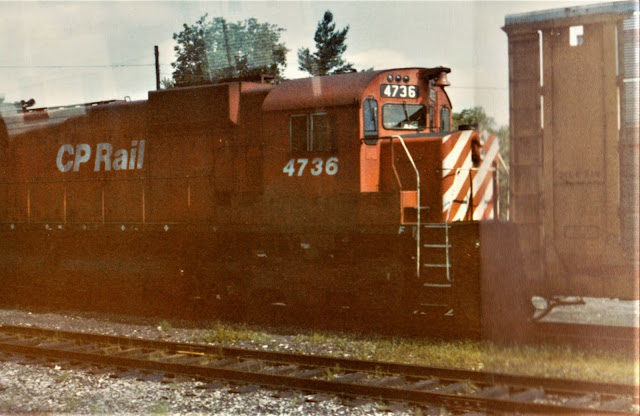
Crossing the Rideau Canal bridge into Smiths Falls, we soon observed a westbound CP freight with 5726-4565-4736 in the yard:

Upon reaching VIA's ex-CN Ottawa station on Tremblay Road, we boarded OC Transpo Orion articulated bus 8504 on the 95 Cumberland route, transferring to GM bus 8817 on the 7 route to visit the Hobby House on Montreal Road. Noted: we disembarked near the Romanian Embassy! We spent nearly two hours and $200 there! The biggest purchase was an Atlas Delaware & Hudson RS-3, decorated in the blue, grey and yellow of one of my Dad's favourite underdog railroads, from its days operating at Montreal and Westmount's Glen Yard. Also styrene, detail parts and magazines. Lunch was cheeseburgers and ice cream sundaes at a nearby Woolworth’s, and we were soon returning with our purchases, less adventurously this time, by taxi ($4.50 fare) to the station.

After waiting a mere 45 minutes before boarding No 45 back to Kingston (6905-3466-3322-3372) we took our seats in car 3322, departing at 1700. Also on the Ottawa station tracks was VIA 6790, the last ex-CN MLW cab unit to wear the red VIA nose logo. The consist for No 49 (6763-5562-Thunder Bay) was also visible nearby. At Brockville, CN 5295 and caboose 79677 were in the yard. A pleasant evening trip into the sunset ended our day. The price for our tickets was a mere $25 apiece. My Dad enjoying our complimentary beverage, International Plastic Modellers' Society RT magazine in seat-back pocket, as the evening sun shines in the LRC coach window (top photo). We occupied the last two seats in coach 3322 on the north side, here passing a crossing west of Brockville:

Running extra...

VIA's inaugural Siemens trainset is testing out of Montreal. Unexpected daylight snag by these railfans near Coteau in this Youtube video.
I like to give Syndrome names to repeated events. There is Strawberry Syndrome (SS), Lemon Meringue Pie Syndrome (LMPS), and I'll tell you here about Grilled Cheese Syndrome (GCS). After a Picton train show, we went with my Dad to the Picton McDonald's. There, looking at the menu sign with with its little slide-in letters, I asked my Dad what I could order him for lunch. "Oh, I'll just have the Grilled Cheese", was his reply. Grilled Cheese? Wow, I thought, dementia is starting to kick in! I gently suggested the Hamburger or Cheeseburger, knowing that he preferred to order the least-expensive menu item. No, he persisted, the Grilled Cheese would be fine. Desperate to show his misunderstanding, I cast around for a diplomatic son solution. And then I saw it, way up in the top-left corner. "Grilled Cheese $1.29". The GCS occurs when you blindly insist you know better than another person, discounting their unique viewpoint.

Ask Me Anything!


According to a recent study, the title above is the Number One blog post title these days. Why? Because it implies you're very open to being asked anything and you have all the answers. Well, I don't. I only know one thing. And it's The One Thing No-One Will Tell You (Number Two most popular blog post tile!). Not even I can tell you. It relates to a Canadian model train company. For legal reasons, I can't publish the company name, or Trackside Treasure risks being sued by a squadron of lawyers, and they'll seize all our assets. And we don't have any. Instead, I'll share a hazy image here that I photographed using No. 12 welding glass, on a cloudy afternoon, through our front door, bounCing the image off our hall mirror. Look quick!

Now that we know who I'm *not* talking about, you need to know The One Thing No-One Will Tell You. Am I going to make you read all the way through this for an anticlimactic ending? Nosireebob. Here it is. Just stand on your head and use a mirror, or turn your device over and use a mirror. Or just read it. It ain't rocket science, dude. Don't hurt yourself:
You read it right - everything since Confederation. One-hundred-and-fifty-five years' worth, baby! Name something. RS-23? Yes. Sclair car? Yep. All types of CP snowplow. Fersher! That beat-up CN tie gon that's been out behind your brother-in-law's place for like, 30 years? Yes. GMDH-1? Yes. [Except if Mark Perry is reading this in which case, sadly no.] The entire Temiscouata Railway fleet? You bet your Quebecbippy. Everything, except the Tyco Missile Car and they're just waiting for the licensing to come through on that.  No more need for product announcements, because it's all getting made and they'll just let you know when it's ready. No guessing. No wagering. No worries. Just relax.

There. Now you know The One Thing that No-One Will Tell You. And you heard it right here on Trackside Treasure. Unless you're a lawyer. In which case, I've just been hacked and I have no idea how this got here. Oh, and I'll be transitioning this into an Ask Me Anything on Facebook Live on the first. It starts just after noon.

Friday, March 18, 2022

Pop-up Post: CN No 376/518/305, March 2022


A shopping mission just after Bagel Bites quickly took shape. In this pop-up post, without the usual weighty research, deep thought, endless photo-editing, word-smithing, flimflammery and haberdashery of your normal Trackside Treasure post we'll start in the middle with the meat of the matter. That would be GTW 6425 on Belleville-Kingston turn CN No 518 seen heading back west at Mi 179 Kingston Sub at 1315 (top photo) complete with blue cab-top paint showing through! Thanks to Malcolm for the heads-up about this sub-lettered unit this morning. But first, Dollarama...
At noon, this sunless and sallow spring shopper sprouted from my seat in the van to snag this eastbound CN No 376 led by 2269 at the Bath Road/Coverdale Drive intersection. Things got CSXy in a hurry.
Salmon sylindrical CNIS 368301 (above) and redrum at a red light (below).
Men at work: GTW 6425 paired with CN 4770 on the lead at Invista along Front Road at 1215. Invista plans to add two more tracks here. Stay tuned for a future Trackside Treasure post documenting the progress when the first survey stake splits the spring sod!

At the plant (above) then taking the south track west at Mi. 179 Kingston Sub:
After Metro merchandise was manhandled at 1325, CN No 305 progressively passed the pedestrian crossing near Canatara Boulevard, led by CN 2938:
The requisite Irving lumber and a a couple of Canpotex empties, this one heading for the shop and maybe not for a paint-job. I'd include the car number if it were visible: 
305 had eight cars of Canadian Forces equipment heading to Wainwright captured in my Youtube video. Youtuber CJ Burnell caught the train at Plug Hat Road. Here's my video capture: 

I won't protest this trucker (above) passing 305 passing me. DPU CN100 3879:
Lots of trains today, but having set out simply for shopping, iPhone photography will have to supphice. Upon returning home, it was time to phocus on some just-arrived online shopping. These are all car-types that I can put to good use on the Hanley Spur - a mix of TrueLine Trains, Proto, Accurail and even a Walthers freebie!

Julian Bernard

October 29, 2006 - Good morning Eric, I have just read your message about consists in Canadian-Passenger-Rail and note that, not only do you seem to have had an eye for 'E' sleepers, you actually recorded the consists, and kept them.  I wish I had done all of these things over the years.

Does 'E' sleeper Equity appear anywhere in your lists?  I have found a very few references to it but for the most part it seems to have escaped the spotlight whereas others (Edmonton, Eldorado, Enfield for example) were seen frequently.  One would thing that every one of them would have had an equal chance to be seen - one in 52. - Julian Bernard, Guelph, ON

[That's the first e-mail I received from Julian Bernard. I had previously seen several of his messages in the Canadian-Passenger-Rail Yahoogroup. All group members had to sign their posts, and his were always simply signed 'Julian Bernard Guelph, ON'. Julian noted that he and his daughter Lesley had gone through consists posted in the Bytown Railway Society Branchline newsletter, looking for CN/VIA E-series 8-4-4 sleeper Equity (numbered 1143), but had given away his entire accumulation to that point to a needy railfan upon moving to Guelph, so he could not go back and look again. I sent Julian a few observations I'd found...]

Thank you for your response.  As there are so few references to Equity, every single one adds a little bit to its story.  Just in case you happened to wonder why the interest in this car, our daughter owns it!  It's not all that far from you, at Actinolite, and is listed in the Trackside Guide, perhaps now under Tweed - the car didn't move but the municipal boundaries did.  It was a wholly impractical and unrealistic purchase but one has to give her credit for pulling it off.  It was a weekend escape place for her for many years and I visited fairly frequently as well when we lived in Toronto but it's not quite as convenient since we moved west, and became older.  In fact, I had often thought that sitting in Equity's open sections on a Saturday evening, drink in hand, enjoying the smooth ride and the view of the Skootamatta River outside, rail sounds coming from a CD player, was almost as good as it gets.  

According to papers found in it, Equity seems to have made its last revenue trip eastbound from the west to Montreal late in 1989 or '90, I can't remember which, and was withdrawn for some mechanical deficiency.  Its trucks were later swapped with those of another car, one of the ex U. S. stainless steel cars I believe, as part of the HEP2 rebuild program but that didn't preclude it being moved on its replacement set from MMC to Cedars, where it spent a couple of years, and then to Belleville, the latter move in a CN freight.

[In my third book, Trackside with VIA - Research & Recollections, Equity was listed as being moved in August, 1991 to Septa Rail in Coteau, QC along with 12 other E-series sleepers to donate their trucks for HEP-rebuilding of stainless steel cars that were obtained from U.S. railroads. In October, 1994 Equity was offered for sale by CANAC with 10 different E-series cars, one of which was Edmunston. Equity was moved to Actinolite in 1997. Julian continued...]

I don't understand why it was spotted so rarely - and it seems that it never had its photo taken - until it was in the "For Sale" lineup at MMC in the early 1990s which was where we visited it, coupled to Edmonton.  Actually I did have Equity checked off on a list of observed cars that I kept, but without date or place, that bit of information wasn't too useful.  Perhaps its real claim to fame is yet to come as it is one of the names chosen by Jason Shron (Rapido Trains) for the series he is now releasing.  I think I'll spend $59 for a model which will be in the CN black and green paint.

November 6, 2012 - Thank you, Eric, for Trackside With VIA - Cross-Canada Compendium which arrived yesterday.  So far I have given it only a quick look, for references to my daughter's Equity, but obviously it will be a good read and it has already reached the bedside table.

[Above - a photo Lesley sent Julian in 2012 that he forwarded to me via e-mail. Lesley noted at the time that a good cleaning, some bodywork and coat of paint was on the job list. Julian continued...]

A few years ago I sent a picture of Equity and Lesley's house/station in Actinolite to a railfan with a note that this was a current picture of the CN local, ready to leave Actinolite en route to Napanee via Yarker with the once a week through sleeping car for Montreal bringing up the rear.  He didn't realize it was tongue-in-cheek and fell for it completely.  That'll teach me to try to inject a bit of levity into rail fan messages!

November 22, 2012 - Reading your second volume, and never having taken many photos of my own at the time to remind me, I had forgotten what a mish-mash of motive power and passenger consists VIA had to assemble in the early years.  I wish now that I had paid more attention to what I was riding in those days though I do recall some weird substitutions for Club cars (if that's what they were called then) on Toronto-Windsor trips in the early 1980s but never on trips east of Toronto.  Perhaps this had something to do with shortcomings of the Tempo equipment which, in my memory, rode poorly at almost any speed over a brisk walking pace.

April 1, 2013 - Lesley did tell me recently that she had met you in Kingston and it was only at that point that I realized she also had acquired your books.  Equity and 5407 are highlighted in my copies and probably in hers as well.  She is so busy and works so hard that our communication tends to be sporadic at times.  But our other two kids were here for Easter Sunday dinner, one from Toronto and one from Kemptville.

[I'd only emailed Julian, but I had the pleasure of meeting Lesley when she stopped by my book table at the 2013 Kingston Rail-o-Rama train show. To me, Lesley seemed to be someone who could and did get things done!] 

I have just posted a response to the fellow who wondered if I was using a CPR pass to ride #51 as he couldn't see any other reason for doing so.  I didn't tell him that, if I had behaved myself a few years earlier, I suppose I might have had a career with CP.  In the summer of 1947, I worked briefly for CP as a dining car pantryman (the lowest of the low) but, after two trips, was fired for insubordination.  My crime was my refusal to end every sentence with "Sir" when speaking to the Steward who happened to be in charge on both of my trips.  I wasn't at all rude to him but just didn't think he was of "sir" quality.  After that I spent the rest of the summer until school re-started in the depths of Union Station in Toronto making ham and cheese sandwiches for the Canadian Railway News Company (which evolved into CARA).  I got into trouble in that job as well when I was caught slipping the occasional extra slice of ham or cheese into the sandwich of a few lucky customers but managed to avoid being fired again.  It's valuable teenage experiences like that which teach you what you do not want to do for the rest of your life.

April 2, 2013 - Eric, your correspondent refers to a man with a cart working the aisle - this sure dates me but I remember the newsy's wares being carried in a rectangular wicker basket!  Another recollection, which I cannot date or place but it must have been during the war, was of a man coming down the aisle with a big, metal urn supported by a wide shoulder strap.  A mate collected the money and toted the supply of cups while the urn carrier poured tea.  It didn't matter how you liked your tea, it came with milk and sugar - no options and I don't remember coffee coming the same way.  It was sweet, milky tea or nothing. I had never thought of the newsies reselling newspapers and magazines but can easily imagine it happening.  Their lot in life cannot have been a particularly happy one.

That appears to be the last email I received from Julian. 

I always appreciated Julian's online posts. They were remarkably full of detail; interesting snapshots of rail travel in earlier eras. Below, I've included some samples of the nearly 50 archived messages he posted to Canadian-Passenger-Rail Yahoogroup from 2002 to 2017. His Yahoo 'handle' was 'derwent1917':

October 22, 2002 - The Turbo did run between Montreal and Ottawa in the mid 1970s.  I rode it in on a Saturday in September 1974 with my three children on #32 from Ottawa to Montreal.  My recollection is that, because of the poorer track conditions, speed was not noticably different than that achieved by conventional equipment and the ride was not as good as it was between  Toronto and Montreal which is another way of saying that it was rough.  I cannot remember if we arrived on time.  The rattling  sounds from beneath the floor which were a feature of every Turbo ride were even more apparent that day.  With the passage of time, my  memories of several Turbo journeys, all but the one mentioned having been between Toronto and Montreal, are now quite fond ones  although they may not have been back in those days when it was frequently late, and sometimes very late.  Nevertheless, it was a brave and futuristic attempt.

May 11, 2006 - My wife traveled from Guelph to Toronto on #84 this morning and returned on #87 this evening.  Shortly before boarding in Toronto she realized that her return ticket was nowhere to be found.  Resigned to buying another one, she explained her problem to the ticket agent at Union Station who checked on the computer, reported that her ticket had been found, probably by one of the cleaning staff, and turned in. Within a couple of minutes she and the ticket were reunited and she is now back in Guelph. Kudos to VIA Rail which handled the situation very well indeed.

September 24, 2008 - On Friday, September 19th, my wife and I undertook a round trip from Guelph to Montreal where we were married in 1959.  When picking up our tickets a few weeks earlier I had mentioned to the VIA agent in Guelph that September 19th would be our 49th anniversary.  What I had not realized was that this bit of information was about to make its way on to the passenger manifest.

Our departure from Guelph on #86 was about 7 minutes late.  Boarding from the VIA 1 Panorama Lounge began at 0905 with passengers for #42 for Ottawa being ushered out the back door to a gate on the east side of the concourse while those for #56 left by the front door for the west side (#42 and #56 formed a J-train with #42 leading).  We had not yet even reached our seats before one of the on-board crew wished us a happy anniversary and that gave us an inkling that this might be a trip with a difference.  As it turned out that was only the beginning.  About 11 am the bar trolley started down the aisle and we were treated well, to say the least.  The famous VIA1 chocolates, which I had thought were offered only in the evening, appeared.  Later in the day an announcement was made that two passengers, Julian and Ann Bernard in seats 5A and B were that day celebrating their 49th wedding anniversary and a round of applause followed.  And to top it off we were then presented with a bottle of Pelee Island Chardonnay, VIA 1's current white wine! 

February 9, 2009 - My own memories of earlier rail travel include sleeping very well for two nights in a 13-section Tourist sleeper on CP's #51, the `Great West' from Winnipeg to Edmonton in 1951.  The leisurely pace, an average speed of about 25 mph, likely had quite a bit to do with the sleeping experience. My recollection is that usually the heavyweight equipment rode more smoothly but, as someone on this list has observed, often the heavyweight cars were not moving as fast.  This was the experience travelling comfortably in a lower berth in a heavyweight Pullman Company sleeper from Toronto to Noranda in 1950.

Overnight service between Toronto and Ottawa in the mid-1970s was a mixed experience with the most restful part by far being between Napanee and Ottawa when the Canadian Northern routing via Yarker was still being used, only 112 miles and plenty of time in which to cover it, quietly, slowly and smoothly. Ex-FEC sleepers Manitou and Windigo were encountered most often on these trains.  I don't know if they qualified as lightweight but, generally, they rode well.  They were also unusual in their variety of accommodation – four sections, four roomettes, one compartment and five double bedrooms, a bit of almost everything which made them useful for that run as normally, there was only the single sleeping car on the train but a variety of accommodation could be offered.

March 25, 2010 - Some of my favourite passenger memorabilia, among many items in my office: Two heavy VIA/CN double bedroom folding chairs, not quite identical to each other, but both in a brown check pattern – often occupied by one or two cats. A photo over my desk of CN 4-6-0 1134 in Moncton. A replica of a C.P. Chateau Lake Louise poster on another wall. And in one of the bedrooms, a Canadian Government Railways sleeping car blanket, with C.G.R. logo.  A bit threadbare in spots, not too surprising after close to a century.

October 9, 2011 - That first, 1938 trip did originate in Walkerville but on the CN, 1.6 miles from the downtown Windsor station.  As for the riding qualities of the heavyweight cars, I have experienced those but whether it was on the Ocean Limited or the Scotian I'm not sure.  One occasion was on a 12 section, one DR car, both during daylight hours and at night.  My recollection is that the ride was smooth and very quiet, that I had the section to myself, that I slept very well and that "it can't get much better than this".  Six wheel trucks probably had as much to do with it as weight.  But I also recall what was probably the worst night ever in a sleeping car.  It was on an overnight CN train from Toronto to Montreal in one of the then new 24 duplex roomette `I' series cars, Indigo, the first one of the series, I think.  My initial reaction was favorable when viewing how so much had been fitted into such a small space but, in the middle of the night when moving at the right combination of high speed and rough track, the bed begin to rattle and the walls vibrated and drummed at a volume guaranteed to waken the most sound sleeper.  Because of the noise, the experience was as bad if not worse than the Tempo cars under the same conditions, but I am not trying here to reignite the recent debate about the Tempo qualities.

I'm glad to hear confirmation from Derek Thompson [Derek was another inveterate train rider and a fervent and faithful supporter of mine. I believe that Julian, Derek and I were all members of the Upper Canada Railway Society, where we each had bylines on items published in their long-running newsletter] that my experience with CN's 24 Duplex Roomette "I" cars was not just a bad dream.  And on six-wheel trucks, too which I had thought almost guaranteed a better ride.  At its worst, the drumming effect even became hard on the ears.  After that early experience I tried to avoid the "I" cars.  Duplex roomettes in other configurations on CN, CP and VIA did not offer any of these challenges other than whether it was better to be in an upper unit (less track noise, perhaps a bit more sway and a Murphy bed to contend with) or a lower unit (more track noise, possibly a slightly more stable ride and a slide-out bed, usually easier to pull out and stow away). 

Funny you should single out the "I" series CN sleepers as being rough, Julian. I endured the same experience many moons ago. [Derek responding to Julian's post!] These cars, in their duplex roomette iteration rode on six-wheel trucks which I expected would give them a superior ride. I have no idea what caused the roughness, but there are at least two of us who can attest to its existence.

December 19, 2011 - I rode the C&GT gas-electric car from Mont Joli to Matane in 1955.  My recollection is that the trailer was not being used that day - certainly it was not needed as the passenger load was sparse.  The car's New York Central origins were very obvious, extending even to the step stool which bore a NYC logo.  The C&GT also had a former Chicago, South Shore & South Bend Railroad parlor car, used by the South Shore in extra-fare luxury service, which the C&GT acquired in 1945.  Whether that car became the trailer sometimes hauled by the gas-electric or was a third piece of equipment I'm not sure.  The last I heard was that the parlor car was back in Indiana awaiting restoration.  Also not to be overlooked were the through sleeping cars which CN and C&GT ran between Montreal and Metis Beach on summer weekends for many years.

January 27, 2012 - In the mid 1970s I was working in Ottawa and was periodically called to appear at meetings in Toronto.  On one occasion, probably in 1976 or '77, two of us were summoned - the manager (me) and the assistant manager.  I made my usual arrangement, a roomette on the overnight Cavalier, but my assistant airily dismissed that idea as old fashioned and said he would catch an early flight from Ottawa the next morning.  At 9 am, having groped my way through a pea soup fog from Union Station to the office, I was in my seat at the boardroom table.   "Where's So-and-so?" was the first question.  "Probably sitting in Ottawa airport" was my response.  "Then how did you get here?" was the next question.  I explained but received only puzzled looks.  Nobody had a smartass comeback for that one because none of them had any idea the Cavalier existed.  And a few months later, So-and-so was transferred.

January 29, 2017 - I took a trip on #36 from Toronto to Montreal in the summer of 1945.   Departure from Toronto Union was scheduled for 9.30 am and boarding began about  9.10 am.  The ticket checker looked at my ticket and told me I was in the wrong lineup and if I hurried, I could catch CN’s 9.15 am Pool train which would reach Montreal two hours earlier.  I assured him my choice of trains was intentional and that I was quite happy to arrive in Montreal at 7.30 pm.  He shrugged and let me board.

Recollections are of riding in a heavyweight steel coach with exceedingly comfortable, overstuffed, blue upholstery.   Meals were offered in a Buffet-Parlor car.  At Sharbot Lake, the north and southbound Kingston - Renfrew trains were both waiting, northbound #613 at the platform while southbound #612 was stopped short on the north side of the diamond crossing.  At Finch we crossed the New York Central’s Cornwall – Ottawa branch where a northbound NYC train was waiting but, as far as I can recall, no passengers were exchanged.

Particularly leaving Toronto, passenger loads were moderately heavy but diminished gradually throughout the day so that there were perhaps only half the number aboard on arriving in Montreal.  Whether anyone else was nutty enough to make the entire trip, I cannot recall; well, the Toronto ticket checker thought I had a screw loose.

Julian had a nice collection of his rail and transit photos posted to Railpictures. This is from the profile information he posted there: 

About Julian Bernard - My first train ride was in 1938, on CN, from Windsor to Toronto. Obviously I wasn’t instantly captivated because the only lingering memory of that journey is of seeing a gantry crane just as we left Windsor which, immediately on arriving home, I rushed to model in Meccano, a nuts, bolts and metal strips building toy. But a July, 1943 journey from Toronto to Gaspé, Quebec, which took 24 hours longer than scheduled, turned out to be my awakening, instilling in me a fondness both for trains and for CN’s 1100 series of ten-wheelers beginning with 1134, the first number recorded in the notebook which I kept for years. Joining the Upper Canada Railway Society in 1947 introduced me to many people sharing similar interests and afforded an opportunity to become aware of and ride much of the dense network of CN and CP branch lines which then covered southern Ontario as well as the last of the electric interurban operations. Subsequently, career and family diverted my attention but I always tried to stay abreast of the railway world. Since that early start I have ridden on rails, long distance, local and urban, throughout Canada and in many different parts of the world but, except for the very occasional trip on VIA Rail, those days are now well behind me. Photography was never one of my strengths and most of my photos have been given away to others. However a number of Canadian electric line photos dating from the 1940s and 50s have survived and, as worthy ones are identified, they will be posted. Now thoroughly retired, I live in Guelph, Ontario. 

Top photo in this post showing combine CN 7145 trailing Thousand Islands Railway 500 at the Gananoque, ON waterfront was taken by Julian in May, 1956.

Julian Rollit Bernard was born in Toronto on July 25 1929, son of George Clarens Bernard and (Mary) Monica Rollit. A happy childhood was spent in Toronto. Wartime vacations were taken in East Farnham or Iberville with grandparents. Later wartime travelling was to HMCS Fort Ramsey in Gaspe which initiated Julian’s lifelong passion for trains and railways. After leaving school, he was employed by the Business Development Corporation where he remained until he retired.

Julian left us on March 5, 2022. Here are some messages from the Canadian-Passenger-Rail groups.io, the successor platform from Yahoogroups in the days after:

I had the chance to meet Julian and Ann in September 2008, while they were staying at the Hilton Bonaventure, enjoying a two days getaway in Montreal. He not only gave us nice pictures, he gave us great memories. He will never be forgotten. - MR

We spent a pleasant afternoon - the only time we met in person, but we occasionally communicated by e-mail after then.  I have nothing but happy memories of my interactions with Julian. -TB

Having met with Julian and spent time with him some years back while I was working on a project, it was a pleasure to have known the man and I appreciated his generosity. - SH

Julian was, in some subconscious way, another 'version' of my father. He was born, and married, two years earlier, was an inveterate railfan and train rider, one who recalled the steam era and was a writer and chronicler of train rides, presented in a detailed, concise yet genial manner. Julian lived six years longer - though this is not a competition - and one could weigh two decades' living with Parkinson's and Dying with Dignity to living a few years in long-term care with physical limitations and dementia. I'd rather not have to choose either option! I prefer instead chronicle these memories I have of Julian and share them with Trackside Treasure's readers as a record-of-the-rails that we can all appreciate and enjoy.

February 2023 postscript:

After publishing a post on the bridges of Yarker, I heard from Lesley Bernard and she kindly sent a photo of the first bridge. I added the photo to the post, then shared this post with Lesley

Equity never seemed to have a notable career. I have found a few photos and in consists. I believe it was in service till about mid Dec 1989 and a steam heat line burst between Roomette 6 and the locker behind it. There were wads of sheets and towels jammed under the seat and around the pipe. With the VIA cuts coming 4 weeks later, that was it for Equity. Yes, Equity did get a truck swap from a ex-NYC car (trucks have NYC cast on them) and, I think, from what would become 8136 (since wrecked and retired) based on other grease pencil scribblings on the trucks. We have done some bodywork and photo attached is from about 2 years ago. "Wholly impractical and unrealistic" is a way to put it as railcars are a huge project. And no, it is not practical to try to live in one, I know, I have tried!

Dad was a regular visitor here in the late 90s/early 00s (moved Equity here in Feb 97) and claimed a favourite roomette. Dad's last visit was in 2016. "Derwent 1917" is an interesting story, too. It refers to HMS Derwent, a British destroyer sunk by a mine in 1917. My grandfather lied about his age and joined the Royal Navy in 1916, at the age of 16. He was assigned to the Derwent. Fifty-eight of the crew of 70 did not survive - my grandfather was lucky. After coming to Canada, he joined the Naval Reserve here and during World War II was assigned to Fort Ramsay in Gaspe. 

Lesley closed by saying she is starting a blog! Another star in the blogosphere has been lit!

Running extra...

Two visits this week were a long time in the works. Vince, Heather and Laura came to visit my HO-scale Hanley Spur layout. The pandemic delayed this visit for a couple of years. Except for the above photo, we masked and distanced. Any day now, the latest issue of The Skeleton Press (named for the Skeleton Park neighbourhood in which it originates) will hit the doorsteps of 3,500+ homes. Vince kindly showed me the article on my layout contained therein. 

Our two grandsons also visited, for a March break sleepover, making me appreciate a largely-uninterrupted night's sleep most other nights! They did very well though - there were no monsters lurking under the bed - and the next day they helped Grandpa destroy some of the remaining snowbanks and observe high-flying Canada geese migrating north - two harbingers of spring!

Scientists have studied those Canada geese formations. We've all noticed that one side of the 'v' is always longer, and intense research by those same scientists has now revealed why. It's because there are more geese in it.