Wednesday, July 7, 2021

Train Orders - Manitoba

I don't really like using the name ephemera for a couple of reasons, primarily because no-one ever knows what ephemera means. How about railroadiana, or railway paper items? No matter what term you use, I've realized that my days of collecting endless model railway equipment, heavy pieces of prototype railway equipment, and even big, thick books are pretty much over. I need something to collect that is more easily jettisoned when my good wife someday has to deal with it. And recyclable! That's it, railway paper! ("Ephemera!", echoes an ever-so-small ethereal voice!)

There are lots of different types of railway paper to collect. Rule books and union agreements are dense but dry, timetables a little more enticing, but I really like train orders because each one, like a train consist gives us a lot of information: a time, a place, events of the day, even who was working on that shift. And of course train numbers, engine numbers, mileages, and other pertinent facts all included together on tissue-thin pieces of paper. The importance of train orders far outweighs their diminutive proportions - they literally can mean the difference between life and death, safe passage or disaster. In this post, I'll share some of these Manitoba missives from my train order collection. 
The wartime CP order (top photo) includes more stations and times than most orders, pertaining to a run across Manitoba in 1944. The above order was delivered at East Tower in 1950. The CN operator position there was abolished in 1964 with the advent of Centralized Traffic Control.
Written when Fort Rouge was a terminal (above).
A trip through northern Manitoba, with many of those place names being so interesting and imbued with much history, like Gillam (above) and just northwest of Portage la Prairie, Gladstone (below - belying a Century west of Winnipeg!):
As far north as you can get without hearing a 'splash', Churchill:
CP Neepawa, 1971:
Dauphin:
Flin Flon (below). Also at Flin Flon in September 1972, Eng 4253 run extra from Flin Flon to Chisel Lake, and in June, 1972 Work Extra 50419 protected against Extra 1073 South between Cranberry Portage and Simonhouse.
Grandview (below). Also at Grandview in September, 1983 was No 832 Eng 5363 meeting Extra 5205 West and Extra 5564 West at Togo; Extra 5582 West meeting No 832 Eng 5024 at Kamsack; and No 830 Eng 5591 at Meharry,
International Boundary, on the way to Duluth. Note the power, CN M-636 2336. As the Tragically Hip sang, "Ahead by a century":
CP La Riviere: 
CP Minnedosa. Interestingly, classmate CP 4038 is preserved there: 
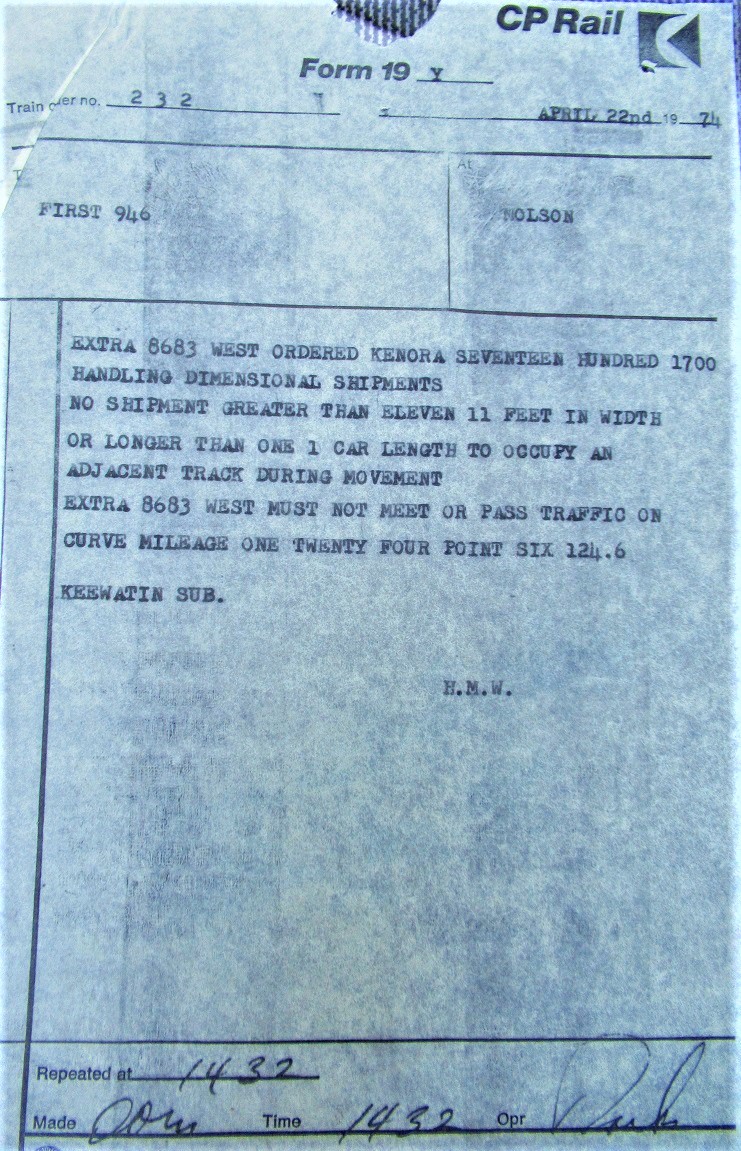
CP Molson:
Morris, note the GMD-1 for power:
Sifton:
CP Souris:
Thicket Portage:
Thompson (below). No 95 Eng 9151 had southward trains waiting until it arrived at Thompson Jct in a Form 19R accompanying this clearance. A further 19R had southward trains waiting at Sipiwesk until No 95 arrived at Gillam; then a Form 19Y allowing No 95 to leave Thompson Jct without registering; a slow order; then cars in siding: Thicket Portage 1, Pikwitonei 1, and Ilford 19.
CP Reston:
And we'll end the post the same way we began, with an order from Portage copied by CP operator Jack Corbett. My aunt and uncle from Portage knew Jack Corbett. He was a Mason and referred to my uncle as 'Doc'. He also had a large collection of Lionel trains!
It's interesting to have these paper snapshots of history. It's neat to see place-names and stations on the railway that are no longer manned, or no longer exist! In the form of train orders, they live on. Watch for upcoming posts from out West and down East!

Running extra...

It's great to be working with John More-Curran at Our Lakes e-magazine, a newsy e-publication focusing on South Frontenac Township and its lakes. The July Issue includes my inaugural 'Rails & Lakes' column about the Kingston & Pembroke Railway, and August will be the Canadian Northern Railway's turn. Now, when's that deadline? Oh, and did somebody say 'sweets'?
The fast-moving Canada Day fire in Lytton, BC claimed much of the deck of the CN bridge over the Thompson River there. In fact, Lytton marks the confluence of the Fraser and Thompson Rivers, and both CN and CP pass through on their way to the West Coast. It's expected the CN bridge is out of commission for one week: 


Friday, July 2, 2021

The Confederation Train visits Kingston


In 1967, Canada celebrated its Centennial of Confederation, and hosted Expo 67 in Montreal. CN and CP were corporate exhibitors at Montreal's Expo 67, and the Confederation Train was one of Prime Minister John Diefenbaker's pet projects - one he imagined as early as 1961. The train was formally commissioned by the Centennial Committee in 1962.  Commission Chairman John Fisher wrote to CN president Donald Gordon and CP President N.R. 'Buck' Crump regarding the project, and the first meeting with CN and CP officials was held in April, 1963. A steam-hauled heavyweight train was even considered! 

The final consist, with equipment contributed by both railways:
  • FP9A 1867 (CP 1411)
  • FP9A 1967 (CN 6509)
  • SGU 15463 (CN)
  • Baggage 4221 (CP)
  • 10-5 sleeper Oak Grove (CP)
  • Diner 1303 (CN)
  • 10-5 sleeper Ash Grove (CP)
  • 10-5 sleeper Fir Grove (CP)
  • Generator car 4731 (CP)
  • Exhibit cars 2210, 2236, 2258, 2266, 2285, 2298 (CP coaches)
The train's eye-catching purple scheme was designed by British graphic designer Peter Vincent and Canadian graphic designer John Arnold. Triangles on the car sides were intended to complement the stylized Expo 67 maple leaf logo designed byToronto artist Stuart Ash. Purple was chosen so as not to be interpreted as the colour of any political party! Artwork (above and below) from Rapido Trains Inc.'s planned 2015 release.
Canadian Pacific's employee magazine 'Spanner' featured the work taking place at Montreal's Angus Shops in the April, 1966 issue. Here, shop forces work on the coaches during their conversion to exhibition cars:
Chronoligically, visitors would travel through time as they walked through the six exhibit cars, in order:
  • Car 1: The Land is Born, Indigenous culture.
  • Car 2: Early European explorers and immigrants
  • Car 3: Pre-Confederation Canada
  • Car 4: The years 1867-1900
  • Car 5: The Twentieth Century
  • Car 6: World War II to the Centennial Year
Governor-General George Vanier's wife, Madame Pauline Vanier, 'launched' the train on January 1, 1967. In preparation for the train to deadhead west as the second section of CN's Panorama, its doors were sealed and locked. At Winnipeg, it switched to CP lines on its journey to Vancouver. To get to Vancouver Island, the train was carried on CP's Princess of Vancouver, debuting on January 9, 1967. At CP's Windsor Station in Montreal:
The train's itinerary included 316 days visiting 65 cities, with millions of visitors touring the train.
  • Jan-Feb: British Columbia
  • March: Alberta
  • Mar-Apr: Saskatchewan
  • Apr-May: Manitoba
  • May-Aug: Ontario, including Ottawa from July 1-12 and Kingston August 22-25.
  • Aug-Sep: Quebec
  • October: Nova Scotia, New Brunswick, Prince Edward Island
  • Nov-Dec: Quebec
Our family with the train at Dorval - September, 1967 (L.C. Gagnon photo scanned by D.J. Gagnon):
Eight units of Canada 67 Confederation road caravans would be included, to reach communities off rail lines.There were 7 million visitors to the caravans at 655 display sites, from May to November, 1967. The cost of both road and rail programs was $48 million. 
The above caravan view on Highway 401, likely near Division Street, through Kingston is one of a series of photos that reside in the Queen's University Archives, (V142.5-44-47). Here are more taken between August 22 and 25, 1967: the train arriving on the waterfront remnants of the Hanley Spur which would last only another three years, and several views from various angles showing daytime and nighttime visitors and celebrations:

You know it's Canada when you see wooden snow fence used in summertime! St. John Ambulance van and volunteers were onsite in Confederation Park. The aptly-named park created after CP vacated its remaining waterfront trackage,was dedicated the year before with CPR 1095 'The Spirit of Sir John A".


The train served as a backdrop for parades, celebrations and concerts, while visitors continued to queue.


I'm sure none of the visitors went away unsatisfied with their trip through time. None.
An aerial view showing the exhibit cars, Confederation Park's pathways, arch and concert state, Ontario Street and City Hall. The train's support cars reached Johnson Street with the power cut off at the Canadian Locomotive Company plant trackage. The plant would close two years later.
1967 was a year of optimism, pride, youthful enthusiasm and hope for a 
better Canada, while acknowledging our unique history!
 
Lots o' links:
Running extra...

As we approach Canada Day 2021, controversy swirls around our constitutional monarchy, our nationhood, our Canada, our very identity. Some suggest shame should be the tone of this Canada Day while some have given their all to ensure that which we have built together endures. Why would we not grow to understand it, celebrate it, and move forward together?

You can knock an icicle down, or you can wait until it melts away as the warmth of spring arrives.

Last fall, I ventured down to Confederation Park. In hand I had my camera, and some archival photos I'd printed off. My goal was to recreate some Dear Photograph scenes along Kingston's waterfront. At the time I didn't foresee a second book on the subject. But now there is one, currently awaiting final proofing and printing, and this image will appear on the cover: 

Monday, June 28, 2021

Canada Day 2021

Craigellachie cairn

It's time to once again mark our national day*, Canada Day. Here are three excerpts from articles on Canada's relationship with its railways. These seem to fit the occasion, and are presented with photos from our 2019 trip west aboard VIA Rail.

The Romance of the Railways: A Canadian Journey. 
By Martin O'Malley, from the Imperial Oil Review, 1983:

By the time I am in the Rockies, marvelling at them, and having come this far across Canada, I begin to wonder if the subdued Canadian personality might have resulted from the recognition of the impoliteness of boasting. It is such a huge country, and so often such a beautiful country, and there are so few of us to lay claim to it that I wonder if perhaps we are reluctant to be strident about it for fear someone will come along and take it away.

Morant's Curve

"Train travel isn't what it used to be 25 years ago," the retired dentist says, looking up the length of the dining car as the waiters serve dinner. "You wouldn't even have thought of sitting down for dinner without wearing a suit and tie. There were roses in snifters on the table, fresh white inen, the silver was polished, and at every sitting after the meal there would be a finger bowl."

...nothing could be finer


Canada and the Train: Inseparable.

By Pierre Berton, from the Reader's Digest condensed from Maclean's, January 1990:

This common love affair with the railway - or, more properly, with the idea of the railway - is as old as Confederation. If we have been shaped by the railway, it is because we are shaped like a railway - a 6,400-kilometre population strip along the border, for the most part no more than 320 kilometres thick. No other country faces this kind of problem. The railway has held us together, spanning a bleak Precambrian desert, an angry ocean of plumed mountains, a chill wasteland of muskeg, to give us the unity we could not otherwise have achieved.

Westbound at Butze, Alberta

Railways and Canadian nationalism [not Canadian National-ism - Ed.] have been inseparable since the days of the Intercolonial system that preceded the CPR in the Maritimes. After the turn of the century, Canada went railway-mad. One transcontinental line would not do. Two would not do. Three were scarcely enough. Railways, it was held, spelled prosperity; the very promise of a branchline sent real-estate values soaring. 

Junction in Saskatchewan

We have lost both the nerve and the pride that ushered in the Golden Age of Steel. If we lose the railway, we lose more than our heritage, and the day will come when we will welcome it back as an old and trusted friend.

Manor view, northern Ontario

Glances From A Train: Are Canada's railways poised for a second golden age? 
By Monte Paulson, from Canadian Geographic, July-August 2011:

Deer leap from the snow-covered tracks as we gain speed. My mind leaps, too, as the train click-clacks forward. I recall a grainy black-and-white photograph of men in top hats driving the Last Spike at Craigellachie, BC. I hear Gordon Lightfoot singing about "an iron road running from the sea to the sea". And I smell the paste of schoolroom dioramas about "The Wedding Band of Confederation". That thin, steel strip that crosses this country is the most important thing we have in Canada when it comes to trade. Vancouver is an Asia-Pacific gateway only because we have a national railway system. If we didn't, Vancouver would be just some backwater fishing village.

Where it all began. Canadian Pacific - Craigellachie

The train at times glides along at a leisurely 30 miles per hour, which is slow enough to get a long look at wildlife we pass. There are no billboards, fast-foot joints or roadside trash to clutter the view - just a rolling panorama of wilderness, with the two gleaming rails pointing the way forward.

Waiting. Uno, Manitoba

Happy Canada Day!
--Eric

Running extra...

*I'm prepared to engage only minimally in discussion in current events sinceTrackside Treasure is, after all, a Canadian railway blog. But in light of current events, I'd like to quote Chief Cadmus Delorme of the Cowessess First Nation in Saskatchewan. "I would never tell someone what to, and what not to, celebrate. I'm a proud Canadian. Read the Truth and Reconciliation Calls to Action."

Friday, June 18, 2021

2021 Front Patio Layout: Lyttle-Redd Caboose Co.

Each summer I enjoy having a sit on my front porch, step or patio or stoop. (Actually, I only stoop when I'm having a nap out there.) This year, as I watched folks passing by, walking their 'pandemic puppies' and young families doing family stuff (hey, remember going for bike rides together?) I also conjured up mental images of a small, easily-operable outdoor HO layout. As I do most summers. And this year was no different.

This year's concept involved a layout that would fit on the arms of my patio-set chair. No need for benchwork, posts, sticks, support legs and the like. I found a piece of 1970's turquoise kitchen counter-top from my parents' kitchen. It used to sit between the stove and the fridge. Now it's inverted and sits between the arms of my chair! As happens each summer, I monkeyed around with various pieces of track, trying to find something that made sense in such a small space.

Immediately my thoughts went to 12x2 feet! Focus, man! One of the only ways to make any kind of operation viable on something so narrow is to use switchbacks. So I did. Needed...a concept! What's a believable one for a switchback layout? Mining operation with Shay locomotives? Mountain logging with Heisler locomotives? With little room for scenery, this would be open-concept. That means I'm open to any concept! Drone footage of a trial run with a 44-tonner (below). Tools at the ready, I was sure to include 'Mears piers' at the end of every track to prevent runaways!

Switchbacks means tail tracks and on something this narrow, tail tracks are short. That means short equipment. I'm used to using 44-tonners and Alco switchers, but this year everything needs to be short! So 44-tonners, a Tyco Shifter 0-4-0T and short freight cars. And what's the shortest freight car on every road? A caboose! That's it! Welcome to the Lyttle-Redd Caboose Co. I added an initial backdrop and of course I've got a beverage in place:

What's the story? It all began when little B'y Lyttle was born (cute-ola concept spoiler alert!) on his family's Angus beef ranch. He was the youngest, bringing up the rear of his family. He was always last to the dinner table, bath time and his parents mostly forgot he was there. Which was crummy of them. After college (his mother and father, both conductors ((of orchestras)) parentally (and parenthetically!) wondered where he'd got to for four years) he met Wellington Redd. His friends called him Well Redd. Born with a sprig of red hair at the tail-end of a road on Carrot-top Mountain in Kentucky, he left school at the age of 12. He lived in a van. Down by the river, though the van had a bay-window. He played hack-ey sack a lot at his out-of-the-way-car. Lyttle and Redd went into business together. Their collaboration gave them a coll-boost and they excelled at manufacturing things that came last, and were coloured red. Cabooses seemed like a natural coupling. So the Lyttle-Redd Caboose Co. was born!

With Redd wanting to get away from it all, and Lyttle late therefore missing the meeting, they soon found their factory built at the top of Cabin Mountain. With an air of affability, they churned out BBC's (Brain-Box Cars) at the rate of one every six months! This was their big brake and business was good, for an under-achiever and a high school drop-out! They used tiny locomotives to take each car down the mountain to the mainline for furtherance to the ordering railroad. Gotta go answer the phone - it's my Front Porch Layout concept calling! I added this view-block. The finished cabooses are stored on the rear-most track prior to pick-up by the plucky locomotive! Did I mention beverages?

Now for my annual shamless plug...is it time for you to consider your own outdoor model railroad for this summer? It's not too late! The summer is young and so are we! To the scrap lumber pile, mes amis! Storm the ramparts of conventional indoor model railroading! Get outdoors to hear the swans honk, the loons plaintively wail and the chickadees chick. Grab a beverage. My laptop transformer powers a Walthers self-propelled crane as it brings another finished product of the Lyttle-Redd Caboose Company out to the mainline after an (imagined) tortoise-paced tortuous trip down the mountain! I may do more scenicking. I may not. I like the wood grain of that old inverted countertop!

The ghost of layouts past. I tend not to completely disassemble each summer's layout, so it's possible to have a rather impractical "Free-Mo" module session of sorts, this photo from 2017. This post includes links to several of my earlier front-of-house productions!

Running extra...

I would never enjoy a meal in my layout room, but it's quite likely I'll enjoy a meal or snack on the front porch. Check out Great Lakes ship cook Catherine Schmuck's upcoming book. If you like tantalizing, original recipes mixed with stories from the galley, your ship may be about to come in!

Recipe for disaster. Acrimony continues here in Kingston as symbols take a hit in the name of a progressive interpretation of history. Largely driven by social media, our city has reacted much as the Taliban did to the Buddhas of Bamiyan: Cancel Culture is an over-used term, as it appears that Topple Culture has set in. What is really needed is constructive dialogue leading to action at the real problems faced by all Canadians. That's all Canadians.

In the words of Rodney King, "Can we all get along?"

That, too, is my wish as we approach Canada Day.