Tuesday, February 12, 2013

CP's Portage Switchers

Each morning in Portage la Prairie, a diminutive diesel coughed to life.  Emerging from a tree-lined grove in the 2x4-framed, green-fenced former CP station garden, it crossed Third Street NE to the yard paralleling the CP Carberry Sub.  Grabbing a cut of cars, it was REV-STOP-KICK, REV-STOP-KICK until the cut was switched out.  Tying onto a wooden end-cupola van, our little train pulled out of the yard and wandered west to the Campbell's Soup plant located northwest of town, off CP's Minnedosa Sub, at 500 15th Street NW.
Working the yard in 1982 (above) as a westbound grain train behind CP 5760-5609 pulled in, setting out two reefers. I had first happened upon S-3 6569 in June, 1976 (L.C. Gagnon photo):
During my visits to Portage over the next several years, it remained the assigned switcher. Can you spot 6569?  Far right, heading past the UGG elevator near West Tower, ducking behind CN's section car shed:
One of CP's last five S-3's, disposed of in June 1986, 6569 could be seen in Winnipeg between March and August, 1986. Passing through Smiths Falls, Ontario on September 24, 1986, the unit was interchanged to CN in October en route to scrapping in Contrecoeur, Quebec.  On June 13, 1982 a westbound coal empties train behind 5792-5533 cross Third Street NE, passing that shady station garden to drop off 6599 after 6569 had been lifted the day before, likely for maintenance in Winnipeg:
Before 1976, CP's switcher in Portage was 6513 now stuffed and mounted in Brandon, and before that a 1957-built DTC (Diesel Torque Converter). DTC's were the last locomotives built by the Canadian Locomotive Company in Kingston.  These little pullers weighed in at 44 tons, thus obviating the then-need for a firemen while in light yard service.  Though this was before my time, it would have been neat to see this mighty mouse's siderods spin! Ken Goslett's undated photo from Bill Linley's Morning Sun Books CP Western Lines volume, showing Campbell's water tower behind the script-lettered van:
Besides Campbell's Soup. the Portage switcher tended industries west of the station: UGG and MPE elevators, Cominco Elephant and Engro fertilizer dealerships, and the small storage yard north of the main line.  East of the station, there was the team track/ramp, CN interchange, and McCallister Pea and Seed. 

Here's a history of the Campbell's plant, from the Manitoba Historical Society:
In January 1957, Manitoba premier Douglas L. Campbell announced that the US-based Campbell Soup Company Limited would build a soup manufacturing plant on the west end of Portage la Prairie to supplement its existing plant at Toronto. Construction of the 125,000-square-foot plant, designed by the Winnipeg architectural firm of Green Blankstein Russell and Associates, began in June 1958. It consisted of five one-storey brick buildings, four of which were used for manufacturing, and a separate one-storey brick building for administrative offices, employee cafeteria, executive dining room, and staff changing rooms. 

A railway spur to the plant allowed up to five boxcars at a time to be loaded from its warehouse, and a tower on site provided water for the facility. Completed in mid-1960 at a cost of some $5 million, the plant became fully operational by the Fall of 1960, opening officially on 4 October 1960. It employed 170 people to take large quantities of peas, corn, potatoes, celery, onions, mushrooms, parsley, barley, poultry, and beef to produce 17 of the company’s 21 varieties of soup, as well as frozen food products, macaroni and spaghetti.

In its first decade of operation, the facility was expanded with a freezer-warehouse in 1964, a mushroom-growing farm in 1966, and a product warehouse in 1968. By the latter year, the plant was making 30 varieties of soup, using 90,000 tons of raw materials annually.
In August 1989, the company announced that the plant would close in December 1990, after 30 years of continuous operation, and transfer its production to a much larger plant near Toronto, Ontario. Today, parts of the huge former factory are used for storage by local businesses and private persons, and part is a factory for building materials. The administrative office building is abandoned and overgrown. 

Phil Mason kindly shared two photos of CP switchers at Portage, near their home across from the station:
CP 21 with  Procor tank car on May 24, 1972 (above) and CP 6609 in 1983 (below) with CP station/Portage water tower visible at right:
Portage-assigned end-cupola vans included 437179 in 1976, 437103 in 1979, 437000 in 1981 and 437182 in 1986.  Brian Schuff photo of CP 437000:
In June 1982, an eastbound 129-car freight behind CP 5918-5552 meets a westbound extra behind 5778-8618.  In the yard with insulated car CN 286527 (not visible in this photo) are Portage's end-cupola van and script-letter Controlled Temperature refrigerator car:
A view from Third Street NE north of the CP mainline shows a westbound freight, cuts of grain cars, and the local's van and cars deeper in the yard, at left. (Following colour photos by D.J. Gagnon)  Note the characteristic tall CP switchstand, equipped with reflective marker but target-less, and shorter yard switchstands.
Most commonly seen heading for Campbell's in the morning and afternoon, here are some of the short consists from 1976, mostly CP and CN 40-foot/50-ton and 50-foot/70-ton insulated boxcars.  A major distribution centre for western Canada, Campbell's loaded CP and CN cars, with the latter interchanged to CN in the Portage yard:
  • July 5: CN 291287 canned goods to Saskatoon
  • July 5 1522 WB: 6569-CN 286144-CP 165292-NAHX 166513-CP 437179
  • July 5 1615 EB: 6569-CN 291694-CN 286166-CP 166086-CP 166581-CN 291267-CP 437179
  • July 6 1522 WB: 6569-CP 165055-CP 165190-CN 291635-CN 286523-CP 437179
In summer 1986, SW900 6719 had taken over for 6569, switching grain cars in the yard (above) and departing with van 437182 black-lined for disposition, in tow for Campbell's (below):
In June 1987, 6719 was still at work towing insulated cars around:
CN 86-foot hi-cube boxcars likely brought in canstock to Campbell's. A westbound train of grain empties approaches as CP ore cars fill the small storage yard.  I had the opportunity to tour the plant in 1978.  Free soup!  Campbell's was incorporated in Canada in 1930, the Portage plant opened in 1961, before closing in 1991 as distribution patterns changed.  Though a typical grocery store contains 17,850 different items, a typical Canadian household still contains eight cans of Campbell's soup.
Brian Schuff photographed SW900's 6714 and 6719 across from the CP station. Brian recalls 6569 having a hot-start electrical plug-in as opposed to the more common oil-fuelled watchman heater, as well as a provincial psychiatric facility in Portage's north end that received shipments of coal for heating, that had been switched by CP.

In June, 1988 former Brandon switcher (1983-1986) SW900 6714 was approaching Campbell's:
The SW900's were in turn dealt away by CP after 1990, with 6714 toiling at IPSCO in Regina, Sask.
6719 sans multimark:
Mark Perry photographed CP 6700 switching the industrial park in September, 1991:


Since the last SW's were swept out of town, a CP Geep living behind a chainlink fence enclosure in the yard emerge to switch Portage's large industries west of town: Can-Oat and Simplot as well as the McCain plant, while hauling a windows-welded-over Angus van rider platform. Here's  CP 3106 safely ensconced (Manny Jacob photograph) and well-weathered:
There's more on Portage switchers, potently posted in this postscript.

Running Extra...

Just finished listening to former CNN national security analyst Peter L. Bergen's book Manhunt which tells the story of the years-long hunt for Osama.  This recording would have been better if read by the author, yet tells a ripping good yarn about the back-burnered yet eventually successful operation.  

Best story from the book?  Obama chiding a top military official for not packing a measuring tape to ensure it was six-foot-four Osama's body.  You crashed a sixty million-dollar helicopter in the compound and you couldn't spend $1.99 on a tape measure??  The official was later presented with a gold-painted tape measure mounted on a wall plaque for his oversight.

On a Yahoogroup I belong to, today someone asked the following question..."Does anyone still buy horn-hook couplers or does everyone just throw them out?"  Dude, some of us still use them on our layouts.  Watch for an upcoming post on this very productive and prolific black plastic paradigm. To me,  McHenry is a prototype McDonald's chocolate bar, and Kadees refer to boxes of Kraft dinner.

Tuesday, February 5, 2013

The Company Photographer

Remember the age of the railway company photographer?  He was paid to portray the railway as a business-like, industrious, modern and friendly corporate presence in Canada. Situations always looked way more serious in the black & white preserved-for-prosperity portrayal of everyday events.  Canadian National, Canadian Pacific, Great Northern, Northern Pacific and many other railway companies maintained photo collections and used photographs extensively in advertising, company publications and newsstand periodicals.  Many people photos used actual railway employees but were obviously posed for the photographer. To lighten things up, I've captioned the photos in this post with some light-hearted captions.

I just have to wander into the world of model railroading and its nexus with the prototype:


Okay, so I'm not the first to use this approach.  You may remember TRAINS magazine's use of similar photos with humourous captions.  Each double-page spread inevitably showed a photo of some smiling running trades crew looking down from the cab with a caption like "David P. Who wants a cab ride?"  Here's my version:


I hope you've enjoyed this whimsical, waggish walk through the world of the company photographer! Now, even more to enjoy - check out the Company Photographer Returns!

Friday, February 1, 2013

Postscript: CN's Hanley Spur

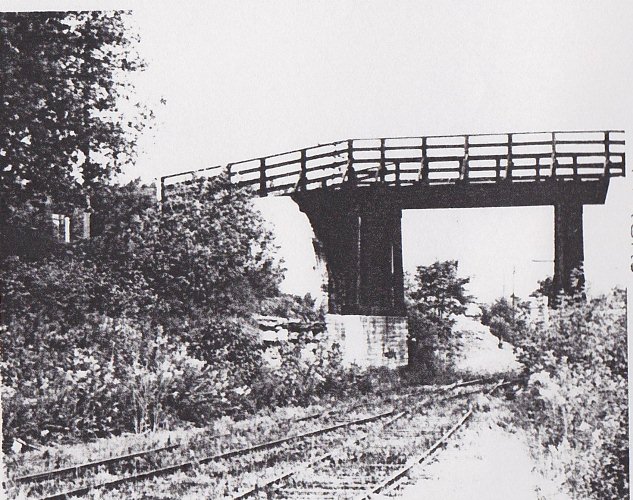
I've received some readers' requests for further photos of the Hanley Spur.  I recently explored the former Hanley Spur from nearby streets: out Ontario, Wellington, Rideau, Cataraqui and Montreal Streets and Village Drive thence John Counter Blvd, Elliott, Division, and Railway Streets back to Rideau.  As you might expect, the abandoned right-of-way looks like one.  Overgrown by shrubbery, a spidery gravel path in places garbage-strewn, yet retaining the unmistakable alignment and profile of a former rail line.  Though I don't recall its use or removal, the former CP access to downtown Kingston was a steel girder bridge over CN's Kingston Sub east of Division Street, built in August, 1922.  As shown in this Kingston street map, the bridge approach curves east to south beyond Division Street, crossing the CN double-track then continuing south between Day and Harvey Streets, before curving east near Railway Street. With the realignment of CN's Outer Station 'bend in the road', this CP bridge had to be removed.
Top photo, from Gordon Smithson's At the Bend in the Road, Kingston (a lavishly-illustrated blended history and a must for any student of Kingston's rail history) the bridge is being removed by CP  Rail crane and B&B gang in March 1974, following Railway Transport committee permission granted on February 18, 1974.  The above view appears to be facing southeast.
Having crossed Elliott Avenue, the CP line (dark, curving at right of photo) headed towards Montreal and Rideau Streets.  Gus Marker's brickyard occupied the current location of Kingston Police's new headquarters on Division Street.  The Marker spur is visible at bottom right corner of the above aerial photo. Could that be yet another Anglin spur leading to that dark, barnlike clerestoried building middle right?  The derelict towers loomed east of Division Street for years after their use ended.  This photo and the ones following are photocopies made from prints held by Queen's University Archives.  
These photos were taken when rails still passed the National Grocers' building.  Note the CP-style switchstand marker in the foreground.  Wheelstops still marked the end of the spur National Grocers' spur at Cataraqui Street.
Looking south from approximately the same location, this view looks along yard trackage:

Here's a 1970 view looking north to the Cataraqui Street crossing. A CP ice reefer is at left, with a CNR boxcar spotted at the National Grocers building (Vintage Kingston Facebook photo):
The River Street bridge no longer exists.  It's been filled in, appearing as an earthen embankment with little indication that the Hanley Spur ever passed through.  These photos show the crossover under the bridge, and a turnout leads to what is likely the CE MacPherson spur.  

Remnants of a tell-tale, in place to warn inattentive brakemen of the low-clearance concussion-inducing bridge timbers ahead:

In 2001, I photographed buildings along Cataraqui Street.  Rosen Heating & Cooling, formerly Anglin Fuels still hosted oil tanks, and the trackage to downtown would have crossed Cataraqui Street in the foreground, heading north where the grove of trees is at left.
Backing up Cataraqui Street to the intersection with Rideau Street, this photo shows the former 'woolen mill' in the distance farthest east, with the National Grocers' building at right, and a former coal yard and office at left.
Another view at the intersection of Rideau (white stucco) and Cataraqui Streets (red brick) shows this coal yard office would make a great model.  This area is desperatly trying to go 'upscale' and lacks much of the workaday character that was still apparent a decade ago.

Friday, January 25, 2013

CN's Hanley Spur, Along the Line

CN's Hanley Spur funnelled cars from the Kingston Sub mainline to customers located along the Cataraqui River along Kingston's waterfront near City Hall.  These industries, large and small, were an interesting mix of post-Industrial Revolution factories, warehouses and team tracks, many alive with waterfront activity.  Though I rarely made the cross-town pilgrimage to photograph the spur, here are some views from the line representing various eras. The first post on the Hanley Spur included aerial views, while this one takes us trackside. Be sure to check Hans Boldt's 1980 photos of his walk along the spur!
The Hanley spur extended 2.2 miles south from the Kingston Sub, crossing the CP at Mi 1.0, crossing Cataraqui Street at Mi 1.1, and sharing a mutual track with CP from Mi 1.8-1.9. CP had also achieved waterfront access with its own trackage, paralleling and crossing CN, sharing track then splitting again at City Hall. The connection from the old alignment of the Kingston Sub, from the present south track thence the Hanley Spur was still in place in April 1985. The Rail Changeout Unit was backing in, and a second track of cars is visible, from which tie plates and spikes will be unloaded by CN crane 50471.  The realigned curve through Kingston is visible in the foreground (above).
Vintage Kingston Facebook photo taken at Belle Park off Montreal Street, taken in 1973 Royal Train used by Queen Elizabeth II during her visit to Kingston for our tercentenary. Located nearby was local bottler Elder's Beverages.  OPP cruisers abound, and the smokestacks of the industries along the Cataraqui River, farther down the spur are visit in the background.
Doug Rickaby shared the above photo of the abandoned Davis Tannery, taken in the 1980's, with the CN track visible in foreground. An excellent article with views of this part of the line was written by former CP'er David Page and published in Bytown Railway Society's November 2005 Branchline.  Spotted at Quattrochi Produce is San Luis Central 232 bringing potatoes from Bath NB, that I photographed in April 1979.  The former CP track is in the foreground, approaching Montreal Street.  A switchlist from April 9/79 listed the following cars switched by CN:

-CP 51309 KH84 CP MT [MacCosham]
-CN 560943, CN 561758, CN 565038 KH10 Whig Paper
-CN 432047 KH15 Imperial Oil
-SLC 232 KH82 Quattrochi Spuds
A Whig-Standard photo from February 16, 1982 taken mere feet from the photo above shows CN 3661 at the intersection of Montreal and Railway Streets:
Gordon Smithson's book At the Bend in the Road Kingston includes excellent coverage of the Hanley Spur, including some 1976-80 photos of a CN train heading down to the waterfront, passing a weed-spraying truck on CP near the crossover. Here are some photos from 2001 of NGB Studios, the former National Grocers Building/Whig-Standard warehouse, now an artist colony on Cataraqui Street, photographed from the west side:
Photographed from the east side, large loading doors facing the former spur location are spaced along the three-storey building as well as the single-story portion of the warehouse:
At North Street, Imperial Oil used a unique limestone warehouse to distribute cases of petroleum products. Located along the CN, the warehouse is now the subject of restoration plans - the only industrial building designed by William Newlands - pegged at $1.5 million! A newly-built Rideaucrest Home looms on the horizon.
Taking a wrong turn while trying to reach Rideau Street, a transport truck has become hung up on the River Street bridge, shown in this March 9, 1993 news photo.  In the foreground was the CP crossing of the CN.
Anglin and Imperial Oil seemed to have received oil by tanker and tank car respectively. A Facebook page entitled Vintage Kingston included this 1973 view of CN yard, Canadian Dredge & Dock, with King Street and Place d'Armes in background:
CN boxcar at seed/feed operation south on Ontario Street, between Brock and Princess Streets - note the L-shaped dock configuration - current site of Holiday Inn. The telegraph line down the spur was removed in 1976, and the spur was thereafter truncated to the north making way for new developments such as the OHIP building, though the CE MacPherson spur was still in place in 1983.
Coal merchants once dotted Kingston's waterfront.  Selling mainly anthracite coal from the Scranton, Pennsylvania area, sales had declined by the late 1970's.  Anglin's was at the front of Bay St.; Crawford at the foot of Queen St; Soward's between Ontario St and Place d'Armes on the current site of Frontenac Village housing complex was purchased by Anglin in 1963, and its wooden, covered unloading trestle was still standing in 1973, ceased operation in 1979; Swift's at the foot of Johnson St near the Canadian Locomotive Co was sold to JP Hanley in 1926, and operated by members of the Hanley family until 1958.
December 30, 1976 Whig-Standard photo showing a CP Rail crew working to throw the switch to the Anglin/Soward coal yard (above). Ontario Street leads to the causeway spanning the Cataraqui River at left, with downtown at right and historic Fort Frontenac in the background. CPR 424 in 1953, in a photo purchased from Railway Memories Collection (below) chuffs between uniquely-shaped buildings around the CN/CP mutual track.  It's still possible to drive along the rear of these buildings, though it's now marked as a one-way private laneway:
In September, 1970 touring British locomotive Flying Scotsman, LNER 4472 trod these same rails to its display location. The last passenger train behind CPR 417 headed north from Kingston in 1957. City councillors brought in an anti-idling bylaw a few years ago to prevent tour buses from idling outside City Hall.  Imagine what their 21st century reaction would be to the cinder-spewing D-4! CPR 485 smokes it up on K&P mixed train M613 in 1953, photo purchased from Dave Shaw Collection.  
CPR S-11 6621 still switches CP freight traffic in front of City Hall in this August 1963 scanned slide, slightly less smoky.  L.C. Gagnon photo:
A CN pile driver drives 25-foot piles on the waterfront CN line, with CP boxcars visible on CP trackage in background, taken on February 18, 1960 photo purchased from the Queen's Archives.  The work was undertaken by Belleville B&B forces to repair the retaining wall at the foot of Clarence and Johnson Streets.  CN's line continued west past this point to reach the Canadian Locomotive Company, which would only last ten more years before being demolished. Its compact location is now home to ritzy waterfront condos, from which steel steeds once arose and steamed to ride the rails.
Running extra...

The results of the Pick(201)3 are in, with a diverse yet focussed winnowing of the field.  Watch for: CP Detours on the Kingston Sub, CN's Wainwright Sub, Car Tracing Accounts, Cars at CP Express and Queen's Interchange, Black Widows (sounds spooky but it's not, really!), 6060 Redux, CN's White Fleet, Other Portage-area Elevators, and the one-of-a-kind 1992 CP Hospital Train.  Thanks for your votes, suggestions, and ardent pleas for posting your favourites...soonest!

That post did not include a whole bunch of other bindered ideas that didn't make it to Post-it note status yet:  BN's Cryogenic Reefers, Weird Auto Rack Prototypes, Cisco and Flexi-Flo, Earning Your Stripes...ACI Labels, the Cox HO-scale Logging Set, The V.I.E.W. (Vancouver Iron & Engineering Works) covered hoppers, and last but not least...it's Schnabel Time!

Welcome Lance Mindheim's layout design blog to the Excellent Train URL's section of the Trackside Treasure sidebar.  Also there are links to Lance's website and further resources.  Often featured in the model railroad press, Lance's ultra-realistic modelling and straightforward concept applications make interesting reading.

Poplar Point, Manitoba is celebrating one hundred years of hockey.  A big came featuring Detroit Red Wings alumni  is coming up on February 8.  Thanks to Vaughn Bend for this notice.  Game on!